Hello, this is Daily Stock, delivering in-depth analysis of financial market trends.
[Image: /stdaily/uploads/202606/gen_6a35f041347963.37340392.png]
Summary
U.S. initial jobless claims decreased slightly to 226,000, proving that the labor market remains resilient.
However, this indicator reflects seasonal distortions, such as temporary claims from non-tenured educational staff during the summer vacation.
In terms of real economic indicators, continued jobless claims—representing those already receiving benefits—surged to 1.81 million, showing signs of prolonged job searches.
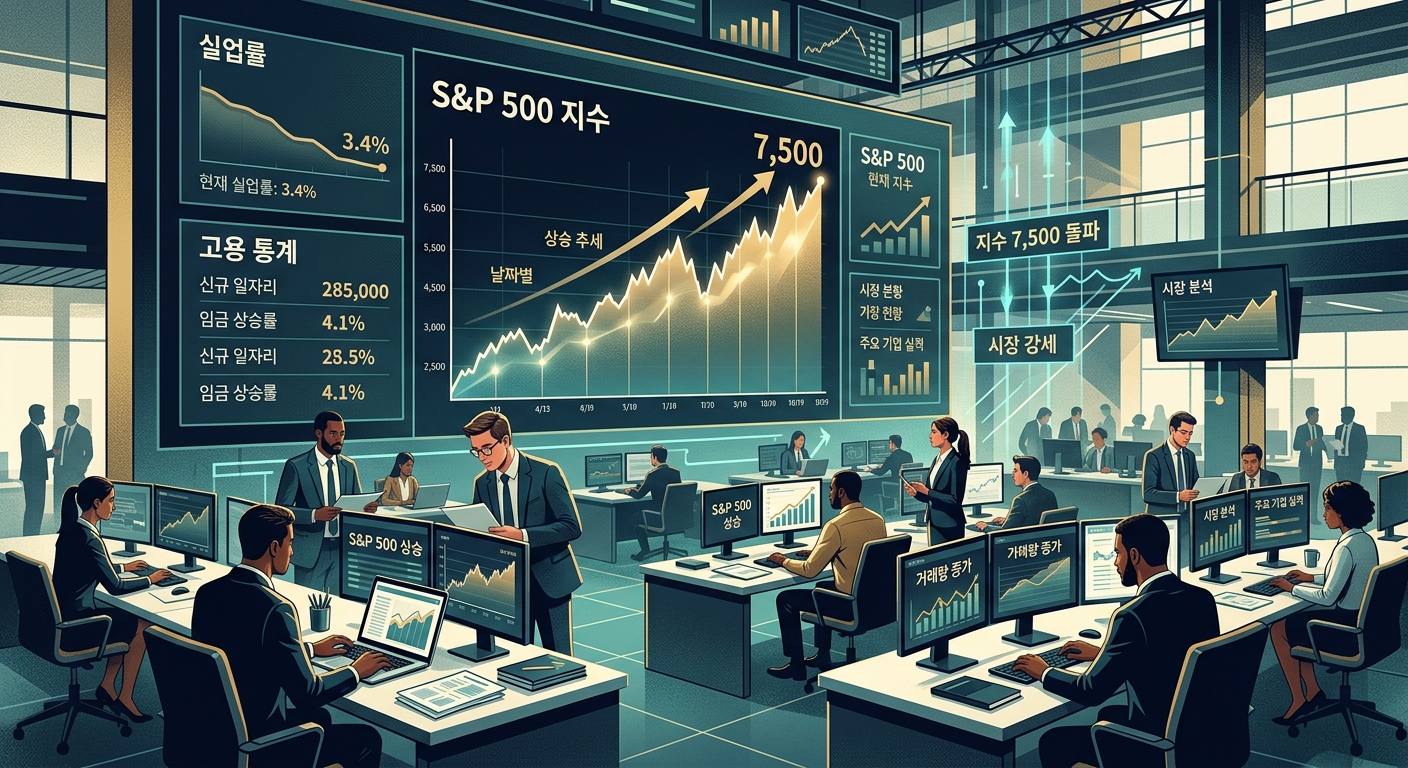
Nevertheless, the New York stock market surpassed the 7,500 milestone for the S&P 500 index for the first time, buoyed by the major geopolitical breakthrough of the U.S.-Iran peace agreement.
Market Overview
According to the U.S. Department of Labor, initial jobless claims for the week ending June 13 fell by 4,000 from the previous week to 226,000.
While this was slightly above the market expectation of 225,000, it demonstrated that the historically low level of layoffs persists.
However, some states, such as Pennsylvania and Minnesota, experienced statistical illusions due to rising claims from non-teaching school support staff who do not receive wages during the summer break.
More concerningly, continued jobless claims were recorded at 1.81 million, signaling a gradual slowdown in the job-seeking market.
Meanwhile, the Federal Open Market Committee (FOMC), led by the new Fed Chair Kevin Warsh, held the benchmark interest rate steady at 3.50% to 3.75%.
However, many committee members left the door open for additional rate hikes this year, further cementing the "higher-for-longer" interest rate stance.
In this environment, a surprise agreement between the U.S. and Iran to reopen the Strait of Hormuz and end conflict sent international crude oil prices tumbling, fueling a market rally.
In Thursday's trading session, the S&P 500 gained 1.08% to close at 7,500.58, while the Nasdaq composite surged 1.91% to finish at 26,517.93.
Financial Analysis
In terms of the real economy and corporate earnings, the S&P 500 continues to exhibit strong defensive strength.
In the first quarter of this year, S&P 500 companies improved their earnings at the fastest pace since 2021, showcasing the fundamental strength that justifies current valuations.
The Federal Reserve Bank of Atlanta's GDPNow model recently upgraded its second-quarter real GDP growth forecast for the U.S. to 3.04%.
However, a closer look reveals that most of the S&P 500's gains this year have been concentrated in the artificial intelligence (AI) technology sector and the energy sector, which benefited from high oil prices.
Excluding these two megatrend sectors, the remaining nine sectors of the S&P 500 have remained flat or underperformed since the beginning of the year.
Furthermore, with the May Consumer Price Index (CPI) rebounding to 4.2%, the burden of high interest rates is gradually pressuring the financial health of real assets and the retail sector.
[Image: /stdaily/uploads/202606/gen_6a35f04a972cb6.68853821.png]
| Indicator | Latest Value (As of 2026-06-20) | Market Implications & Trends |
|---|---|---|
| S&P 500 Index | 7,500.58 | Reflects positive peace deal news, settling above 7,500 for the first time |
| Nasdaq Index | 26,517.93 | Sharp rebound led by Big Tech and AI semiconductor sectors |
| KOSPI Index | 9,052.42 | Domestic stock market in neutral phase, Fear & Greed Index at 51.9 |
| US Initial Jobless Claims | 226,000 | Slightly above forecast (225k) but historically low |
| Continued Jobless Claims | 1.81 million | Signals longer re-employment periods and qualitative labor slowdown |
| US Benchmark Interest Rate | 3.50% ~ 3.75% | Kept unchanged under Fed Chair Kevin Warsh |
| US CPI | 4.2% (May YoY) | Upward pressure from rising gas prices and Middle East risks |
Valuation
The 12-month forward price-to-earnings (P/E) ratio of the S&P 500 is hovering at elevated levels around 24x to 25x.
While the easing of energy cost concerns following the U.S.-Iran peace treaty is positive, the likelihood of interest rates remaining "higher for longer" continues to weigh on valuation multiples.
Consequently, the premium gap between technology growth stocks and value stocks has widened near historical peaks.
However, as interest rate anxieties eased slightly, signs of rotation into cyclical sectors were also detected, with the small-cap Russell 2000 index jumping 2.12%.
According to Daily Stock's proprietary analysis, the Nasdaq's Fear & Greed Index currently stands at 37.3, indicating a state of "Fear."
In contrast, the domestic KOSPI Fear & Greed Index is at 51.9, indicating "Neutral," highlighting cautionary sentiment regarding the valuation overheating of U.S. tech stocks.
Expert & Institutional Analysis
The Chief Investment Officer (CIO) of Wealth Management at Standard Chartered (SC) Group projected a mid-term target of 7,950 for the S&P 500 in its second-half investment report.
They argued that the stabilization of global supply chains and oil prices following the reopening of the Strait of Hormuz has boosted the probability of a soft landing for the U.S. economy to over 60%.
Nancy Vanden Houten, lead economist at Oxford Economics, commented, "Recent fluctuations in jobless claims demonstrate that the labor market is neither overheating nor cooling too rapidly."
She assessed that the Fed now has room to patiently monitor inflation without rushing to cut interest rates.
Bloomberg Intelligence also summarized that the current labor market is well-calibrated under a "low-layoff" regime, which supports macroeconomic health.
Risk Factors
The core risk to watch is the steady upward trend in continued jobless claims (1.81 million).
As of May, the average duration of unemployment in the U.S. increased to 11.6 weeks, indicating that unemployed individuals who fail to find work are staying in the market longer.
If the economy's capacity to absorb labor is weakening behind the cover of low initial layoffs, it could eventually lead to sluggish consumer spending and trigger recession signals.
In addition, consumer inflation at 4.2% carries the risk of sticky inflation that may not easily subside despite the peace agreement.
As many Fed members favor an additional rate hike this year, volatility in financial markets could expand again in the final phase of the tightening cycle.
Investment Outlook
The moderate pacing of U.S. employment data provides a foundation for the S&P 500 to achieve a soft landing backed by solid corporate earnings.
However, the rise in continued claims and the prolonged job-seeking period serve as a reminder that downward pressures are gradually building beneath the surface of the real economy.
While the S&P 500 reaching 7,500 is historic, growth relying solely on AI and energy increases the risk of overvaluation within portfolios.
Rather than focusing on weekly initial claims, investors should monitor the stability of the 4-week moving average (223,250 claims) and maintain a balanced asset allocation.
Investor Checklist Q&A
Q1. Is it always good for the stock market when initial jobless claims are lower than expected?
- It is favorable for short-term sentiment as proof that the labor market is not collapsing. However, it is neutral for long-term multiples because it may prolong the Fed's hawkish stance.
Q2. Why are continued claims rising while initial claims remain low?
- Although companies are not conducting mass layoffs (defending initial claims), they are scaling back new hires for open positions, which has prolonged the job search period for job seekers.
Q3. What is the technical reason for the distortion in summer jobless data?
- During the summer vacation, some states allow non-teaching educational support staff who do not receive wages to file temporary unemployment claims. It is difficult for seasonal adjustment models to adjust for this perfectly.
Q4. What positive dynamics did the signing of the U.S.-Iran peace agreement bring to the S&P 500?
- Crude oil prices, which had spiked due to the Strait of Hormuz crisis, fell sharply, easing high-cost inflationary pressures. This delivered a strong relief rally across cyclical and tech stocks.
Q5. How should we interpret the Nasdaq Fear & Greed Index being low at 37.3?
- Although the index is near record highs, the threat of additional Fed rate hikes and high-interest rate concentration in tech stocks has peaked, indicating rising investor caution and profit-taking sentiment.