Hello.
This is Daily Stock, delivering the latest trends in the global financial market with accuracy and depth.
Summary
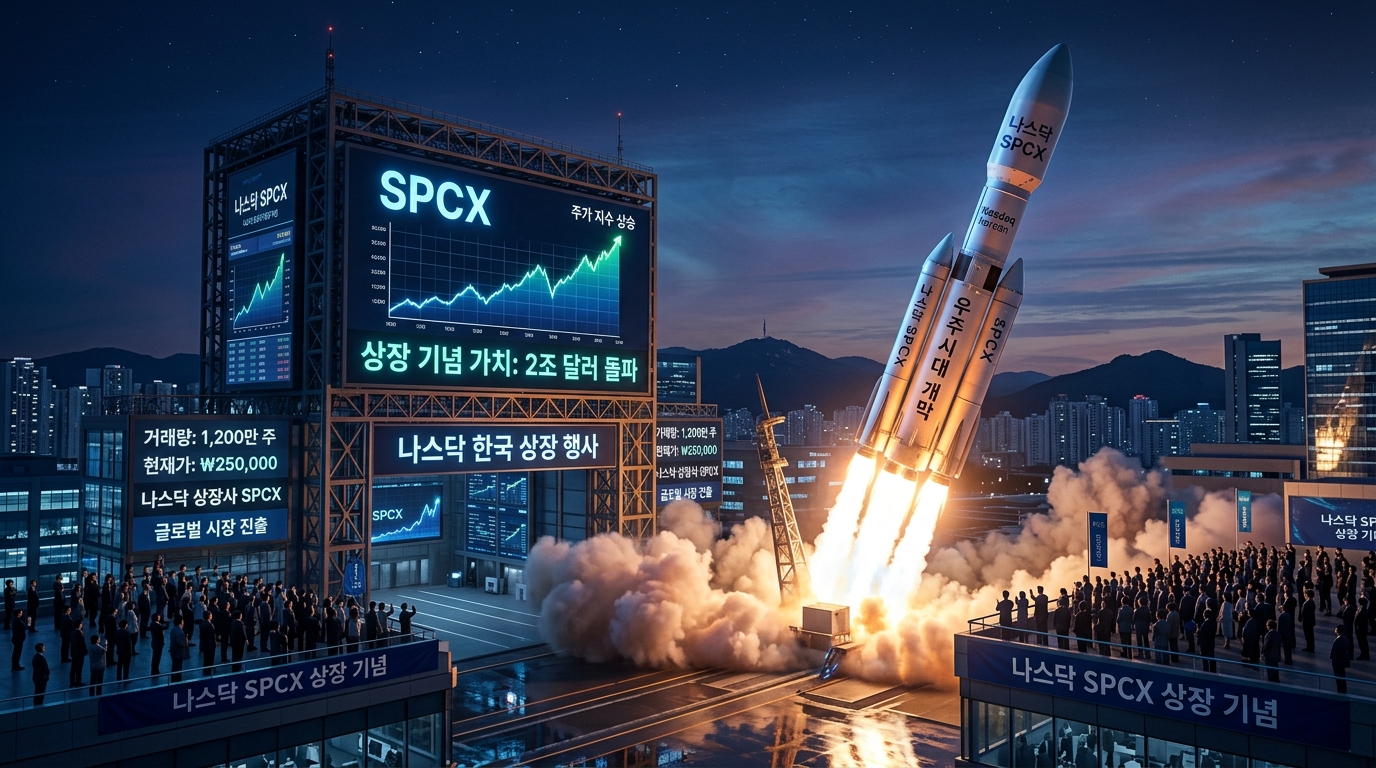
SpaceX (SPCX), which executed the largest initial public offering (IPO) in history, has shaken up the New York stock market by surpassing a $2 trillion market capitalization immediately after its listing.
It declared its evolution beyond an aerospace manufacturer into a global AI computing and planetary-scale internet infrastructure company.
Just four days after its listing, it made a surprise acquisition of AI coding startup 'Cursor' for $60 billion, aiming for dominance in the 'agentic AI' market.
While controversy over hyper-valuation and future lock-up volume pressures persist, contrasting evaluations from global institutions coexist.
Current Status Summary
SpaceX made its debut on the Nasdaq market on June 12, 2026, at an offering price of $135, raising a total of $75 billion to set the record for the largest IPO in history.
After closing at $160.95, up 19.2% from the offering price on its first day of trading, buying pressure intensified alongside the launch of options trading, driving the stock to a peak of $225.64 on June 16.
During this rally, its market capitalization surpassed $2.5 trillion, overtaking Amazon and briefly trailing closely behind Microsoft, placing it around 5th to 6th in the US market cap rankings.
CEO Elon Musk's personal net worth reached $1.1 trillion, making him the official first 'trillionaire' in human history.
[Image: /stdaily/uploads/202606/gen_6a35d8739ab694.54849924.png]
However, the announcement of the $60 billion acquisition of AI coding platform 'Cursor' on June 16 triggered dilution concerns.
Due to resulting selling pressure, the stock price corrected back to the $185 range as of the June 18 close.
As June 19 (US time) was closed for the Juneteenth holiday, the final price for the debut week was established at $185 per share.
Maintaining a rise of approximately 37% over its offering price, the company concluded its turbulent first week on the market.
Financial Analysis
SpaceX's revenue is on a steep upward trajectory, but it is currently traversing a net loss phase on an enterprise level due to massive capital expenditure (CAPEX).
As of 2025, revenue stood at $18.7 billion, while the final net loss was around $4.9 billion.
Among its business units, the low-Earth orbit satellite network 'Starlink' generated $11.4 billion in revenue and $4.4 billion in operating profit, serving as its primary cash cow.
On the other hand, the heavy launch vehicle development segment, including Starship, remains highly capital-intensive, consuming approximately $2.5 billion in cash in the first quarter of 2026 alone.
However, market consensus projects 2026 revenue to nearly double year-over-year to $34.5 billion, and reach $64.5 billion by 2027.
Operating profit is also expected to rapidly narrow its losses, with the company projected to reach the break-even point (BEP) around 2027.
| Financial Category | 2025 Performance (Actual) | 2026 Forecast (Consensus) | 2027 Forecast (Consensus) |
|---|---|---|---|
| **Annual Revenue** | $18.7 Billion | $34.5 Billion | $64.5 Billion |
| **Net Income** | -$4.9 Billion (Net Loss) | EPS -$0.64 | EPS -$0.09 |
| **Gross Profit Drivers** | Starlink operating profit of $4.4B | Reflection of Google/Anthropic infra revenue begins | Starship commercial launches & orbital data centers activate |
In particular, massive AI computing infrastructure supply contracts signed prior to the listing have emerged as a new breakthrough for profitability.
A 3-year, $45 billion data center supply contract with Anthropic and a $30 billion supply contract with Google Cloud are scheduled to be recognized sequentially.
Once fully applied, these two contracts will activate a recurring revenue engine with high margins worth approximately $26 billion annually.
Valuation
At the current stock price of $185, its market capitalization sits around $2.5 trillion.
This translates to a price-to-sales (P/S) ratio of approximately 130 times based on 2025 revenue, remaining in an extremely overvalued territory by traditional metrics.
This stands in stark contrast to Nvidia, the leading AI stock, which has a P/S ratio of about 20 times during the same period, and the Nasdaq 100 index average P/S ratio of around 5.3 times.
Therefore, the current valuation is interpreted as factoring in the value of a global low-Earth orbit 'AI infrastructure' platform, rather than just a simple spacecraft manufacturer.
[Image: /stdaily/uploads/202606/gen_6a35d87c008584.11030074.png]
SpaceX is realizing an 'orbital data center' model that combines satellite communication backhauls, power grids, and massive computing clusters.
Additionally, it is citing software and service synergies from its integration with the AI coding program 'Cursor' as justification for its valuation multiple.
Given the nature of high-growth tech stocks that are sensitive to interest rates, an upward trend in the 10-year US Treasury yield (US10Y) and the Dollar Index (DXY) could impact the valuation discount rate.
A slowing macroeconomic environment or a rising interest rate climate would exert downward pressure on maintaining such ultra-high multiples.
Analyst & Institutional Commentary
Wall Street's views are sharply divided around contrasting outlooks and valuation metrics.
Arete Research initiated coverage with a 'Buy' rating and a target price of $401 shortly after the listing.
They project that enterprise-wide revenue could exceed $200 billion by 2030, with the physical integration of Starlink and AI serving as an irreplaceable competitive moat.
Oppenheimer also aggressively raised its target price from $190 to $250 in light of the Cursor acquisition.
This is driven by their assessment that SpaceX has gained dominance over everything from hardware manufacturing to cloud and applied agent service layers.
Conversely, Morningstar strongly warned of overheating, presenting a fair value of $62 per share.
They explained that even under the most optimistic scenario, overcoming short-term share dilution and astronomical investment costs would limit the upside to around $169.
NewStreet Research also set a conservative target of $165, advising caution regarding incoming supply pressure.
Risk Factors
The most immediate and potent potential drag on the stock price is the release schedule of lock-up volumes, which account for over 95% of shares.
Currently, the free float stands at a mere 4.3%, making the stock price highly volatile even with low trading volumes.
However, starting around August and September, when the first quarterly results are anticipated, the first wave of lock-up expirations worth over $240 billion is expected to hit the market.
By the end of the year, up to $1 trillion worth of additional shares will be unlocked, placing a heavy overhang burden of potential selling pressure on the market.
Additionally, the dual-class share structure (Class B) gives Elon Musk complete control of 80% to 85% of the voting rights, raising governance uncertainties.
Because of this, public pension funds such as those in California and New York continue to raise concerns regarding index fund inclusion processes and the infringement of minority shareholder rights.
On top of this, mechanical and physical risks inherent to the space industry apply.
Any news of critical safety defects or launch failures during Starship or Starlink launch projects could immediately impact the stock price.
Investment Outlook
SpaceX's Nasdaq listing and its breakthrough of the $2 trillion mark signify a return of the information technology paradigm from asset-light models to physical asset-integrated models.
Its long-term growth potential as a unique infrastructure company combining planetary-scale networks with AI computing remains clear.
However, Wall Street's assessment that the current stock price is in a "priced beyond perfection" territory—fully reflecting long-term results up to 10 years out—is also reasonable.
In the short term, passive buying from index inclusions may act as a partial buffer supporting the stock price.
Yet, a testing ground awaits with the first lock-up expiration schedule in August-September and the confirmation of actual profit margins.
Rather than short-term chasing, a prudent long-term installment approach while monitoring the lock-up digestion process and stabilization of macroeconomic interest rates seems advisable.
[Image: /stdaily/uploads/202606/gen_6a35d8861f16e3.10374615.png]
FAQ
Q1. Can Korean retail investors trade SpaceX (SPCX) stock freely?
- Yes. Since it has successfully listed on the Nasdaq under the ticker SPCX, real-time trading as a foreign stock is available through major domestic brokerages' MTS/HTS. However, investors should be mindful of the extreme volatility typical of newly listed stocks.
Q2. How much equity does Elon Musk hold, and what influence does he exert?
- CEO Musk holds about a 42% stake in SpaceX. However, by controlling Class B shares that carry 10 votes per share, he single-handedly commands over 80% of the total voting power.
Q3. What kind of company is 'Cursor', the AI coding app acquired right after listing?
- It is a next-generation AI coding engine for developers founded by MIT alumni. It was acquired for $60 billion to lead the software coding market by integrating with the model capabilities of xAI, a SpaceX affiliate.
Q4. Why is there a massive volume of shares waiting to be unlocked?
- This is because only about 4.3% of shares were made available to the public as free float during the IPO. While this restricted supply drove the price up in the short term, lock-up agreements for major insiders and early investors will begin expiring around August-September, potentially unleashing profit-taking sales.
Q5. Will SpaceX be quickly added to major indices like the Nasdaq 100 or S&P 500?
- For the Nasdaq 100, fast-track inclusion utilizing special provisions for mega-cap stocks is being discussed, potentially occurring within two weeks of listing. However, for the S&P 500, strict criteria including consecutive quarters of cumulative profitability must be met, meaning formal inclusion is anticipated around 2027 at the earliest.
---
Today's Market Indicators (As of 2026-06-20)
- **KOSPI**: 9,052.42
- **KOSDAQ**: 966.59
- **NASDAQ**: 26,517.93
- **USD/KRW**: 1,533.00 KRW
- **Daily Stock Fear & Greed Index**:
- KOSPI Fear & Greed: Neutral (51.9) | 1 Week Ago: Neutral (53.7)
- NASDAQ Fear & Greed: Fear (37.3) | 1 Week Ago: Fear (35.5)
---