Hello, this is Daily Stock, your trusted companion in investment, delivering verified market data and in-depth analysis.
Executive Summary
As of intraday trading on June 19, 2026 (tentative), the S&P 500 is showing dynamic movement ahead of its upcoming quarterly rebalancing on June 22. This is driven by news of historic joint collaborations in tech and positive seasonal tailwinds.
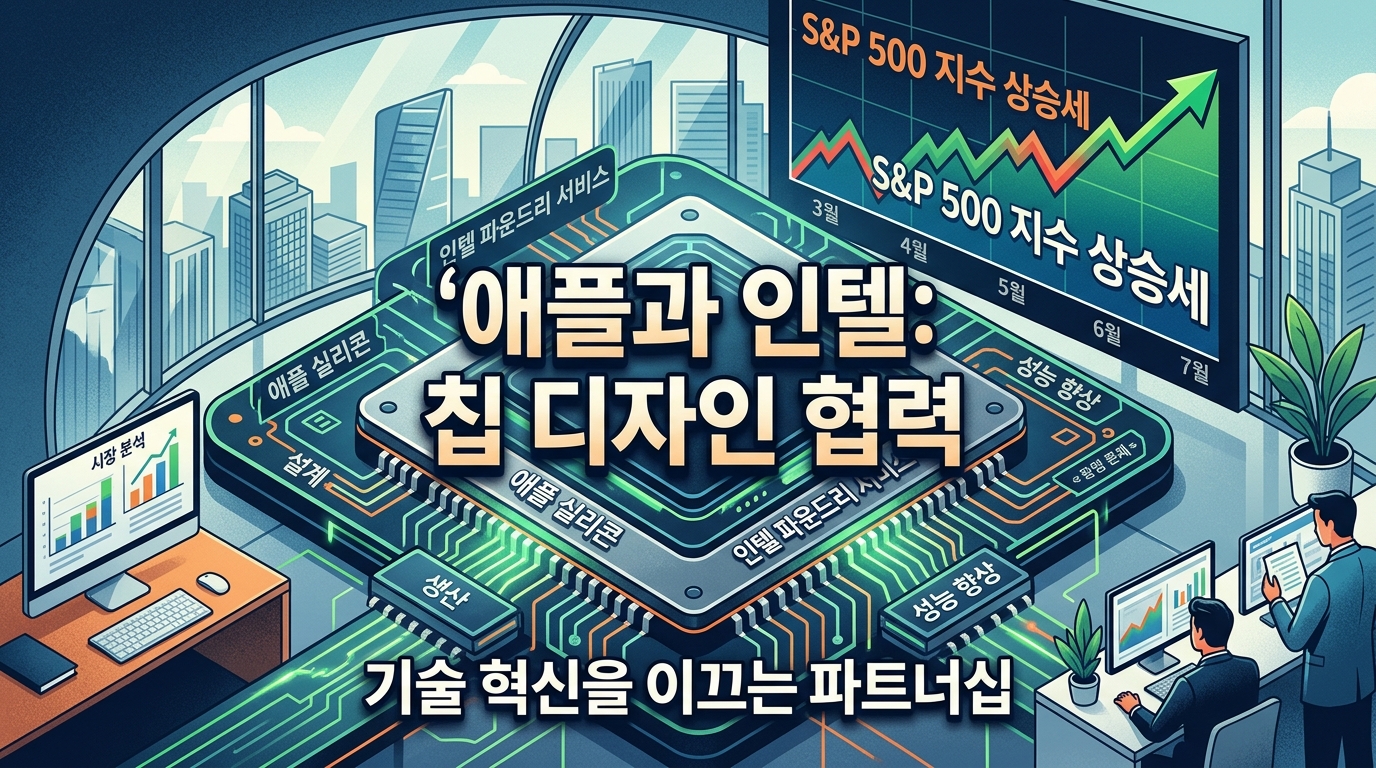
Particularly, news of Apple and Intel’s domestic chip manufacturing partnership has signaled a reorganization of the semiconductor supply chain, while expectations for a statistically strong "July effect" are rising.
Through this rebalancing, Marvell Technology (MRVL) and Flex (FLEX)—key beneficiaries of the AI data center boom—will be added to the index, while traditional consumer goods companies Pool Corp (POOL) and Campbell Company (CPB) will be excluded, further intensifying the index's concentration in tech.
[Image: /stdaily/uploads/202606/gen_6a349562ce8555.59016280.png]
Current Market Summary
As of 10:02 AM on June 19, 2026 (tentative), domestic and international stock markets are showing mixed performance.
The KOSPI is currently at 9,333.94, and the KOSDAQ is at 982.98. The USD/KRW exchange rate remains somewhat elevated at 1,538.30 won.
The tech-heavy Nasdaq is hovering around the 26,517.93 level.
According to the Fear & Greed Index calculated by Daily Stock, the KOSPI is currently in the "Neutral" (54.5) phase, maintaining a calm trend similar to one week ago (44.6) and one month ago (50.3).
On the other hand, the Nasdaq Fear & Greed Index is in the "Fear" (37.5) phase. While this is a slight improvement from last week (31.6), investor sentiment has weakened compared to the "Greed" (61.5) stage recorded one month ago.
Amid the Federal Reserve's hawkish rate stance and persistent inflationary pressures, US President Trump announced a chip design and manufacturing partnership agreement between Apple and Intel within the US via social media, driving a strong intraday rebound in the semiconductor sector.
Financial Analysis
Marvell Technology (MRVL) and Flex (FLEX), newly added to the S&P 500 in this rebalancing, are proving their solid financial health and direct benefits from AI infrastructure expansion.
In contrast, Pool Corp (POOL) and Campbell Company (CPB), which are scheduled to be excluded, reflect margin pressures caused by prolonged high interest rates and slowing consumer spending.
| Stock Name (Ticker) | Sector | Change Type | Financial Characteristics & Momentum |
|---|---|---|---|
| **Marvell Technology (MRVL)** | Information Technology (IT) | Inclusion (Effective 6/22) | Rapidly growing revenue in high-speed networking and connectivity chips for AI data centers; improved free cash flow. |
| **Flex (FLEX)** | Information Technology (IT) | Inclusion (Effective 6/22) | Earnings turnaround driven by demand for global electronics manufacturing, power, and supply chain infrastructure. |
| **Pool Corp (POOL)** | Consumer Discretionary | Exclusion (Effective 6/22) | Revenue pressure due to slowing pool equipment and housing-related spending amid prolonged high interest rates. |
| **Campbell Company (CPB)** | Consumer Staples | Exclusion (Effective 6/22) | Failed to meet market capitalization requirements due to limited pricing power against rising raw material costs and sustained low growth. |
Newly added IT companies are at the center of capital expenditure (CAPEX) cycles of major hyperscalers, raising the likelihood of continuous upward revisions in earnings estimates in the second half of the year.
In contrast, consumer staples like Campbell Company are seeing their weight reduced in the major benchmark index amid a low-growth environment.
[Image: /stdaily/uploads/202606/gen_6a34956f098241.92502924.png]
Valuation
The S&P 500's forward price-to-earnings (P/E) ratio continues to maintain a somewhat elevated valuation multiple, supported by improved earnings projections for Big Tech companies.
Apple, in particular, is trading at a P/E of around 36x, supported by expectations of secured supply chain stability following its chip design and manufacturing partnership with Intel in the US.
However, as Apple CEO Tim Cook mentioned that product price hikes may be inevitable due to memory chip shortages, maintaining profit margins will act as a key variable for its future valuation.
Marvell Technology also exhibits a high multiple as the AI infrastructure premium is priced in, but mechanical buying from passive funds is expected to support the stock's downside.
Historically, because multiples tend to normalize after a temporary overshooting immediately following index inclusion, caution is advised against chasing the rally.
Expert & Institutional Analysis
Wall Street institutions project that once the end-of-quarter rebalancing and the record-scale options expiration in late June pass, a robust seasonal flow of capital will begin starting in early July.
According to analysis by Scott Rubner of Citadel Securities, the first half of July is historically one of the periods when the S&P 500 shows its strongest upward bias of the year.
Since 1928, the S&P 500 has risen 69% of the time in the first half of July, posting an average return of 1.5%. The Nasdaq 100 has risen 76% of the time since 1985, averaging a 2.2% gain.
Notably, the S&P 500 has posted positive monthly returns in July for 11 consecutive years.
Experts suggest that the so-called "July Effect," where retail investors' new capital deployment is concentrated at the start of the second half, could spark another tech-driven rally.
Risk Factors
The biggest risk is the uncertainty surrounding hawkish monetary policy under the newly appointed Federal Reserve Chair.
At the recent Federal Open Market Committee (FOMC) meeting, the Dot Plot containing Fed officials' interest rate projections turned more hawkish, significantly dampening expectations for rate cuts this year.
Some members have even projected additional interest rate hikes within the year, presenting a persistent risk to the soft-landing scenario.
Additionally, concerns over demand contraction that could arise as Apple begins passing rising semiconductor costs onto consumers cannot be ignored.
While geopolitical risks appear to be easing slightly, if supply chain bottlenecks are not completely resolved, valuation pressures on tech stocks could trigger profit-taking at any time.
Investment Perspective Summary
In the short term, the S&P 500 is expected to digest stock changes and options-expiration volatility resulting from the late-June rebalancing.
However, the seasonal favorability of the "July Effect" proven by historical statistics and positive news regarding the US-centered supply chain reorganization, represented by the Apple-Intel alliance, are sufficient to stimulate sideline buying demand.
Therefore, rather than focusing on traditional industries being excluded from the index, investors may find it effective to narrow their portfolios to IT and core AI infrastructure stocks that have proven earnings growth momentum.
However, as investor sentiment in the Nasdaq remains in the "Fear" stage, a split-purchase approach rather than aggressive chasing is recommended.
[Image: /stdaily/uploads/202606/gen_6a34957ab6eb84.51232261.png]
Investor Checklist Q&A
Q1. Which stocks are being excluded from the S&P 500 in this June rebalancing?
A1. Pool Corp (POOL) from the Consumer Discretionary sector and Campbell Company (CPB) from the Consumer Staples sector are being excluded from the index.
Q2. What is the impact of the Apple-Intel collaboration news on the market?
A2. The news that Apple has agreed to design and manufacture chips with Intel domestically in the US is evaluated as a milestone that will reduce supply chain dependency on specific foundries and enhance US semiconductor self-reliance.
Q3. What is the statistical basis of the "July Effect"?
A3. The S&P 500 has closed higher in July for 11 consecutive years, and the probability of an increase in the first half of July has reached 69% since 1928, making it one of the strongest seasonal bull periods of the year.
Q4. What is the current investor sentiment in the Nasdaq market?
A4. As of June 19, 2026, the Nasdaq Fear & Greed Index is at the "Fear (37.5)" stage, indicating that investor sentiment for tech stocks has cooled compared to the "Greed (61.5)" stage from a month ago.
Q5. Why are tech stocks holding up despite weakening expectations for interest rate cuts?
A5. Despite the Fed's hawkish stance, actual profit performance is supporting the index, with Big Tech companies like Microsoft, Google, and Amazon increasing their AI capital expenditure (CAPEX) by more than 70% year-over-year.