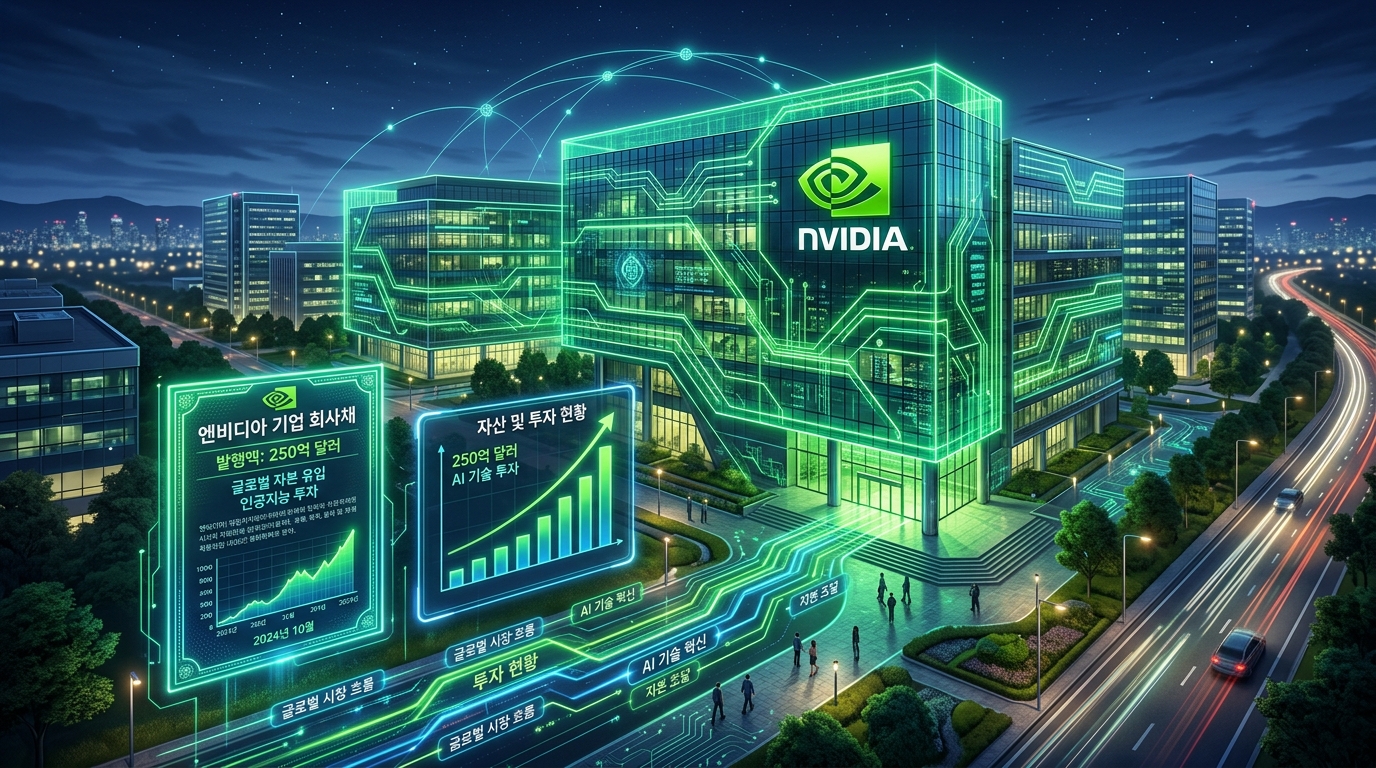
Hello, Daily Stock readers. Today, we will deeply analyze Nvidia's massive bond issuance that recently shook the global capital markets, and the capital allocation strategies hidden behind it.
[Image: /stdaily/uploads/202606/gen_6a3440b66c54b4.56517644.png]
Summary
Nvidia (NVDA) has made a surprise return to the bond market for the first time in five years since 2021, finalizing a $25 billion (approx. 37.8 trillion KRW) corporate bond issuance, far exceeding its initial plans.
Despite generating massive cash flows as the dominant leader in the global AI market, Nvidia's move to issue bonds is part of a sophisticated capital structure optimization strategy aimed at securing long-term funds at low interest rates and maximizing shareholder returns.
This corporate bond issuance attracted a whopping $85 billion in orders, far exceeding the initial target of $20 billion, proving Nvidia's solid credit rating (AA).
The secured liquidity is expected to fund its $80 billion share buyback program, dividend hikes, and equity and financial investments across the AI ecosystem.
Market Overview
On June 15, 2026 (local time), Nvidia filed a preliminary prospectus with the U.S. Securities and Exchange Commission (SEC) and decided to issue corporate bonds consisting of seven tranches with maturities ranging from 2 to 30 years (maturing in 2056).
The issuance was timed perfectly as U.S. Treasury yields fell to around 4.925% (for the 30-year bond) on news of a geopolitical agreement between the U.S. and Iran, and S&P Global upgraded Nvidia's credit rating to AA.
This move comes amid a "tripolar decoupling" phase, where the economic fundamentals of the three major global regions—the US, Europe, and Asia—are diverging sharply amid cooling inflation and volatile commodity prices.
While U.S. tech giants are raising massive capital backed by abundant liquidity, manufacturing-heavy Europe and monetary-easing Asia (PBOC in China and BOJ in Japan) are showing differing relative strengths.
[Image: /stdaily/uploads/202606/gen_6a3440bf3143f9.09093588.png]
Currently, shifts in credit spreads caused by differences in global manufacturing PMI and monetary policies are prompting tech giants to raise capital preemptively.
As of intraday trading on June 19, 2026 (provisional), key indicators reflecting the global financial market show the KOSPI fluctuating around 9063.84, KOSDAQ at 1000.93, Nasdaq at 26365.40, and the USD/KRW exchange rate around 1536.80.
Indeed, major hyperscalers such as Alphabet, Meta, Amazon, and Oracle have issued tens of billions of dollars in bonds this year, accelerating the funding race.
Amid the impact of volatile prices for key commodities like crude oil and copper on global liquidity, highly rated tech giants are securing long-term capital at relatively low costs.
Financial Analysis
Nvidia did not choose debt financing due to a lack of cash. In fact, it is a cash-rich company expected to generate more than $200 billion in operating cash flow in fiscal year 2027 alone.
In the first quarter of this year, Nvidia's net income skyrocketed more than threefold quarter-on-quarter to $58.3 billion, and its cash and cash equivalents stood at $13.24 billion at the end of Q1.
| Classification | Key Financial & Funding Indicators (As of June 2026) | Note |
|---|---|---|
| **Recent Bond Issuance Size** | $25 billion (approx. 37.835 trillion KRW) | 7 tranches (2 to 30-year maturities) |
| **Order Book Demand** | $85 billion (approx. 128 trillion KRW) | Over 4x oversubscribed vs. $20B target |
| **Credit Rating (S&P / Moody's)** | AA (Positive) / Aa1 (Positive) | Upgraded to AA on June 12, 2026 |
| **Authorized Share Buyback** | $80 billion (additional authorization) | $19.3 billion repurchased and retired in Q1 |
| **Quarterly Dividend per Share** | $0.25 | Significantly increased from the previous $0.01 |
| **Estimated Total Debt** | Approx. $30 billion (post-issuance) | Increased from the previous $8.5 billion |
The yield spread for the longest 30-year tranche (maturing in 2056) was set at just 0.5% percentage points (50 bps) over U.S. Treasuries, proving Nvidia's overwhelming creditworthiness.
This is largely because Nvidia operates as a fabless company focusing on GPU design, exposing it to significantly lower risks compared to other hyperscalers that face astronomical capital expenditures (CAPEX) for building their own data centers.
Valuation
From an equity market perspective, Nvidia's latest move is highly regarded as "non-dilutive financing" that does not erode shareholder value.
Amid concerns over high valuations, such as the price-to-earnings (P/E) ratio, the company bolstered its $80 billion share buyback program using ultra-low-interest corporate bonds instead of issuing new shares.
At the same time, in terms of global stock market valuations, the U.S. market maintains a high premium driven by AI growth stocks, while European (CAC40, DAX) and Asian markets show relative discounts.
Although Nvidia's stock has enhanced its valuation defense thanks to massive shareholder return policies and credit backing in the bond market, multiple volatility remains open depending on the contraction of global macroeconomic liquidity.
[Image: /stdaily/uploads/202606/gen_6a3440c80064c8.26214408.png]
Institutional & Analyst Insights
Major Wall Street institutions view this bond issuance not merely as debt refinancing, but as securing "war chests for strategic AI territorial expansion."
According to an analysis by Bloomberg Intelligence, Nvidia plans to use the proceeds to make large-scale equity investments in strategic AI allies, further cementing the "Nvidia-centric ecosystem."
Indeed, Nvidia has been exerting powerful control over the AI hardware supply chain and software platforms, investing $30 billion in OpenAI, up to $10 billion in Anthropic, and $5 billion in Intel shares.
Some analysts point out that by actively repurchasing its own shares with low-cost capital, Nvidia is benchmarking the "leverage-based shareholder return strategy" once utilized by Apple (AAPL).
Risk Factors
However, concerns are rising that building an exclusive ecosystem based on heavy debt could trigger a new type of systemic risk.
The biggest risk is the controversy surrounding "circular transactions," which arise when AI startups or cloud partners funded by Nvidia turn around and purchase Nvidia's GPUs with those very funds.
If the actual monetization of generative AI services takes longer than market expectations, the default risk of these partners could transfer back to Nvidia as a credit guarantee burden.
In addition, global supply chain disruptions due to geopolitical conflicts (such as reliance on TSMC's advanced nodes) and resurgent global inflation driven by surging commodity prices like oil and copper could widen bond spreads.
Investment Perspective
Nvidia's mammoth $25 billion bond issuance is a highly sophisticated financial strategy aimed at securing long-term capital under the most favorable conditions during global tripolar decoupling, rather than a response to a cash shortage.
By leveraging cheap capital to sustain share buybacks, the company is boosting earnings per share (EPS) while fostering a virtuous cycle of investing across the AI infrastructure ecosystem.
However, investors must keep in mind that macro risks remain in the short term, including global liquidity flows, commodity volatility, and cracks in the relative strength of US, European, and Asian equity markets.
Currently, it seems wise for investors to build conditional response scenarios while monitoring fundamental indicators, such as actual AI monetization metrics and supply chain stability.
[Image: /stdaily/uploads/202606/gen_6a3440d3639c52.39292790.png]
Investor Q&A
Q1. Why did Nvidia issue a massive $25 billion bond when it generates so much cash?
A1. It is to optimize its capital structure and set credit guidelines by lock-in long-term capital at the lowest cost. Instead of diluting shareholder equity by issuing new shares, Nvidia is utilizing lower bond yields to fund share buybacks, increase dividends, and sustain growth investments.
Q2. Why was there such high investor demand for this bond issuance?
A2. It is due to its high-quality 'AA' rating and rarity. Furthermore, because of its fabless business model that avoids direct data center construction, its direct CAPEX risks are significantly lower than those of other big tech firms, making its bonds highly secure and attractive to fixed-income investors.
Q3. How does this connect to the recently announced $80 billion share buyback program?
A3. In Q1 (Feb–Apr) of this year alone, Nvidia repurchased and retired $19.3 billion worth of its shares. Running a continuous buyback program requires liquidity. Raising low-interest debt preserves its existing cash reserves while providing the robust financial strength to execute massive shareholder returns.
Q4. What is behind the concerns over "circular transactions and indirect financing"?
A4. It stems from the structure where Nvidia invests heavily in or provides financial guarantees to partners like OpenAI and Anthropic, who then use those funds to purchase Nvidia's GPUs. Some on Wall Street warn that if AI monetization is delayed, this circular chain could unravel.
Q5. What are the current readings of the Fear & Greed Index in the domestic and global markets?
A5. As of intraday trading on June 19, 2026 (provisional), according to Daily Stock's proprietary Fear & Greed Index, the KOSPI Fear & Greed is currently in Neutral (53.4) territory (compared to Neutral 44.6 a week ago, Neutral 50.3 a month ago, and Extreme Fear 17.7 three months ago). The Nasdaq Fear & Greed remains in Fear (32) territory (compared to Fear 31.6 a week ago, Greed 61.5 a month ago, and Neutral 54.3 three months ago).