Hello. This is Daily Stock, precisely analyzing daily stock market trends and the intrinsic value of key promising stocks.
Key Summary
As of June 19, 2026, EcoPro BM (247540), a representative growth stock in the KOSDAQ market, is attempting a structural turnaround based on structural changes in the global cathode export market and momentum from starting local operations in Europe.
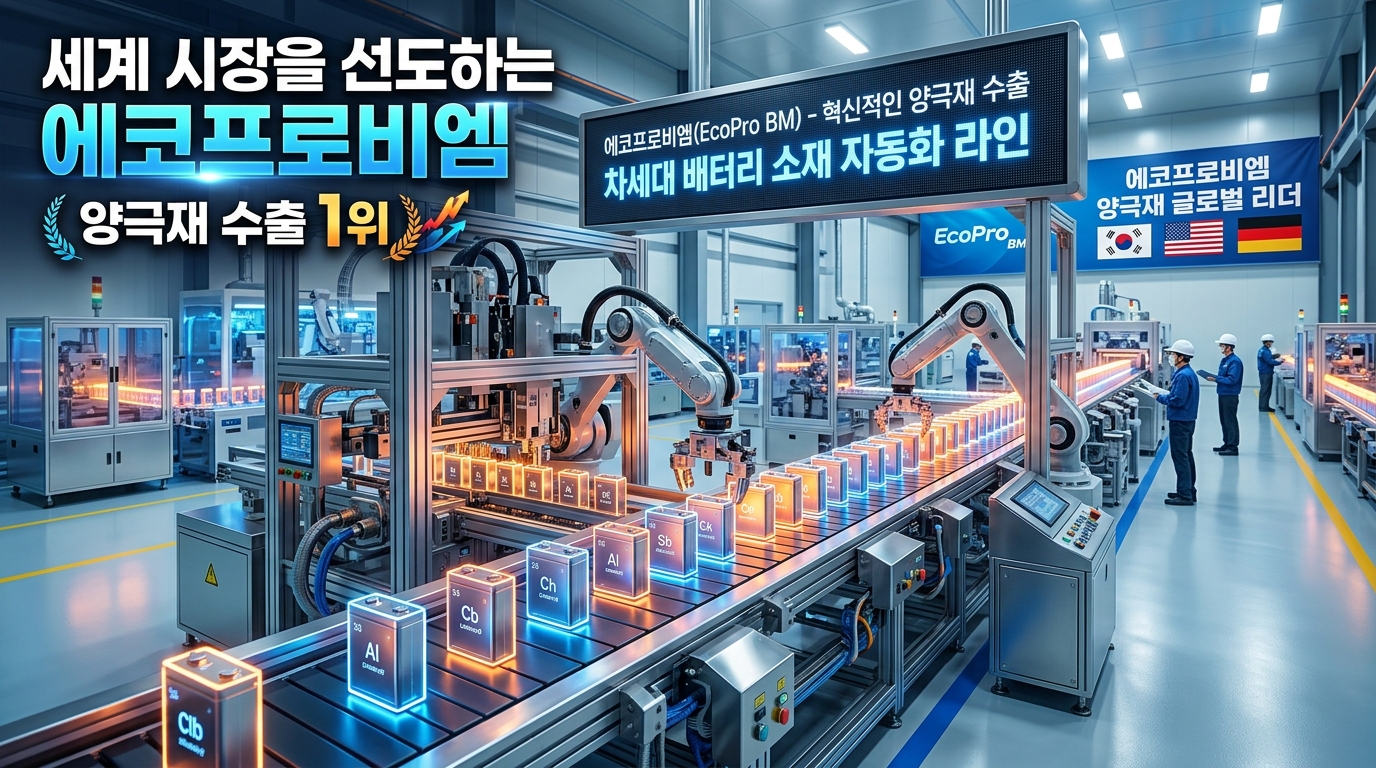
Despite short-term volatility in the electric vehicle (EV) industry, exports of cathodes for energy storage systems (ESS) have surged, showing progress in portfolio diversification.
With the full-scale operation of its Hungarian plant coinciding with the European Union's (EU) policy to strengthen regional supply chain regulations, a mid- to long-term export recovery and market share rebound scenario is drawing significant attention.
Current Situation Summary
As of the close on June 19, 2026, EcoPro BM closed at 169,400 KRW, down 1.68% (2,900 KRW) from the previous trading day.
On this day, the KOSPI index broke above the 9,000 level for the first time in history, closing at 9,052.42, while the KOSDAQ index was relatively marginalized, showing a weak consolidation pattern at 966.59.
From a supply and demand perspective, the program trading trends of foreign and institutional investors and the 'debt investing' credit balance trend that has persisted since the beginning of the year are key variables determining the downward pressure and rebound strength of the stock price.
Currently, Daily Stock's KOSPI Fear and Greed Index stands at 53.4 (Neutral), and the Nasdaq Fear and Greed Index is at 37.3 (Fear), reflecting ongoing concerns over global liquidity contraction.
[Image: /stdaily/uploads/202606/gen_6a34f769d17ae1.11078704.png]
Financial Analysis
For the first quarter of 2026, EcoPro BM recorded consolidated revenue of 605.4 billion KRW and an operating profit of 20.9 billion KRW, posting an earnings surprise that significantly exceeded market consensus.
In particular, exports of ESS cathodes, which surged by about 140%, defended the overall performance, and one-off profits, such as the reversal of inventory valuation loss provisions (worth approximately 31.8 billion KRW) due to a rebound in lithium hydroxide prices, contributed to improved profitability.
Despite the temporary slowdown in the US electric vehicle market, the transition of inventory adjustments by European battery customers to their final stages and the recovery in shipments are positive factors.
The following is a comparison of EcoPro BM's recent quarterly performance trends.
| Classification | Q1 2026 (Preliminary) | Q4 2025 | Q1 2025 | Year-on-Year (YoY) | Quarter-on-Quarter (QoQ) |
|---|---|---|---|---|---|
| **Revenue** | 605.4 billion KRW | 497.0 billion KRW | 629.8 billion KRW | -3.9% | +21.8% |
| **Operating Profit** | 20.9 billion KRW | 41.6 billion KRW (One-off reflected) | 2.3 billion KRW | +822.6% | -49.6% |
| **Net Income** | 12.2 billion KRW | Net Loss Recorded | Net Loss Recorded | Turned to Profit | - |
Valuation
Currently, EcoPro BM's stock price is attempting to build a bottom in the mid-160,000 KRW range, after undergoing a correction of about 70% from its peak of 584,000 KRW over the past three years.
Although the price-to-sales ratio (PSR) and price-to-earnings ratio (PER) valuations compared to past performance peaks have declined significantly, creating price attractiveness, the price-to-book ratio (PBR) still remains high at 9.7x relative to its asset value.
In the future, valuation pressures can only be alleviated once the production lines of the Debrecen plant in Hungary, with an annual capacity of 54,000 tons, normalize and utilization rates rise, leading to full-scale profit recovery.
Therefore, rather than short-term performance growth, estimating the mid- to long-term free cash flow (FCF) based on the execution of new cathode sourcing contracts with global automakers (BMW, Mercedes-Benz, etc.) in 2027-2028 is the key keyword for valuation assessment.
[Image: /stdaily/uploads/202606/gen_6a34f7740da853.52046368.png]
Expert and Institutional Analysis
Major domestic securities firms, such as Yuanta Securities, are focusing on the possibility of EcoPro BM becoming the biggest beneficiary of Europe's battery territory expansion policy.
This is because the EU recently finalized its 'Battery Booster' program, which supports the construction of large-scale battery production facilities in the region with 1.8 billion euros (over 3 trillion KRW) to counter the offensive of Chinese EV batteries.
Experts analyze that due to the mandatory regional sourcing legislation for batteries and cathodes in Europe starting next year, EcoPro BM, which has its own cathode production base in Europe, has gained the opportunity to dominate non-China orders.
However, some institutions, such as iM Securities, present a cautious view that the growth potential of the company's ESS business, which has a product portfolio centered on ternary batteries (high-nickel NCM/NCA), may face limitations amidst the global strength of LFP batteries.
Risk Factors
The biggest risk factors are the restriction of growth stock liquidity due to delayed global interest rate cuts and the intensifying volatility of the KRW/USD exchange rate (around 1,526.00 KRW).
If the prices of raw materials, such as lithium and nickel metals, turn downward again after a short-term rebound, a scenario of declining product selling prices and additional inventory valuation losses cannot be ruled out.
In addition, as the conversion request period for overhang (potential large-scale selling) volume, such as the private convertible bonds (CB) worth approximately 440 billion KRW issued on a large scale in 2023, continues, it could act as a supply-side burden dragging down the upper limit of the stock price.
Fixed cost burdens and defect rate control costs during the initial operation of the new Hungarian factory are also threats to short-term profit margins.
Summary of Investment Perspective
EcoPro BM is deemed to be passing through the deepest valley of the 'chasm' phase, marked by a short-term performance slowdown and industry-wide winter.
The operation of the European production base and the local sourcing mandate legislation within the global value chain are expected to be the most powerful allies for the recovery of the company's export market share.
Rather than aiming for a technical rebound based simply on price declines, it seems valid for investors to take a split-buying approach while confirming the contract announcements of the Hungarian plant and improvements in shipment indicators.
Investor Checklist Q&A
Q1. What was the biggest contributor to the Q1 2026 performance improvement?
A1. While cathode exports for US electric vehicles were somewhat stagnant, cathode sales volume surged 140% as demand for ESS (Energy Storage Systems) in downstream industries exploded due to the global expansion of AI infrastructure.
Q2. What is the operation schedule and expected effect of the Debrecen plant in Hungary?
A2. Operation of one line began in the second quarter (May) of 2026, and an additional line is scheduled to start operating in September of this year. It has the advantage of being Korea's only European local cathode plant capable of proactively responding to the EU's policy mandating regional parts sourcing.
Q3. Did the rise in raw material metal prices have a positive impact on performance?
A3. As the price of lithium hydroxide rose from $10.3 to around $18.5 per kg, the downward trend in product selling prices stopped, and the reversal of previously accumulated inventory valuation losses significantly boosted operating profit.
Q4. What are the plans and schedules for the development and mass production of next-generation products, such as solid-state batteries?
A4. With the goal of mass production in 2027, the EcoPro Group, along with its customers, is advancing technologies to build a next-generation full value chain, including solid electrolytes for solid-state batteries, solid-state cathodes, and lithium-metal anodes.
Q5. What is the scale of the convertible bonds (CB) identified as a potential overhang risk?
A5. There are private convertible bonds (CB) worth approximately 440 billion KRW issued in 2023, and the desire to convert these holdings into stock and realize profits has the potential to act as a supply-and-demand burden.