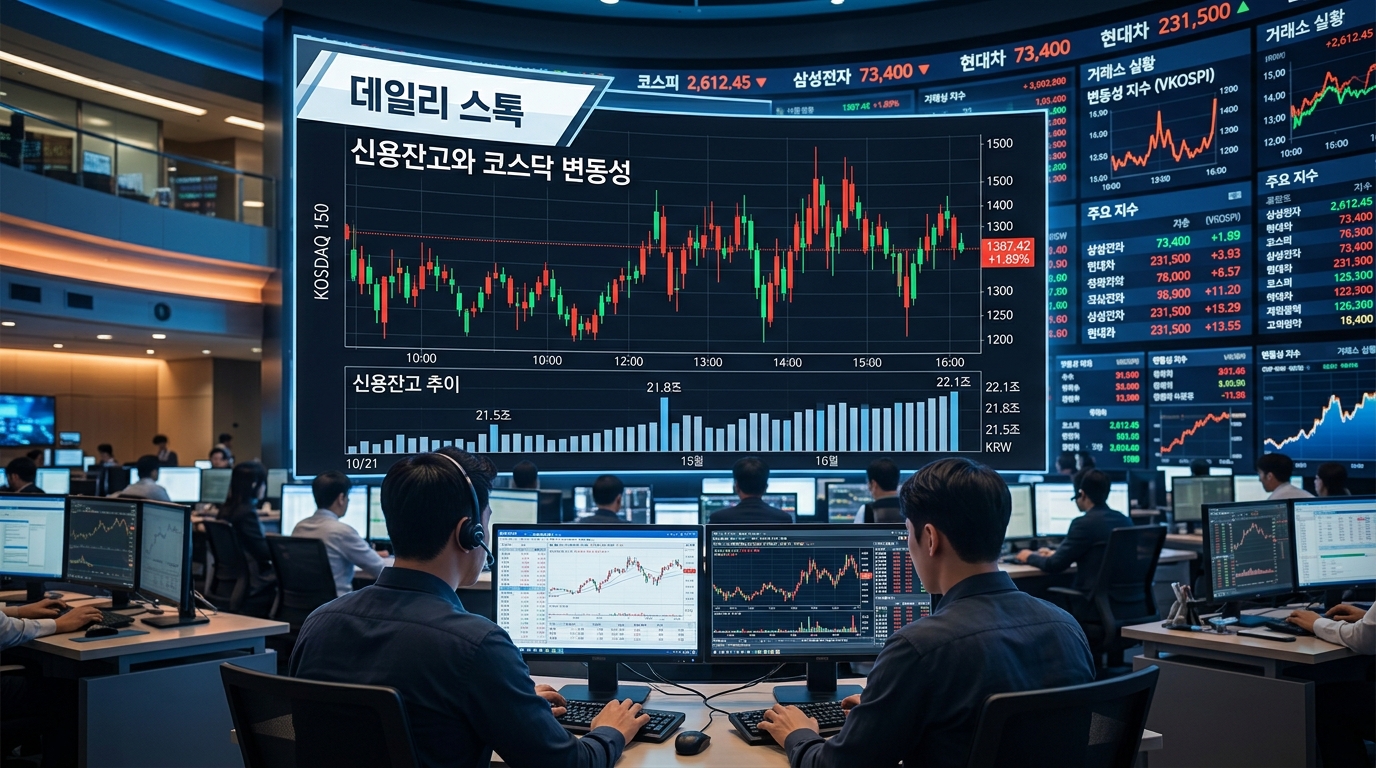
Hello, this is Daily Stock, a financial blog providing sharp insights into capital market trends.
[Image: /stdaily/uploads/202606/gen_6a33a5e17e0900.37770785.png]
Summary
With the KOSDAQ market experiencing extreme volatility around the 1,000-point mark, the trend in individual investors' credit loan balances is emerging as a key variable.
Due to the concentration of capital into KOSPI's large-cap semiconductor stocks, the absolute size of KOSDAQ's credit balance has decreased slightly. However, its ratio relative to market capitalization remains overwhelmingly high, leaving volatility risks intact.
This article systematically analyzes the recent flow of funds and the margin call risks associated with credit loans to assess future scenarios for the KOSDAQ market.
---
Current Status Summary
As of the market close on June 18, 2026, the KOSDAQ index fell 3.01% from the previous day to close at 1,000.93, barely defending the 1,000-point level.
In contrast, the KOSPI, driven by large semiconductor giants SK Hynix and Samsung Electronics, rose 2.25% to close at 9,063.84, highlighting an extreme polarization between the two markets.
In terms of supply and demand, the overall credit loan balance of the domestic stock market, which surpassed a record high of 38 trillion won in early June, has recently adjusted slightly to the 36–37 trillion won range.
Crucially, while the KOSDAQ credit balance rapidly shrank from the 11 trillion won range to around 8.9 trillion won, the KOSPI credit balance surged to over 28 trillion won, indicating a "great migration of credit funds to KOSPI."
Daily Stock's proprietary Fear & Greed Index also reflects the diverging sentiment in both markets.
The KOSPI Fear & Greed Index currently stands at Neutral (54.5), recovering slightly from Fear (32.2) a week ago. However, the Nasdaq Fear & Greed Index remains at Fear (32.7), applying downward pressure on KOSDAQ due to dampened sentiment regarding global growth stocks.
[Image: /stdaily/uploads/202606/gen_6a33a5eb949259.33984183.png]
---
Financial Analysis
While the absolute amount of KOSDAQ's credit loan balance appears smaller than KOSPI's, the "credit balance-to-market cap ratio"—which represents the leverage burden relative to market stamina—is very high.
According to data from the Korea Exchange (KRX) and the Korea Financial Investment Association, KOSDAQ's credit loan ratio relative to its market capitalization is 1.68%, which is about 3.8 times higher than that of the KOSPI market (0.44%).
In particular, the supply-and-demand gap between large-cap growth stocks (biotech, secondary batteries, IT components, etc.) in the KOSDAQ 150 index and KOSDAQ Small (small-cap stocks) is widening.
Small-cap stocks suffer from limited liquidity and a high proportion of short-term retail trading. Consequently, when the index undergoes temporary corrections, gap volatility becomes structurally strong as selling triggers more selling.
| Classification | KOSPI Market | KOSDAQ Market | Remarks |
|---|---|---|---|
| **Daily Close (2026-06-18)** | 9,063.84pt (+2.25%) | 1,000.93pt (-3.01%) | Extremely polarized market |
| **Credit Balance Size (Mid-June)** | Approx. 28.5tn KRW | Approx. 8.9tn KRW | KOSPI surged, KOSDAQ decreased |
| **Credit Ratio to Market Cap** | 0.44% | 1.68% | KOSDAQ is approx. 3.8 times KOSPI |
| **Recent Major Risk Factors** | Intensified concentration in leading stocks | High interest rates, margin calls, low liquidity gaps | Qualitative change in supply and demand |
---
Valuation
Recently, KOSDAQ has been highly synchronized with the sharp fluctuations of the Nasdaq index, placing valuation multiple contraction pressure on growth stocks.
Several leading stocks in the secondary battery and biotech sectors remain near historical highs based on forward Price-to-Sales (PSR) and EV/EBITDA ratios, making them highly sensitive to concerns over delayed macroeconomic rate cuts.
On June 8, when the index plunged, KOSDAQ crashed 9.08% in a single day. This triggered a massive wave of forced margin call liquidations, temporarily threatening the lower valuation support line.
On the other hand, some stock groups in semiconductor equipment (materials/components/equipment) and AI software are seeing narrower PSR valuation gaps as earnings visibility improves, leading to rapid fundamental differentiation among individual stocks.
[Image: /stdaily/uploads/202606/gen_6a33a5f6604b39.95496053.png]
---
Expert & Institutional Analysis
Academic and market experts point out that in the current debt-investing craze, the "speed of change" and the "margin call conversion cycle" are more dangerous risk factors than the simple balance ratio.
According to the Korea Capital Market Institute, the speed at which outstanding receivables are forcibly liquidated during price drops has accelerated compared to the past, which could exacerbate the index's decline during deleveraging.
In fact, the cumulative volume of forced margin calls across the stock market over the past month hovered around 1 trillion won, clearing the market's credit bubble while maximizing volatility.
Institutional investors advise against bottom-fishing for thematic stocks where retail speculative leverage was heavily concentrated, unless solid earnings growth is guaranteed.
---
Risk Factors
First, persistent global high interest rates and the USD/KRW exchange rate stabilizing at the 1,529.80 won level could trigger foreign capital outflows, shrinking liquidity in the KOSDAQ market.
Second, KOSDAQ small- and mid-cap stocks with high retail credit ratios have a vulnerable structure. When prices correct, a shortage of collateral leads to margin call orders flooding the market during the next morning's pre-market opening auction.
Third, major market players (foreigners and institutions) are restricting program buying primarily to large-cap KOSPI stocks, leaving KOSDAQ small- and mid-caps with a prolonged liquidity void.
---
Investment Outlook Summary
Currently, the KOSDAQ 1,000 level serves as more than just a number; it is a psychological threshold for retail investors and a critical line of defense for maintaining leverage collateral.
Stocks with excessively high credit loan balances require extreme caution, as even minor market corrections can trigger deep drops due to involuntary forced liquidations.
Therefore, rather than chasing beaten-down stocks, a reasonable KOSDAQ investment strategy at this point is to focus on select sectors where credit balances are steadily declining and earnings fundamentals are improving.
[Image: /stdaily/uploads/202606/gen_6a33a6016b7b58.41507437.png]
---
FAQ
Q1. Why is index volatility still high even though the KOSDAQ credit balance is decreasing?
A1. Although the absolute credit balance decreased as funds moved to large-cap KOSPI stocks, the ratio relative to market capitalization remains high—about 3.8 times that of KOSPI. Additionally, retail money is concentrated in low-liquidity small- and mid-cap stocks, making them highly vulnerable to selling shocks.
Q2. What is the fundamental cause of the recent surge in margin calls?
A2. As stock prices fluctuated sharply in the short term, more accounts failed to meet the collateral maintenance ratio (typically 140%). With the liquidation cycle of unpaid accounts shortening, mechanical forced selling hit the market all at once.
Q3. Why are the credit transaction flows of KOSPI and KOSDAQ moving in opposite directions?
A3. Retail and institutional buying became extremely concentrated in large-cap semiconductor stocks like Samsung Electronics and SK Hynix, which benefit from AI and HBM. This led to a rapid migration of credit funds from growth-stock-heavy KOSDAQ to KOSPI.
Q4. Is it safe to invest in KOSDAQ when the global Fear & Greed Index is at the "Fear" level?
A4. When the Nasdaq Fear & Greed Index is in "Fear" (32.7) territory, supply and demand for tech stocks can be highly unstable. It is safer to enter the market gradually after confirming that the index has stopped falling and the liquidation of credit balances is nearing completion.
Q5. How can retail investors manage risks in this volatile market?
A5. You should regularly monitor the credit balance ratio of your holdings (caution is advised if it is above 5%). Considering the high exchange and interest rates, avoid leverage investments and maintain a certain level of cash balance at all times.