Hello, this is Daily Stock. Amid growing volatility in the global stock market recently, a very dramatic shift in investor fund flows surrounding the Philadelphia Semiconductor Index is being detected.
[Image: /stdaily/uploads/202606/gen_6a31e3d33d7160.49878584.png]
Key Summary
- **Aggressive Leverage Bets by Domestic Investors**: During the second week of June (June 8 to 12), domestic retail investors made a massive net purchase of $1.75743 billion (approximately KRW 2.67 trillion) in the Direxion Daily Semiconductors Bull 3X ETF (SOXL)—a high-risk product tracking three times the daily performance of the Philadelphia Semiconductor Index—placing it in the overwhelming No. 1 spot.
- **Polarization Between Passive and Leveraged Funds**: Conversely, the iShares Semiconductor ETF (SOXX), a passive ETF that tracks the same index at a 1x ratio, recorded net sales of approximately $91.67 million, contrasting with profit-taking flows from institutional and long-term investors.
- **Buying the Dip Amid Extreme Volatility**: Due to adjustments in valuation expectations for the semiconductor industry, SOXL experienced a short-term plunge in early June. However, on June 11, the Philadelphia Semiconductor Index surged about 8% in a single day, recording its largest increase in a year, demonstrating strong resilience and stimulating the inflow of funds.
- **Global Capital Diversification Variable**: While massive AI capital expenditures (CAPEX) from companies like Microsoft and Amazon continue to support the revenue growth of semiconductor firms, the dispersion of liquidity into ultra-large themes, such as the Nasdaq listing of space company SpaceX, is emerging as a new variable in capital flows.
Current Status Summary
Currently, global stock markets are showing a clear wait-and-see attitude ahead of the June Federal Open Market Committee (FOMC) interest rate decision, with the Nasdaq index hovering around 26376.34 and the KOSPI fluctuating near 8612.74.
According to Daily Stock's own Fear & Greed Index, the Nasdaq is currently at 39.2, pointing to the "Fear" stage, showing a slight slowdown in overall buying compared to the "Greed (63)" stage a month ago.
Nevertheless, domestic investors are revealing their aggressive investment inclinations without hesitation, using the short-term correction of the semiconductor index as an opportunity to buy the dip.
According to the Korea Securities Depository, domestic investors, who had recorded net sales in the US stock market for two consecutive months in April and May, turned to a net buying position of over $800 million in the second week of June alone.
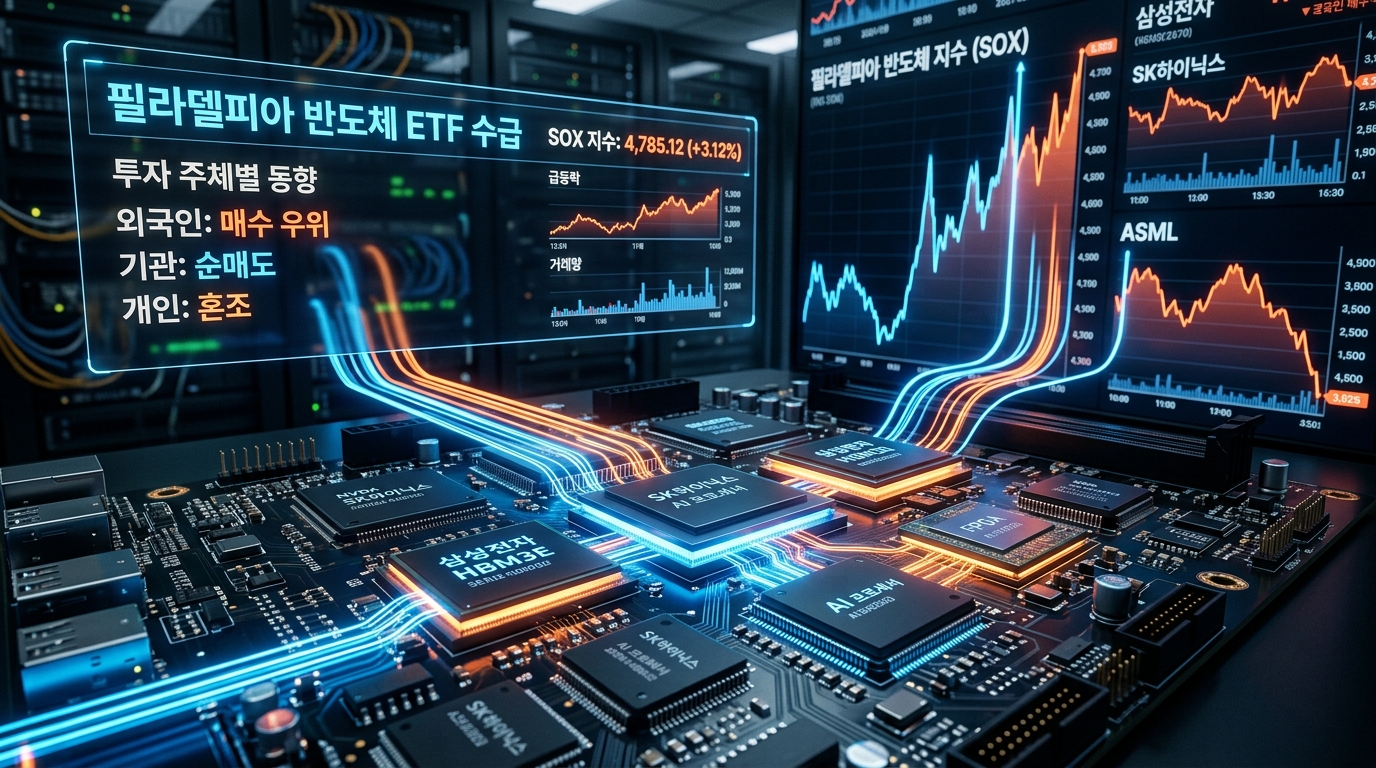
At the center of this storm of buying is the fleet of ETFs tracking the Philadelphia Semiconductor Index (SOX), the representative semiconductor index of the United States.
[Image: /stdaily/uploads/202606/gen_6a31e3dd3af698.89447344.png]
Financial Analysis
Recent fund flows and asset characteristics of major ETFs that use the Philadelphia Semiconductor Index (SOX) as an underlying asset or are closely linked to it are as follows:
| Product Name (Ticker) | Leverage Multiple | Net Purchase Volume in the Past Week (6/8~6/12) | Recent Share Price Volatility & Key Notes | Assets Under Management & Structure |
|---|---|---|---|---|
| **Direxion Daily Semiconductor Bull 3X (SOXL)** | 3x Bull | +$1,757.43 million (approx. KRW 2.67T) | Plunged 35.6% in early June, then rebounded 29.9% over two days on 6/11-12 | Daily rebalancing structure; risk of long-term compound interest erosion exists in sideways markets |
| **iShares Semiconductor ETF (SOXX)** | 1x Bull | -$91.67 million (turned to net selling) | Fell 8.8% in early June as profit-taking orders emerged upon reaching perceived peaks | AUM of approx. $38.4 billion; adopts a weighted cap method for top 30 holdings |
| **Direxion Daily MU Bull 2X (MUU)** | 2x Micron | +$52.42 million (ranked 4th in net buying) | Continued leverage demand targeting individual market leaders amid memory super-cycle rally | Specialized leverage flows aiming at individual memory semiconductor strength |
During the recent decline in stock prices, while outflows from 1x passive funds like SOXX were observed as investors aimed to hedge against further downside, funds for SOXL, which are predominantly driven by retail investors, bet heavily on a rebound scenario following the short-term over-adjustment.
Valuation
The justification for the valuation of semiconductor ETFs goes beyond the price-to-earnings ratios (PER) of individual companies and is closely linked to the capacity of big tech hyperscalers to execute AI capital expenditures (CAPEX).
In fact, the combined AI infrastructure investment scale of major hyperscalers such as Microsoft, Google, Amazon, and Meta in 2026 is estimated to reach between $600 billion and up to $720 billion.
As this massive liquidity flows directly into the revenue and operating profits of the index component companies, it serves as the fundamental strength supporting their valuations.
However, they recently experienced temporary multiple adjustments due to concerns over profitability burdens and financing at some hyperscalers.
Particularly in the case of leveraged ETFs, since their value is determined not only by the direction of stock price movements but also by the amplitude of volatility itself, it is time to constantly monitor the discrepancy rates.
Expert and Institutional Analysis
Global and domestic investment institutions are providing cautious yet positive evaluations regarding the recent concentration of funds into semiconductor ETFs.
According to research teams at firms like Mirae Asset Securities, the majority opinion is that long-term earnings upgrades across the semiconductor sector remain solid due to the ongoing diversification of infrastructure such as High Bandwidth Memory (HBM) and high-speed networking chips.
However, some analyses suggest that in the short term, the risk of liquidity dispersion due to the listing of new large-scale themes must be considered.
Indeed, Elon Musk's space enterprise, SpaceX, which made its debut on the Nasdaq on June 12, attracted an unprecedented KRW 1.2 trillion in buy orders from domestic investors on its first day of trading alone, resulting in the absorption of tech liquidity that previously remained in the semiconductor sector.
Some overseas analytical institutions continue to warn that excessive leveraged fund inflows could abnormally increase short-term volatility amid lingering concerns over the Fed's hawkish stance on interest rates.
[Image: /stdaily/uploads/202606/gen_6a31e3e69ad131.33314350.png]
Risk Factors
- **Negative Compounding Effect (Volatility Decay)**: 3x leveraged ETFs like SOXL inherently carry decay risks where cumulative returns can be rapidly eroded during the daily rebalancing process if the underlying index fluctuates sideways without a clear direction.
- **Limits on Customers' Financial Capacity**: Because the free cash flows of hyperscalers supporting semiconductor sales are not unlimited, if future guidance on slowing down CAPEX is announced, the entire chip supply chain could take a hit.
- **Liquidity Absorption by Massive New IPOs**: Following the successful listing of SpaceX, successive listings of next-generation AI leaders such as OpenAI and Anthropic are anticipated, which could prompt a reorganization of passive capital previously concentrated in semiconductor ETFs.
Investment Outlook Summary
Current flows into the Philadelphia Semiconductor ETF represent a classic watershed phase, where aggressive dip-buying by retail investors clashes tightly with profit-taking through rebalancing by passive funds.
While there is no doubt about the long-term growth potential of the AI ecosystem itself, changes in the Fed's interest rate outlook and the liquidity-absorbing nature of mega-themed stocks are lowering the predictability of capital flows.
Therefore, rather than blindly holding 3x leveraged products for the long term, a conditional scenario strategy—approaching through installment buying while verifying macro stability and actual earnings realization of core companies—appears more advisable.
Investor Checklist Q&A
Q1. What is the primary reason domestic investors net purchased SOXL at a record-high scale recently?
A1. During the US market correction in early June, valuation concerns and profit-taking led to a drop of over 35% in SOXL. Retail investors perceived this as a strong rebound opportunity and flooded in to buy the dip.
Q2. While inflows into SOXL surged, why did SOXX record net selling?
A2. Investors in SOXX (predominantly institutions and long-term investors), which is a 1x passive product, sought to manage risk or lock in existing profits during the correction. In contrast, risk-tolerant retail investors aimed to maximize short-term technical rebounds using 3x leverage.
Q3. What is behind the Philadelphia Semiconductor Index's sudden 8% surge in a single day recently?
A3. Although there are concerns about big tech spending burdens, massive AI infrastructure capital expenditures (CAPEX) continue to be executed. The market witnessed a sudden influx of buying as the long-term earnings outlook for semiconductor firms was highlighted once again.
Q4. What structural limitation must leveraged ETF investors keep in mind?
A4. Because leveraged ETFs compound returns daily, in a range-bound sideways market where the index fluctuates up and down, investors can suffer significant principal losses even if the underlying index ends up in the same place due to the "rebalancing decay effect."
Q5. How do thematic IPOs, such as the SpaceX listing, affect semiconductor ETF flows?
A5. As demonstrated by the more than KRW 1.2 trillion in domestic investor funds that concentrated on SpaceX's first day of listing on June 12, market liquidity can disperse from a single semiconductor sector to space and AI software, causing temporary capital outflows and volatility in existing tech stocks.