Hello, this is Daily Stock.
Key Summary
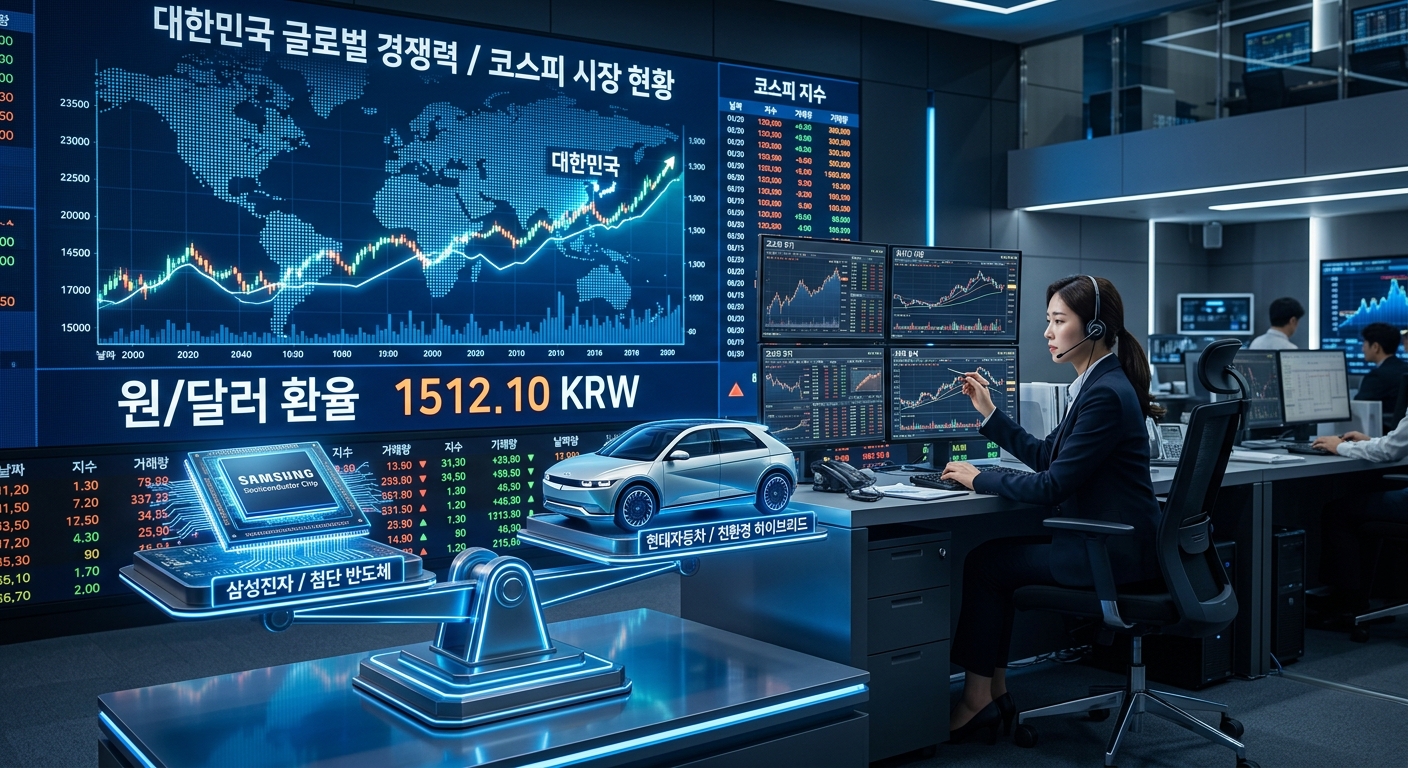
- On June 17, 2026, the USD/KRW exchange rate stabilized to 1,512.10 won, easing volatility in the aftermath of falling oil prices following the U.S.-Iran peace agreement.
- Samsung Electronics (005930) overcame early weakness and closed up 1.02% at 346,500 won, as DS Investment & Securities boldly raised its target price to 530,000 won and projected quarterly real operating profit capacity of 100 trillion won.
- On the other hand, Hyundai Motor (005380) closed down 3.28% at 619,000 won, hit by May's 'triple decline' indicators in exports, domestic sales, and production, concerns over slowing profits due to a falling exchange rate, and dual-union risks.
[Image: /stdaily/uploads/202606/gen_6a324f04befd98.98951815.png]
Current Situation Summary
With the recent news of a peace agreement between the U.S. and Iran easing Middle East war risks, the sharp high exchange rate situation is showing signs of stabilizing.
Today, the KOSPI market, boosted by easing external uncertainties and stable oil prices, surged from the previous trading day to reach an all-time high of 8,864.24 points.
In the Seoul foreign exchange market on this day, the USD/KRW exchange rate closed lower at 1,512.10 won compared to the previous session.
The temporary plunge in the exchange rate reduced foreign investors' concerns about currency losses, acting as a core driver to lead buying focused on large export-driven stocks.
However, amid the strengthening won trend, the direction of domestic large export-driven stocks is highly polarized by sector.
Samsung Electronics fell to 332,000 won in early trading due to the plunge in the Philadelphia Semiconductor Index (-5.71%) in New York overnight, but closed up 1.02% at 346,500 won as massive bargain-hunting rushed in.
On the same day, SK Hynix surged by a whopping 5.12% to settle at 2,504,000 won, opening the '2.5 million Hynix' era for the first time in history.
Conversely, Hyundai Motor closed at 619,000 won, down 3.28% from the previous session, highlighted by poor auto performance indicators in May and unprecedented dual-union risks between primary and subcontracted labor.
Concerns about shrinking book-value FX gains due to the falling exchange rate are also analyzed as one of the scenarios prompting profit-taking.
According to the Fear & Greed Index compiled by Daily Stock, KOSPI's Fear & Greed is currently recording Neutral (53.4), compared to Fear (31.4) a week ago, Neutral (58.9) a month ago, and Fear (36.1) three months ago.
Nasdaq's Fear & Greed currently points to the Fear (39.3) stage, compared to Fear (26.9) a week ago, Greed (63) a month ago, and Neutral (57.4) three months ago.
Financial Analysis
Samsung Electronics is highly likely to achieve an earnings surprise in its second-quarter operating results, driven by high memory semiconductor prices.
According to the financial investment industry, Samsung Electronics' Q2 consolidated revenue is estimated at 174 trillion won and operating profit at 91 trillion won.
Its real capability, excluding employee incentive factors to be paid in the first half, is evaluated to exceed 100 trillion won in quarterly operating profit.
[Image: /stdaily/uploads/202606/gen_6a324f1172c7b9.14181686.png]
On the other hand, Hyundai Motor is targeting annual revenue of around 194 trillion won and operating profit of around 12 trillion won backed by the new car effect in the second half, but weak short-term indicators held it back.
According to the May automobile trends released by the Ministry of Trade, Industry and Energy, domestic automakers' export value fell 5.9% year-on-year to $5.83 billion due to the impact of a fire at a parts supplier.
Due to a reduction in domestic working days and some delivery delays, production fell 8.2% and domestic sales fell 10.3%, recording a 'triple sluggishness.'
The table below summarizes key data of the two representative export stocks based on the closing price on June 17, 2026.
| Item | Samsung Electronics (005930) | Hyundai Motor (005380) |
|---|---|---|
| **Daily Closing Price** | 346,500 KRW | 619,000 KRW |
| **Change from Prev. Day** | +1.02% | -3.28% |
| **Major Institutional Consensus** | Target price raised to 530,000 KRW (DS Investment) | Investment opinion downgraded to 'Hold' (Yuanta Securities) |
| **Core Financial Momentum** | HBM4 integrated platform and visibility of foundry turnaround | US factory operation and defense of high-margin HEV sales ratio |
| **Macro Issues Faced** | Global tech profit-taking pressure | Triple decline in May export value and dual-union risks |
Valuation
Currently, Samsung Electronics is in a rapid rerating phase based on an unprecedented price hike cycle for DRAM and NAND flash.
In particular, the one-stop production capability of the base die based on its own 4-nano process starting from the HBM4 generation is considered a unique premium factor encompassing both foundry and memory.
As a result, the scenario that the valuation ceiling is wide open continues to gain support.
In the case of Hyundai Motor, it has been recognized with a relatively high multiple compared to its competitors, highlighted by expectations for the listing of Boston Dynamics and the value of shifting to a physical AI robot platform.
However, neutral opinions are being raised that short-term valuation overheating has occurred relative to its core auto manufacturing performance.
Furthermore, as the benefit of the high exchange rate enters a stabilization trend, analysis follows that the reduction in FX gains could hinder operating profit margin growth.
Expert & Institutional Analysis
In a report today, DS Investment & Securities dramatically raised its target price to 530,000 won, stating, "The average selling price of DRAM and NAND will rise significantly, driving performance improvement."
Expectations that Samsung Electronics' 2-nano foundry process could be adopted for Google's next-generation AI chip, TPU 10th generation, and the possibility of a foundry turnaround in Q4 were also used as key rationales.
[Image: /stdaily/uploads/202606/gen_6a324f1f0449d5.80323292.png]
Conversely, Yuanta Securities advised a cautious shift in stance regarding Hyundai Motor.
While the long-term vision of robotics value remains valid, the brokerage downgraded its investment opinion from 'Buy' to 'Hold', pointing out that it was reflected too quickly compared to current automobile performance indicators.
However, Heungkuk Securities maintained its Buy rating, contrastingly trusting solid fundamentals given the smooth hybrid mass production mix at the North American new plant in the second half.
Risk Factors
The first variable is the rapid fluctuation of the USD/KRW exchange rate.
As the super-high exchange rate market, which exceeded 1,550 won until last month, rapidly stabilized along with oil prices due to the conclusion of the peace treaty, there is a possibility that the scale of FX gains affecting exporters overall will decline.
Some companies also need to closely monitor foreign exchange loss risks arising from breaking the 'currency hedge trigger' bands executed during high exchange rate periods.
The second is the dual-union risk faced by Hyundai Motor.
With the Ulsan Regional Labor Relations Commission accepting the subcontracted union's request for correction of bargaining demands, the primary union of regular workers is also taking steps toward joint strike procedures, including a strike vote.
If long-term operations are suspended due to difficulties in negotiations, it could cause serious setbacks in the production recovery speed, which is already experiencing bottlenecks.
Lastly, there is the impact of profit-taking in global big tech.
Temporary tech profit-taking sentiment in overseas markets immediately after the end of the Iran war could cause a supply-demand imbalance across domestic large IT stocks through foreign capital outflows.
Investment Perspective Summary
As the USD/KRW exchange rate recovers to the 1,512.10 won level, financial markets are gradually escaping extreme foreign exchange anxiety.
In this situation, beyond simply expecting 'high exchange rate trickle-down effects', the top priority is to discover independent earnings-driven companies armed with high-value-added technological competitiveness.
Quality companies like Samsung Electronics that can expand shareholder returns and secure contracts in a macro-stabilization phase may find it advantageous to utilize short-term corrections as scenarios to increase exposure.
However, for the finished car sector, where several obstacles such as strike concerns and temporary production bottlenecks have materialized in both domestic and export markets, a short-term trend verification seems necessary.
It may be effective to maintain a waiting position for the recovery of support lines while monitoring conservative valuation analysis and foreign capital supply-demand volatility.
Investor Checklist Q&A
Q1. The USD/KRW exchange rate plunged to 1,512.10 won. Will this immediately hit the performance of large export companies?
A1. Although the exchange rate fell from the 1,550 won level last month, it still remains in the 1,510 won range, which is significantly higher than the long-term average, so the direct hit to exporters is not expected to be significant. However, there remains room for short-term earnings releases to be affected by slight reductions in won-converted margins of dollar revenues or valuation volatility in warranty reserves adjusted to high period-end exchange rates.
Q2. What is the decisive background for Samsung Electronics' target price being raised to 530,000 won?
A2. The background behind DS Investment & Securities' bold forecast lies in the continuous rise in DRAM/NAND average selling prices (ASP) and expectations of a turn to profitability due to improved utilization of foundry 4-5nm process orders. In particular, expectations that Samsung Electronics' strength in integrated processes encompassing memory and advanced foundry packaging will be maximized starting from the next-generation HBM4 market played a significant role.
Q3. Is Hyundai Motor's 'triple decline' in May performance a signal of a completely structural recession?
A3. It is difficult to conclude so. The significant decline in May was largely due to disruptions in the supply of engine-related parts caused by an unexpected fire at a parts supplier and a decrease in working days in May. Once supply chain normalization is complete and hybrid (HEV) vehicle sales capabilities recover, it is highly likely to re-develop a scenario for an earnings rebound in the second half.
Q4. What is the practical danger of the 'dual-union risk' surrounding Hyundai Motor?
A4. This incident is complicated because, along with the acceleration of collective bargaining strike procedures by the primary regular workers' union, the subcontracted irregular workers' union has legally gained status as a collective bargaining partner. If the demands of both unions concentrate at the same time, the risk of production line shutdowns due to strikes or prolonged bargaining difficulties could impact supply and demand and act as a short-term stock price discount factor.
Q5. The US Nasdaq is in the Fear stage, but what is the driving force behind KOSPI reaching an all-time high?
A5. This is because the soaring oil prices and strong dollar environment rapidly eased following the news of the dramatic peace agreement between the U.S. and Iran. Since the Korean stock market is extremely sensitive to imported oil prices, foreign net buying, which continued for three consecutive days alongside easing inflation risks, rushed heavily into Korea's flagship tech and large-cap stocks.