Hello. This is Daily Stock, keeping you sharp on the core trends and subtle capital flows of the global financial markets.
[Image: /stdaily/uploads/202606/gen_6a304c23cbb1e0.13550387.png]
Core Summary
In 2026, the Indian stock market (SENSEX) experienced its largest-ever halt in Foreign Portfolio Investor (FPI) inflows and a record outflow of approximately 2.87 trillion rupees.
However, the dramatic announcement of a US-Iran peace agreement and the subsequent plunge in international crude oil prices (below $85) delivered a powerful short-term relief rally to oil-importing India.
In response, the Indian government and the Reserve Bank of India (RBI) have stepped up by implementing regulatory easing (FEMA amendments) to significantly expand capital inflow channels for Persons Resident Outside India (PROI).
Market Summary
As of intraday trading on June 16, 2026 (tentative), global markets are showing mixed performances, with the fundamental decoupling (each regional market charting its own path) among the US, Europe, and Asia becoming more pronounced.
Currently, the KOSPI is at 8,545.98 and the KOSDAQ is at 1,034.03, while the USD/KRW exchange rate remains tense at 1,513.10 won.
The US Nasdaq index stands around 26,487.67. On its Fear & Greed Index, the Nasdaq is recording "Fear (34)," reflecting dampened investor sentiment compared to "Greed (63)" a month ago.
On the other hand, the KOSPI Fear & Greed Index is holding at a "Neutral (52.9)" level, testing its downward support against external volatility.
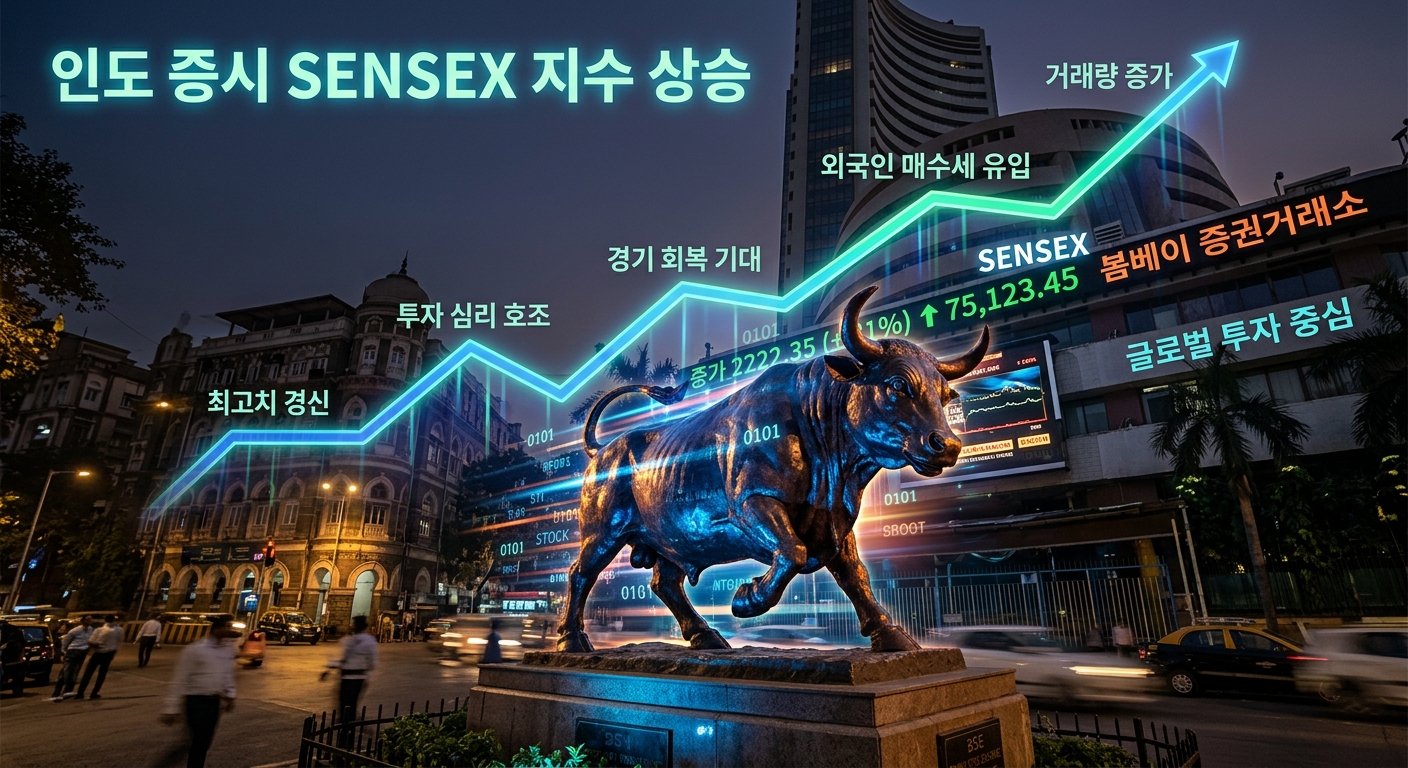
Amid this macro environment, the Indian SENSEX index closed at 76,264.33 on the previous trading day (June 15), surging by 736.38 points (0.97%) and leading the recovery of risk-on sentiment across Asian stock markets.
Financial Analysis
The most significant liquidity-related issue surrounding the Indian stock market in 2026 has been the harsh net-selling streak by Foreign Portfolio Investors (FPIs).
Indeed, the outflow in the first two weeks of June alone reached 628.5 billion rupees, easily surpassing last year's total annual outflow of 1.66 trillion rupees.
| Classification / Month (2026) | FPI Net Buy/Sell (Unit: Rupee) | Key Market Macro Variables |
|---|---|---|
| January | -359.6 billion rupees (Net Sell) | Fed rate path concerns and onset of geopolitical tensions |
| February | +226.1 billion rupees (Net Buy) | Record monthly high inflow in 17 months |
| March | -1.17 trillion rupees (Net Sell) | All-time high outflow driven by global asset rebalancing |
| April | -608.4 billion rupees (Net Sell) | Deepening West Asian crisis and widening FX volatility |
| May | -329.6 billion rupees (Net Sell) | Accumulated current account pressure due to high oil prices |
| June (First half) | -628.5 billion rupees (Net Sell) | Massive selling concentrated in just two weeks |
| **2026 Cumulative** | **-2.87 trillion rupees (Net Sell)** | **Far exceeds the entire 2025 outflow (1.66 trillion)** |
At its Monetary Policy Committee meeting on June 5, the Reserve Bank of India (RBI) kept the benchmark interest rate unchanged at 5.25% and announced "booster shot" regulatory easing measures to prevent capital outflows and defend the value of the rupee.
In particular, the RBI has introduced interest and capital gains tax exemptions on government securities (G-Sec) investments, alongside favorable currency swap measures to encourage foreign currency borrowing by public institutions.
Valuation
Historically, the Indian SENSEX index has commanded a valuation premium compared to other emerging markets (EMs), backed by its robust domestic consumption growth potential.
However, in 2026, as the rupee approached the 95 mark against the US dollar under pressure from high US interest rates and a strong dollar, its relative attractiveness against other emerging currencies adjusted slightly for foreign investors.
Nevertheless, the mid-June spike that pushed the index back above 76,200 is analyzed to be the result of a strong defensive shield of domestic institutional investors (DII) capital.
Amid the US-EU-Asia tri-polar decoupling, the Indian stock market—which completed price corrections earlier than highly valued US tech giants—is opening up the possibility of entering an attractive re-rating phase combined with tax-efficient return improvements.
Expert and Institutional Analysis
Global investment bank (IB) experts agree that the surprise announcement of the US-Iran peace agreement on June 15 has created a highly favorable environment for emerging markets.
US President Donald Trump declared a deal with Iran, easing risks in the Strait of Hormuz—a vital oil transit route. This caused Brent crude and other international oil benchmarks to plunge by over 4%, acting as an immediate boon to Indian equities.
Since India imports more than 80% of its crude oil, falling oil prices serve as the ultimate macro vaccine to curb inflation and narrow its chronic current account deficit.
Furthermore, the Indian government's amendment to the Foreign Exchange Management Act (FEMA) non-debt instrument regulations to raise the single foreign individual investor (PROI) limit in listed companies from 5% to 10%, and the aggregate limit to 24%, is evaluated as a move that will open the floodgates for fresh liquidity.
[Image: /stdaily/uploads/202606/gen_6a304c30114a41.35352093.png]
Risk Factors
The most critical domestic risk to monitor is that India's Wholesale Price Index (WPI) inflation rose sharply to 9.68% in May from the previous month's 8.26%.
While this figure reflects the lagging effects of energy and food prices, sustained high inflation in a consumption-driven economy like India could restrict household purchasing power.
Secondly, the US Federal Open Market Committee (FOMC) meeting scheduled for June 16–17 is key.
If the Fed maintains a more hawkish stance than expected, global liquidity may retreat back into bonds and safe-haven assets, diluting India's efforts to attract additional capital.
Investment Perspective Summary
Under the tri-polar US-EU-Asia decoupling framework, the Indian stock market is demonstrating a unique relative strength—sensitivelty reacting to macro changes while holding its ground on domestic fundamentals.
In the short term, a "conditional recovery scenario" is dominant, where the market tests liquidity recovery through the combined benefits of FX stability from lower oil prices and the government's lowering of investment barriers for foreign direct and indirect capital.
For investors, given the high volatility of macroeconomic variables, a selective approach focused on consumer goods and blue-chip financial holding companies—which are expected to directly benefit from the easing of foreign participation rules—appears more sensible than tracking passive indices.
Investor Checklist Q&A
Q1. Why was foreign capital outflow so severe in the Indian stock market in the first half of 2026?
A1. Concerns grew over India's inflation and current account balance as crude oil prices rose due to prolonged high interest rates by the US Fed and heightened geopolitical risks. Consequently, investors shifted their portfolios heavily into safer assets like US Treasuries.
Q2. What are the key points of the newly introduced foreign investment deregulation (FEMA amendment)?
A2. It establishes a pathway for Persons Resident Outside India (PROI) to invest directly in listed Indian stocks without undergoing complex institutional registration procedures. The individual investment limit was also raised from 5% to 10% to boost capital inflows.
Q3. Why did the US-Iran peace agreement trigger the Indian SENSEX rebound?
A3. Easing Middle East tensions caused international oil prices to plunge below $84–$85 per barrel. For India, an oil importer, this serves as a double positive—controlling inflation and supporting a stronger rupee—positively impacting capital flows.
Q4. Are there concerns about tightening due to the sharp rise in India's Wholesale Price Index (WPI)?
A4. May WPI surged to 9.68%, but this was largely due to a change in the base year (2022-23) and the temporary reflection of accumulated energy costs. A scenario where inflation gradually eases as lower oil prices feed into future data is being projected.
Q5. What is the most critical event to watch for when considering investing in the Indian market going forward?
A5. The outcome of the US Fed's FOMC meeting on June 16–17. Depending on the Fed's policy tone, emerging market liquidity and the USD/INR exchange rate could experience temporary volatility, making close monitoring essential.