Hello. This is the Financial Analysis Team at Daily Stock.
[Image: /stdaily/uploads/202606/gen_6a2a5d63378340.18378911.png]
Key Summary
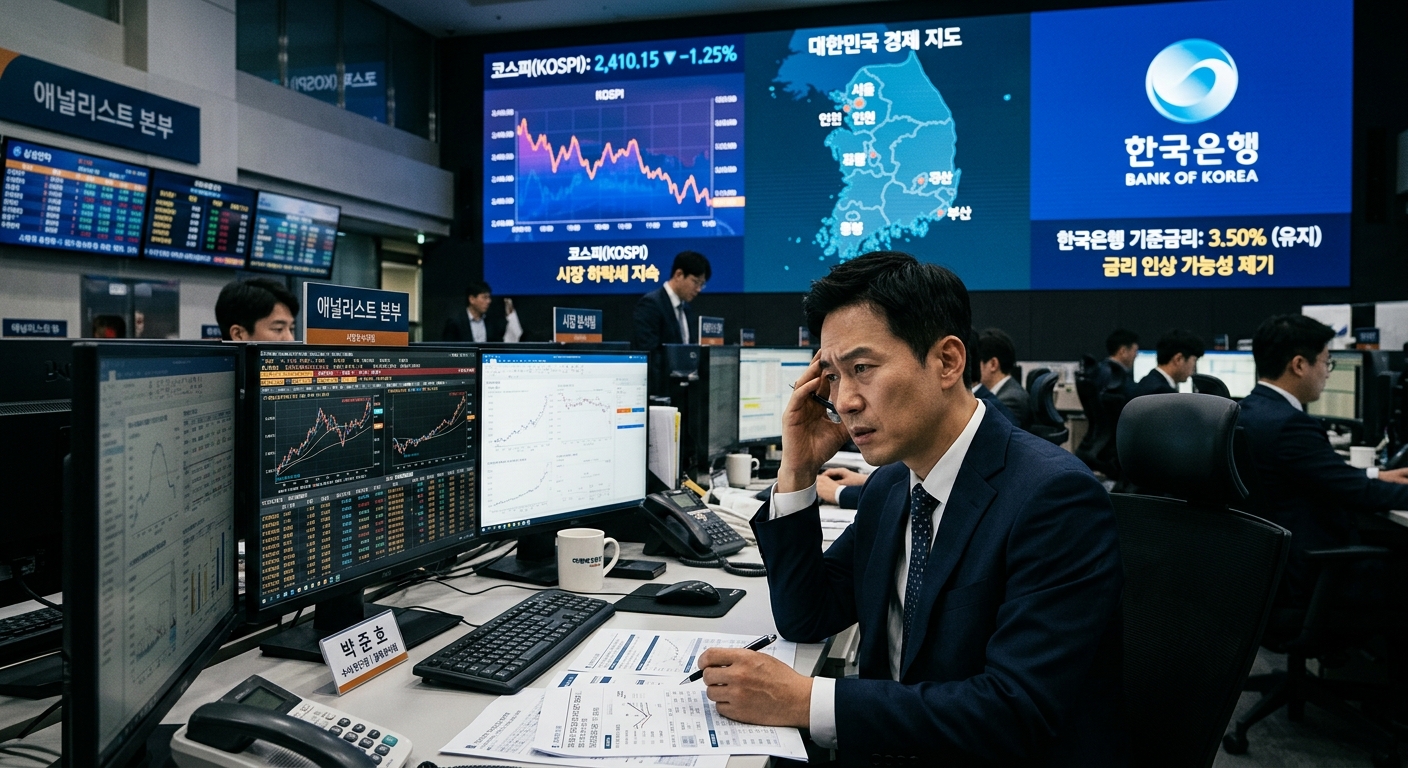
- **Prelude to a Hawkish Freeze**: On May 28, the Bank of Korea (BOK) Monetary Policy Committee (MPC) kept the base interest rate unchanged at 2.50% per annum. However, it sent a strong tightening signal by explicitly including the phrase "determining the timing of interest rate hikes" in its policy statement and recording two dissenting votes calling for an immediate hike to 2.75%.
- **Substantial Upward Revision in Growth and Inflation Forecasts**: The BOK significantly raised South Korea's real GDP growth forecast for 2026 from 2.0% to 2.6%, and its consumer price inflation forecast from 2.2% to 2.7%. This officially acknowledges growth upside driven by the semiconductor boom and inflationary pressures stemming from the prolonged war in the Middle East.
- **Awaiting the Release of the Minutes on June 16**: With the detailed rationale for enhanced tightening set to be revealed in the May MPC minutes on June 16, the bond market has begun pricing in a scenario where the terminal rate reaches 3.50% after two hikes (totaling 100bp) within the year.
- **Souring Won and Tightening KOSPI Liquidity**: Amid a super-dollar trend that pushed the USD/KRW exchange rate up to 1,532.70 won, the KOSPI index faced foreign selling pressure in both spot and futures markets, slipping to the 7,763.95 level as it navigates a monetary policy inflection point in the second half of 2026.
Current Situation Summary
Although the May MPC meeting—the first rate decision since the inauguration of BOK Governor Shin Hyun-song—resulted in the eighth consecutive freeze at 2.50%, the underlying tone was a shocking "hawkish pivot."
Expectations for rate cuts, which had previously dominated the market, have effectively vanished. Instead, warning lights have turned on, signaling that the base rate could rise within the year.
In particular, during this meeting, members Chang Yong-sung and Ryoo Sang-dai expressed dissenting opinions advocating for an immediate hike to 2.75%, maximizing market tension.
The "dot plot after six months," which the BOK uses as forward guidance for future monetary policy, also showed dots concentrated on two additional hikes to 3.00%, foreshadowing a stronger-than-expected tightening cycle.
As of the close on June 11, 2026, the KOSPI index ended at 7,763.95, with selling pressure intensifying compared to the previous trading day.
With the USD/KRW exchange rate surging to 1,532.70 won, net selling by foreign investors targeting large-cap KOSPI stocks due to concerns over foreign exchange translation losses has become the main factor testing the 7,760 support line.
According to Daily Stock's proprietary Fear & Greed Index, the KOSPI Fear & Greed Index is currently in the "Fear (32.2)" stage. This represents a severe deterioration in investor sentiment compared to "Neutral (56.6)" one week ago and "Greedy (64.6)" one month ago.
With the US Nasdaq index fluctuating around 25,169.50 and the Nasdaq Fear & Greed Index also entering the "Fear (27.6)" stage, global concerns over prolonged high interest rates are driving liquidity out of emerging market stock markets.
[Image: /stdaily/uploads/202606/gen_6a2a5d706ae529.20465871.png]
Financial Analysis
The BOK's revised economic outlook for May 2026 and its dot plot analysis indicate that the macro-financial environment going forward will not be favorable for businesses.
While an exceptional super-cycle in the semiconductor sector is driving overall growth figures, domestic-focused companies are highly likely to face heavier cost burdens as long as high exchange rates and high oil prices persist.
| Key Economic and Monetary Policy Indicators | Previous Forecast (Feb 2026) | Revised Forecast (May 2026) | Change / Market Consensus |
|---|---|---|---|
| **2026 Real GDP Growth Rate** | 2.0% | 2.6% | +0.6%p (Upward Revision) |
| **2026 Consumer Price Inflation (CPI)** | 2.2% | 2.7% | +0.5%p (Upward Revision) |
| **Current Base Interest Rate** | 2.50% | 2.50% | 8th consecutive freeze |
| **Appropriate Rate in 6 Months (Dot Plot)** | - | Concentrated at 3.00% | Chosen by 10 out of 21 total dots |
| **Terminal Rate Forecast for Year-End (Market)** | Below 2.50% | 3.00% ~ 3.50% | Two hikes in H2 highly likely |
The most painful aspect of these shifting indicators is the upward revision of the inflation forecast.
As the consumer price index (CPI) was revised up to 2.7%, significantly diverging from the BOK's target of 2.0%, the monetary authority faces a tighter financial environment with few choices other than tightening to stabilize prices.
Reflecting the hawkish stance of the MPC in real-time, the 3-year Korean Treasury Bond (KTB) yield surged vertically to the mid-3.7% level.
Consequently, the average borrowing cost for KOSPI-listed companies is also under upward pressure, raising red flags over the financial soundness of marginal firms and construction companies with high debt ratios.
Valuation
The BOK's guideline suggesting a "base rate hike" is acting as a multiple-derating factor for KOSPI valuations.
When risk-free Treasury yields rise, the required rate of return in the stock market increases accordingly. As a result, the fair valuation multiples (PER) for large-cap KOSPI stocks are inevitably discounted.
The 12-month forward PER of KOSPI 200 large-caps is facing downward pressure, dropping from its historical average of 10.5x to around 9.2x.
In particular, large blue-chip companies such as Samsung Electronics and Hyundai Motor, which are highly sensitive to foreign capital flows, face limits in expanding their valuation multiples despite improved export performance due to liquidity contraction and the exchange rate breaking past 1,530 won.
Meanwhile, the mid-to-small cap index showed sharper declines compared to large-caps, reflecting concerns over weak domestic demand amid sustained high interest rates.
While export-oriented large-caps are defending their earnings thanks to the "semiconductor super-cycle," domestic-focused small-and-mid caps are suffering the double whammy of rising borrowing costs and shrinking consumption, dragging down their relative valuation attractiveness.
Expert & Institutional Analysis
Major domestic financial institutions have unanimously updated their forecasts, projecting that the BOK will raise the base rate by 25 basis points each in the third and fourth quarters of this year, bringing the year-end rate to at least 3.00%.
Institutions that previously anticipated a "rate cut within the year" have abruptly shifted to a "hawkish hike" outlook.
In a recent report, Woori Finance Research Institute observed, "Reflecting the revised growth and inflation outlooks alongside the MPC's hike signals, two rate hikes (2.50% → 3.00%) will be implemented in the second half of this year. Additional hikes in the first half of next year could bring the terminal rate to 3.50%." This is deemed inevitable to preemptively combat import price pass-through and the surging USD/KRW exchange rate.
Some securities firms believe that the resoluteness of the hawkish remarks in the May MPC minutes, scheduled for release on June 16, will be a watershed moment determining the direction of KTB yields in the second half.
If arguments for an "exchange-rate-defensive rate hike" targeting foreign exchange stability are strongly voiced within the minutes, forex volatility may temporarily ease, but stock market liquidity risks further contraction.
[Image: /stdaily/uploads/202606/gen_6a2a5d7b2621a1.74752187.png]
Risk Factors
- **USD/KRW Exchange Rate Stuck in the 1,530s**: Coupled with expectations that the Fed will keep rates high (with a hawkish pause scenario maintaining a 3.75% upper bound), if the USD/KRW rate fails to descend from the 1,532.70 won level, secondary inflation from rising import prices could force the BOK to hike rates faster than the market expects.
- **Delinquencies in Household and Self-Employed Loans**: If the base rate reaches a terminal level of 3.50%, commercial mortgage and credit loan rates could approach 7% to 8%. This potential increase in financial system risks, centered on vulnerable borrowers, could compromise the soundness of the KOSPI financial sector.
- **Liquidity Void from Foreign Outflows**: If the inverted US-Korea interest rate differential widens further or high exchange rates persist, foreign investors may continuously dump KOSPI 200 futures and spot stocks to avoid currency translation losses, distorting supply and demand and capping the index.
Investment Perspective Summary
The BOK's hawkish shift toward monetary tightening is highly likely to act as a structural hurdle, capping any aggressive V-shaped recovery of the KOSPI index for the time being.
However, a highly selective market environment driven by individual sector earnings momentum is expected to intensify.
Rather than reacting with panic to interest rate fears, investors may find it more advantageous to focus on companies with pricing power in a high-rate, high-exchange-rate environment or export stocks that maintain a monopolistic position in global supply chains, such as semiconductors.
Conversely, a conservative approach is recommended for high-debt, domestic-demand-sensitive sectors, closely monitoring the rate hike path indicated in the BOK minutes on June 16.
Investor Checklist Q&A
Q1. The BOK froze the base rate in May. Why is the market interpreting it as hawkish?
A1. Although the base rate itself was maintained at 2.50%, two out of seven MPC members voiced dissenting opinions calling for a rate hike. Furthermore, tightening language regarding "measuring the timing of base rate hikes" was introduced for the first time in the monetary policy statement.
Q2. What is the main reason behind the BOK sharply raising its economic growth forecast to 2.6%?
A2. Despite sluggish domestic facility investment and a weak construction sector, semiconductor exports—bolstered by surging AI demand—continue to show record-breaking strength that far exceeds initial expectations.
Q3. What should investors focus on in the MPC minutes to be released on June 16?
A3. Investors should check how many of the five members who voted to freeze rates also raised the necessity of future hikes, and assess the strength of arguments supporting rate hikes as a tool to counter the rising USD/KRW rate and import price pass-through.
Q4. Which KOSPI sectors are relatively defensive in a prolonged high-interest-rate and high-exchange-rate environment?
A4. Large-cap IT and export stocks like semiconductors and automobiles, which carry out transactions in USD and benefit from margin improvements when the exchange rate rises, are expected to remain robust. Large-cap financial stocks that can defend their net interest margins (NIM) during rate hike cycles may also show resilience.
Q5. How high is the BOK's terminal base rate expected to go?
A5. Bond market experts and major financial research institutions currently project two rate hikes in the second half of this year to reach 3.00% by year-end. Depending on inflation trends, they are leaving open the scenario of a steep hike cycle reaching a terminal rate of 3.50% in the first half of next year.