Welcome to Daily Stock, where we provide precise analysis of the global macroeconomy and core metrics of big tech companies.
[Image: /stdaily/uploads/202606/gen_6a28a96eec7bd6.28095443.png]
Summary
Nvidia reported revenue of $81.6 billion for the first quarter of fiscal year 2027 (February–April), significantly beating market expectations.
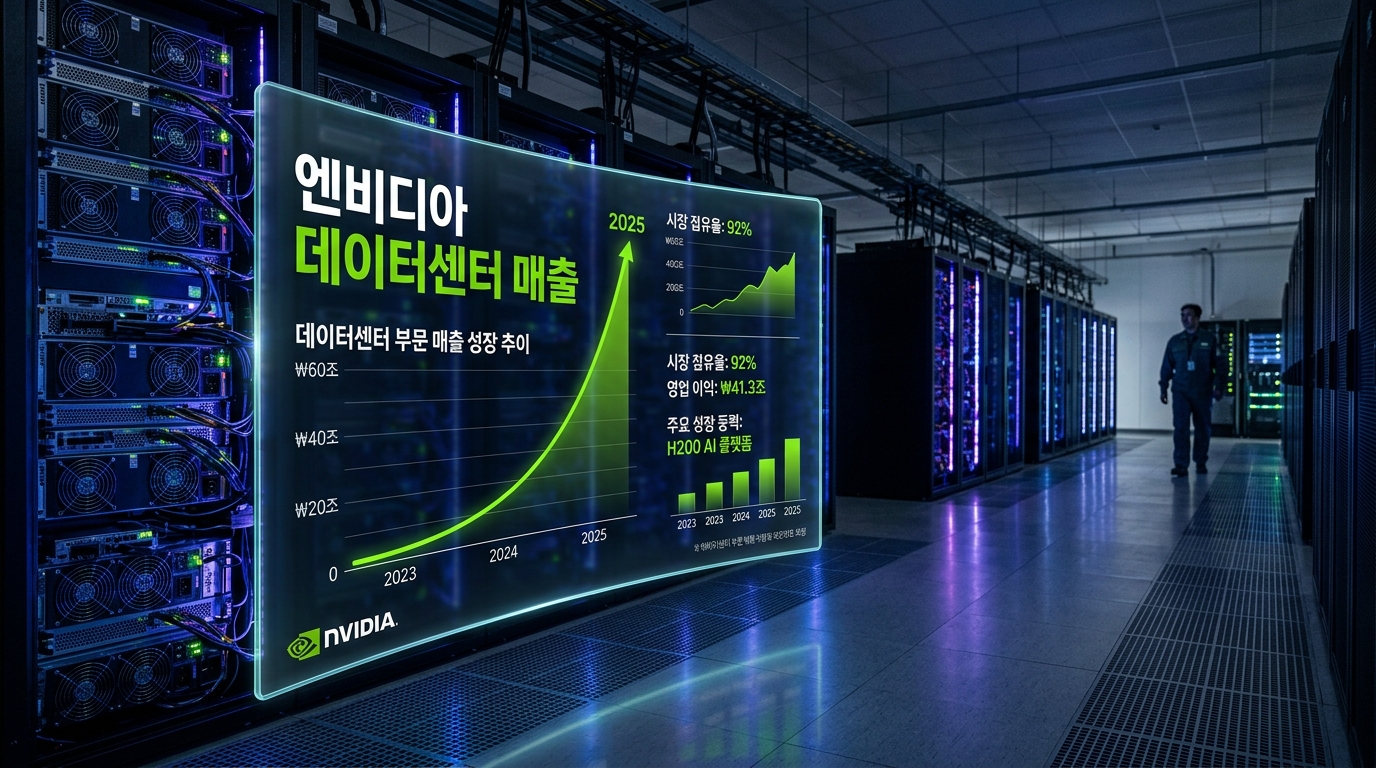
Its core growth engine, the Data Center division, drove overall performance with sales surging 92% year-over-year to $75.2 billion.
Alongside this, Nvidia solidified its roadmap for the next-generation AI accelerator 'Vera Rubin' platform and 'Vera CPU,' declaring entry into a new $200 billion total addressable market (TAM).
However, the stock has experienced minor consolidations following the guidance release, showing that the bar set by the market has become incredibly high.
Current Market Context
As of intraday June 10, 2026 (tentative), global macroeconomic indicators continue to pressure tech multiples amid treasury yield volatility and a strong US dollar.
Today in the Korean market, the KOSPI is trading at 7890.49, while the KOSDAQ stands at 956.24.
Meanwhile, the Nasdaq is at 25678.82, and the USD/KRW exchange rate is hovering at 1526.00, reflecting intensifying upward pressure on the dollar.
Alongside recognizing full-scale revenue from its next-generation Blackwell chips, Nvidia has entirely restructured its Data Center reporting framework into 'Hyperscalers' and 'ACIE' (AI Cloud, Industry, & Enterprise).
This structural shift serves as a key yardstick to measure Nvidia's ability to diversify revenue beyond its heavy reliance on the big three cloud hyperscalers.
Currently, sentiment in the Nasdaq market remains somewhat subdued, and Nvidia is also facing short-term profit-taking pressure despite posting record-breaking earnings.
For reference, the Fear & Greed Index compiled by Daily Stock for each asset market is as follows:
| Market | Current | 1 Week Ago | 1 Month Ago | 3 Months Ago |
|---|---|---|---|---|
| **KOSPI Fear & Greed** | Neutral (48.8) | Neutral (59.1) | Greed (67.7) | Fear (30.9) |
| **Nasdaq Fear & Greed** | Fear (33.4) | Neutral (56.1) | Greed (67.3) | Greed (63.4) |
As the Nasdaq index enters "Fear" territory (33.4), calls for risk management in high-multiple growth stocks are growing louder.
Financial Analysis
Nvidia's Q1 financial statement demonstrates some of the most dominant profitability in the history of hardware infrastructure companies.
Its Non-GAAP gross margin stood solid at 75.0%, proving the company's industry-leading pricing power.
Below is a summary table of recent quarterly earnings and upcoming guidance:
| Item (in USD Billions) | Q1 FY27 (Actual) | Q2 FY27 (Guidance) | YoY Growth Rate |
|---|---|---|---|
| **Total Revenue** | 816.0 | 910.0 (±2%) | +85% (Based on Q1) |
| **Data Center Revenue** | 752.5 | N/A | +92% (Based on Q1) |
| **Edge Computing Revenue** | 64.0 | N/A | +29% (Based on Q1) |
| **Non-GAAP Operating Income** | 537.8 | - | +147% (Based on Q1) |
| **Non-GAAP Gross Margin** | 75.0% | 75.0% (±50bps) | +14.2%p (Based on Q1) |
Quarterly Free Cash Flow (FCF) reached $48.5 billion, demonstrating its formidable cash-generating capabilities.
Backed by this cash flow, the company authorized a new $80 billion share buyback program and raised its quarterly dividend to $0.25 per share.
[Image: /stdaily/uploads/202606/gen_6a28a97b0e1904.12681047.png]
Valuation
Despite the overwhelming earnings growth, Nvidia's Forward P/E ratio is converging around 26 to 30 times.
This indicates that its valuation attractiveness has improved compared to the overvaluation debate during past rallies when the multiple exceeded 50 times.
However, a crucial variable will be potential margin dilution during the transition period—moving to mass production of Blackwell in late 2026 and eventually transitioning to Vera Rubin in 2027.
Concerns persist that if initial yield rates for the next-generation platform encounter bottlenecks, the current gross margin target of 75% could face downward adjustments.
At current levels, the market appears more sensitive to the sustainability of revenue acceleration rather than simple earnings beats.
Analyst and Institutional Analysis
Wall Street analysts have expressed positive feedback regarding Nvidia's new reporting segments (Hyperscalers vs. ACIE).
The fact that the ACIE segment (which includes Sovereign AI and enterprise) recorded $37.4 billion out of total data center sales implies a healthier, reduced reliance on hyperscalers.
Some global investment banks forecast that once the 'Vera CPU'—which targets Agentic AI and robotics—grows visible, it could add billions of dollars in standalone CPU revenue.
Conversely, other analysts warn of potential revenue hits due to regulatory risks in Asian regions, particularly China.
Consequently, institutional investors are closely tracking actual infrastructure build-out metrics to confirm further upward momentum.
Risks
The most immediate risk is export control constraints resulting from intensifying US-China trade tensions.
Nvidia stated that it explicitly excluded China-focused data center computing revenue when formulating its Q2 guidance.
Secondly, big tech companies are increasingly adopting custom-built AI chips (ASICs).
If the adoption rate of in-house accelerators like Google's TPU or Meta's MTIA rises, Nvidia's near-monopoly market share could face partial erosion.
Lastly, as a global macroeconomic variable, rising US 10-year treasury yields pose a liquidity risk that could pressure tech sector multiples.
Investment Outlook
In conclusion, Nvidia's data center guidance suggests that the AI ecosystem remains in a powerful expansionary phase.
However, the muted market reaction despite record performance suggests that investors are beginning to factor in potential 'AI CAPEX peak-out' scenarios over the next 1–2 years.
The successful transition to the 'Vera Rubin' product roadmap and the pace of AI adoption in non-Big Tech sectors will be the main keys to future multiple re-rating.
Rather than being swayed by short-term volatility, a prudent strategy would be to monitor big tech capital expenditure guidance in tandem with Nvidia's quarterly margin defense capabilities.
Investor Checklist Q&A
Q1. What was the most surprising metric in this quarter's earnings report?
A1. It was the total revenue of $81.6 billion and the Non-GAAP gross margin of 75.0%.
In particular, the rapid growth of Data Center revenue to $75.2 billion, accounting for 92% of overall sales, was highly impressive.
Q2. Why is the stock price consolidating despite record-breaking results?
A2. Much of the optimism was already priced in ahead of the earnings release.
Additionally, there was some psychological resistance as the Q2 revenue guidance of $91 billion fell short of some of the market's most bullish, ultra-optimistic forecasts.
Q3. What is the significance of 'Vera Rubin' and the new CPU?
A3. Vera Rubin, the next-generation platform, signals a massive global infrastructure transition beginning late 2026.
Specifically, the 'Vera CPU' is a specialized processor built for the Agentic AI era, expected to unlock an additional $200 billion TAM for Nvidia.
Q4. How much of a financial impact are the Chinese market regulations causing?
A4. Due to US export restrictions on China, Nvidia faces direct limitations on shipping chips like the H20.
To proactively offset this risk, the company completely excluded China-focused data center compute revenue from its Q2 guidance.
Q5. Is Nvidia securing new revenue streams outside of hyperscalers?
A5. Yes. Revenue from the newly disclosed ACIE (Sovereign AI, Industrial & Enterprise Cloud) segment reached $37.4 billion, virtually matching hyperscaler revenue ($37.8 billion).
This is a critical shift that addresses concerns about Nvidia relying solely on a small handful of big tech giants.