[Image: /stdaily/uploads/202606/gen_6a2766ff2153f8.50136934.png]
Hello, this is the financial writing team at Daily Stock.
Recently, global financial markets have encountered an unusual phase of volatility due to monetary policy uncertainties and geopolitical tensions lurking beneath seemingly robust macroeconomic indicators.
Key Summary
In early June 2026, a shock in U.S. employment data combined with profit-taking in the semiconductor sector triggered a significant correction in the S&P 500 and Nasdaq.
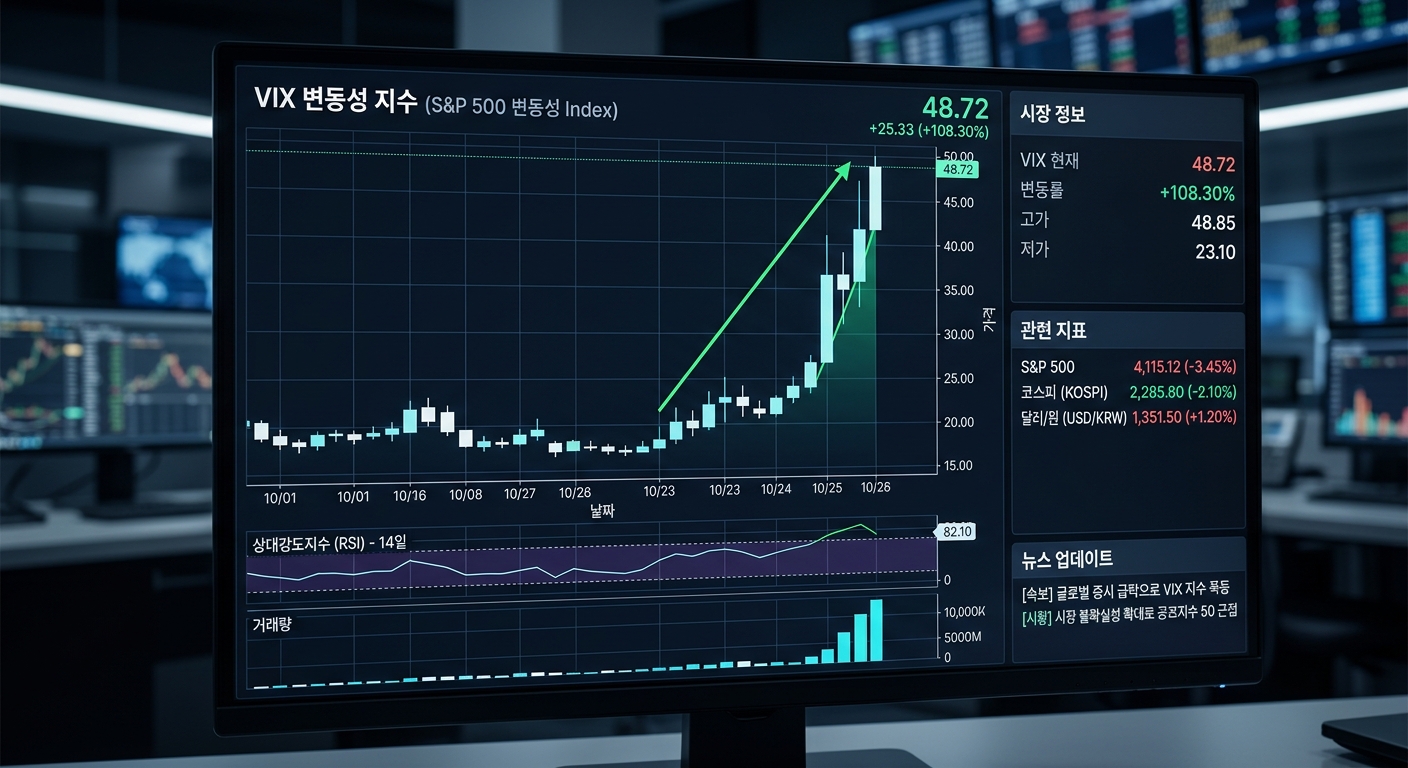
During this process, the CBOE Volatility Index (VIX), often called the market's "fear gauge," skyrocketed by 39.68% in a single day, causing market sentiment to cool rapidly.
Beyond just reflecting negative news, the reason the decline expanded exponentially was the powerful feedback loop of "Short Gamma" hedging by option market makers (dealers).
Ahead of the June FOMC meeting and inflation data releases, investors' demand for downside hedges concentrated on short-term options, driving this volatility spike.
Current Situation Overview
U.S. non-farm payrolls for May were reported at 172,000, significantly exceeding market expectations and dampening hopes for an early rate cut by the Federal Reserve.
Consequently, Treasury yields surged, and the momentum of leading semiconductor and AI stocks weakened, triggering large-scale sell-offs.
Particularly in trading on June 5, 2026, the VIX index jumped from 15.40 points on the previous trading day to 21.51 points, reflecting heightened market anxiety.
Compounded by geopolitical friction in the Middle East over the weekend, a domino effect of volatility has started spreading across global asset markets, including Asia and Europe.
As of intraday on June 9, 2026 (provisional), the KOSPI is trading around 2,710.80, the KOSDAQ is at 969.77, the Nasdaq is at 25,929.66, and the USD/KRW exchange rate is at 1,522.80 KRW.
According to Daily Stock's proprietary Fear & Greed Index, the KOSPI Fear & Greed Index is currently at Fear (31), compared to Neutral (57.4) a week ago, Greed (66.3) a month ago, and Fear (35.9) three months ago.
The Nasdaq Fear & Greed Index is currently at Neutral (40.1), compared to Neutral (56.5) a week ago, Greed (67.3) a month ago, and Greed (61.8) three months ago, indicating a gradual cooling of investor sentiment.
[Image: /stdaily/uploads/202606/gen_6a27670bebcb63.46517098.png]
Financial Analysis
Looking into the supply and demand flows on the CBOE, open interest and daily volume of short-dated (0DTE and weekly) S&P 500 put options exceeded historical averages.
As retail and institutional investors sought large-scale downside protection (buying put options) ahead of macroeconomic events, option dealers, as counter-parties, found themselves in a "Short Gamma" position.
Dealers in a short gamma state are technically compelled to sell underlying futures in large quantities as asset prices fall to keep their portfolios delta-neutral.
This completed a mechanical selling loop: "Falling stock prices -> Dealers selling futures to hedge -> Further price drops -> Spiking volatility (VIX)."
| Indicator | As of June 4, 2026 | As of June 5, 2026 | June 8, 2026 (Latest Checked) | Flow and Supply/Demand Evaluation |
|---|---|---|---|---|
| **CBOE VIX Index** | 15.40 points | 21.51 points | 18.08 points | Stabilized slightly after a 39.68% single-day spike |
| **S&P 500 Index** | - | 7,383.74 points | Slightly weak trading | Under pressure from employment surprise & tech correction |
| **US 10-Year Yield** | - | 4.576% | Settling in mid-4.5% range | Financial tension rises as rate cut expectations recede |
| **Option Market Structure** | Low volatility maintained | Short gamma squeeze occurs | Hedging ahead of next week's CPI | Distinct crowding into short-term put options |
Valuation
As volatility surged, the S&P 500 implied volatility skew steepened sharply, and the cost of downside protection option premiums inflated significantly higher than usual.
If the delayed rate-cut scenario materializes, the justification for the high forward P/E multiples that the equity market has enjoyed will face challenges.
The 20-day realized volatility of the Nasdaq 100 entering an upward trajectory above the 13% level is a factor that pressures growth stock valuations.
In particular, short-term money market tension rose as a temporary backwardation phenomenon was observed, where short-term implied volatility surpassed medium-to-long-term volatility.
Expert & Institutional Analysis
Major global investment banks and derivatives research firms view this plunge as a classic "overshoot of supply-demand mechanisms."
An options strategy report from Saxo Bank pointed out that mechanical position liquidations and rollovers by dealers expanded the downward pressure by at least twofold, rather than a deterioration in fundamentals.
Some hedge fund managers warn that if geopolitical tensions spike commodity prices, equity selling could extend beyond a technical correction into a structural trend reversal.
Conversely, some optimists argue that volatility induced by option flows can normalize quickly (mean-revert) once short-term supply-demand imbalances are resolved.
[Image: /stdaily/uploads/202606/gen_6a2767173cbb29.90118137.png]
Risk Factors
The most critical risk to watch is a scenario where prolonged monetary tightening or additional rate hikes become real possibilities due to sticky inflation concerns.
Additionally, military conflicts in the Middle East over the weekend could spark oil price spikes, triggering another energy-led inflation shock.
Lastly, there is the technically sticky "Short Gamma Zone."
If the index drops below key support levels, there remains a risk that market makers' hedging sell orders could flood the market, dragging indices into sudden undershooting territory.
Investment Perspective Summary
During a volatility spike driven by short gamma dynamics in the options market, it is beneficial to avoid making aggressive directional bets or attempting to time the market.
In a volatility regime where the VIX hovers around 20, rather than entering trades based purely on short-term drops in individual names, building defensive positions centered on value stocks with robust fundamentals and margin resilience is recommended.
Maintaining a dollar-cost averaging approach while monitoring macroeconomic schedules and option expiration flows seems appropriate from a risk management standpoint.
Investors should view volatility not just as a crisis, but as an opportunity to purchase quality assets at reasonable prices, though it remains prudent to confirm that volatility indicators have stabilized first.
Investment Checklist
Q1. Does the stock market always fall when the VIX index spikes?
The VIX index and the S&P 500 show a strong negative correlation, but exceptional cases where both rise together do happen. Generally, a sharp VIX spike is highly correlated with short-term cooling of investment sentiment and index corrections.
Q2. How does the dealers' 'Short Gamma' state end?
If the index rebounds or consolidates, causing implied volatility to drop, dealers' hedging sell pressure gradually dissipates. It also normalizes naturally after put options expire and open interest is cleared.
Q3. Why do 0DTE (zero days-to-expiration) options amplify volatility?
Ultra-short-term options with less than a day to expiration have extremely high Gamma values (the rate of change of Delta). Because of this, even a minor drop in the underlying index requires dealers to execute massive hedge trades, acting as a catalyst that exponentially inflates volatility.
Q4. What is a safe position for retail investors during volatile periods?
The standard approach is to avoid volatility waves by significantly reducing leverage and increasing cash or safe-haven assets like short-term Treasuries. If you choose to maintain stock exposure, concentrating your portfolio on large-cap value stocks with stable dividends and low earnings volatility is advisable.
Q5. Is this VIX spike a signal of an ongoing bear market?
This VIX surge has strong characteristics of a technical overshoot caused by supply-demand friction in the options market. However, the possibility remains that the overall volatility band could shift higher depending on the persistence of high inflation and prolonged geopolitical risks.