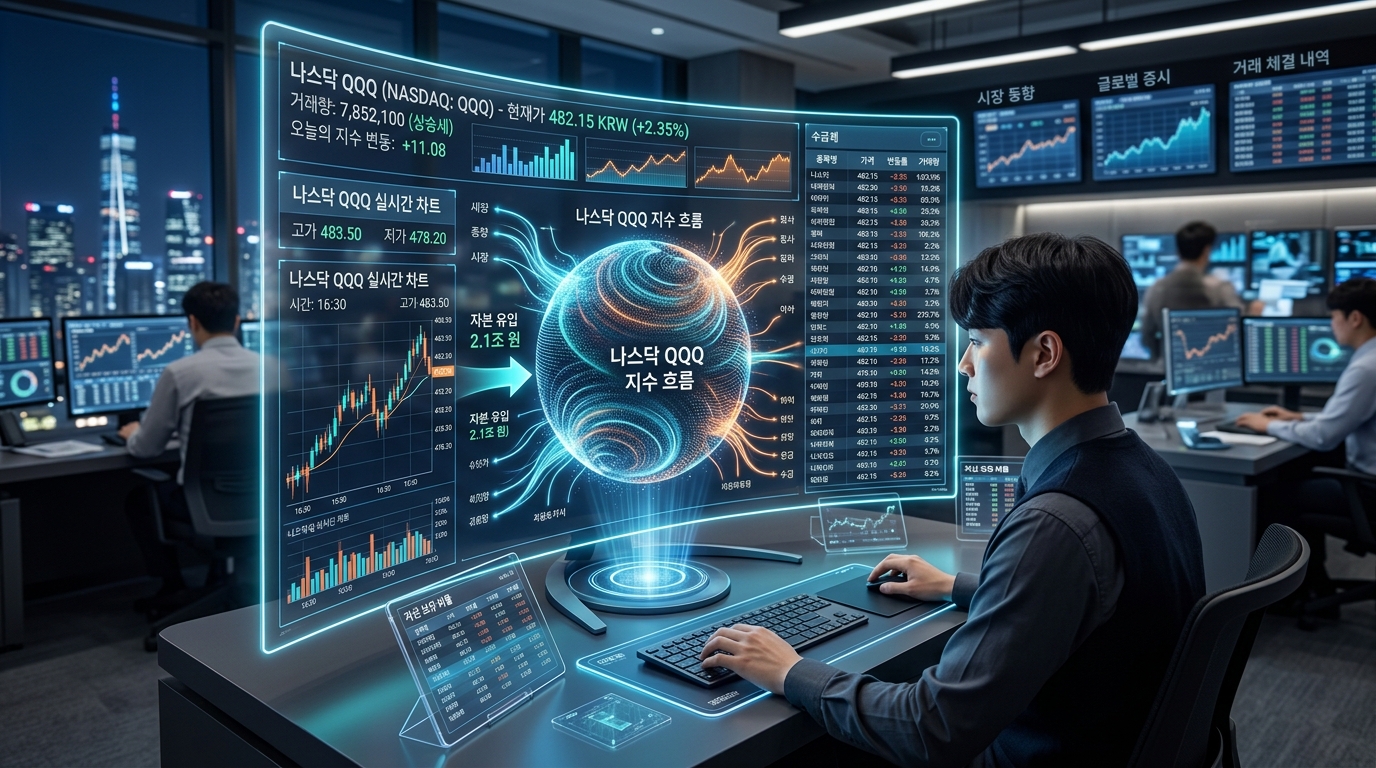
Global financial market volatility has recently expanded significantly.
Global fund flows into Invesco QQQ, a representative technology Exchange Traded Fund (ETF), are once again emerging as a primary point of interest.
Key Summary
- **Dramatic Turnaround in Capital Inflows**: After slowing down in March with a large net outflow of approximately $5.05 billion, QQQ saw massive net inflows of about $9.982 billion in April alone.
- **Tug-of-War with Treasury Yields**: Although the US 10-year Treasury yield (US10Y) recently rebounded to around 4.53%, testing the valuation of growth stocks, smart money in the market is weighing in favor of major AI companies' outstanding earnings-generation power.
- **Intraday Volatility Unfolds**: As of intraday trading on June 8, 2026 (tentative), the Nasdaq-100 Index stood at 25,709.43 points, moving sensitively in tandem with sticky macro data and the US Dollar Index.
Current Status Summary
As of intraday trading on June 8, 2026 (tentative), the Nasdaq Fear and Greed Index, which quantifies investment sentiment in the US tech market, currently stands at 42.1 (Neutral).
This indicates that optimism among market participants has eased somewhat compared to a week ago (Neutral at 59.5) or a month ago (Greed at 67.3).
Meanwhile, the domestic KOSPI Fear and Greed Index currently stands at 51.8 (Neutral), showing a very gradual downward stabilization compared to last week's level of 57.5 (Neutral).
In this way, both Asian and US stock markets have passed the indiscriminate greed phase and are entering a cautious phase to verify macro indicators and Federal Reserve comments first.
Recently, the US 10-year Treasury yield rose to around 4.53%, raising concerns over a prolonged high-interest-rate environment.
Nevertheless, thanks to the strong fundamentals of mega-cap tech stocks, QQQ's Assets Under Management (AUM) surged past $439.7 billion.
With this, it firmly maintains its position as the fifth-largest ETF in the US market.
[Image: /stdaily/uploads/202606/gen_6a2606593c9b45.48225207.png]
Financial Analysis
QQQ's asset allocation and detailed supply-and-demand indicators are a yardstick for determining the direction of market liquidity.
Based on recent disclosures and objective market data, the fund's profile is summarized as follows:
| Indicator | Details & Characteristics | Remarks |
|---|---|---|
| **Underlying Index** | Nasdaq-100 Index | 100 of the largest non-financial market-cap stocks |
| **Assets Under Management (AUM)** | Approx. $439.78 billion (latest disclosure) | Top-tier passive fund in the US |
| **Annual Expense Ratio** | 0.20% | Reasonable fee for a tech sector passive fund |
| **Recent Monthly Net Inflow** | Approx. +$9.982 billion (for April) | Completely recovered March's massive outflow in a single month |
| **Dividend Yield** | Approx. 0.42% (latest calculation) | Growth-oriented model, but pays regular dividends |
Although temporary outflows occurred in March as global geopolitical tensions intensified, massive capital rushed back in early April as concerns eased, such as news of ceasefire agreements.
This indicates that when risks subside, the underlying asset that investors prefer and buy first is the Nasdaq-100 technology stock group.
Valuation
Currently, the average price-to-earnings (P/E) ratio of the Nasdaq-100 index is hovering around 32.4x, continuing to trade at a significant premium compared to historical averages.
This multiple is supported by the enormous cash reserves held by global mega-cap tech giants and their plans for exponentially increasing capital expenditure (CAPEX) every quarter.
However, the US 10-year Treasury yield (US10Y) breaking above 4.5% again places clear pressure on justifying growth stock valuations.
Under current circumstances, if high interest rates continue without capping their upper limit, the discount on future earnings will widen, raising concerns that valuations could adjust downward.
Expert and Institutional Analysis
While leading foreign financial institutions and analysts highly praise the Nasdaq-100's excellent earnings power, they collectively worry about the "concentration phenomenon" in a handful of mega-cap tech stocks.
In a recent report, asset rating agency Morningstar noted that as QQQ's concentration in mega-caps has intensified compared to the past, unexpected variables affecting individual companies could ripple through and shake the entire fund.
However, it remains positive that the companies in the index are still actively investing to secure long-term competitive advantages.
Research and Development (R&D) spending by companies in QQQ averages close to 10.7% of revenue, easily beating the S&P 500 average (8.6%) by a wide margin, representing long-term superiority.
[Image: /stdaily/uploads/202606/gen_6a260665b70515.42969218.png]
Risk Factors
- **Potential Delay in AI Capex Payoffs**: With astronomical capital expenditure (CAPEX) continuing for the long term, short-term valuation corrections in tech stocks remain possible if actual contributions to business profits are not verified soon.
- **Prolonged High Interest Rates**: Due to a strong US labor market, the path for rate cuts has narrowed. If the 10-year Treasury yield settles above the 4.5% range for the long term, growth momentum could be delayed by rising borrowing costs.
- **Supply Chain and Geopolitical Instability**: The concentration of the semiconductor value chain in East Asia and unexpected geopolitical events in the Middle East risk driving up raw material supply costs and damaging the earnings of large tech companies.
Investment Perspective Summary
Robust liquidity inflows into QQQ prove the determination of global investors who believe in long-term growth despite short-term macro fluctuations.
However, with the Treasury yield hovering above 4.5% and sentiment indicators cooling down, a conservative dollar-cost averaging strategy may be more reasonable than entering with a lump sum at once.
In the future, a conditional portfolio response that monitors market fluctuations while considering the remarks of Fed members and actual infrastructure revenue growth will be necessary.
Investor Checklist Q&A
- **Q1. Why did QQQ capital inflows suddenly surge in April after capital flight in March?**
- A1. It was because geopolitical tensions in the Middle East showed signs of easing and quarterly earnings guidance from mega-cap tech companies re-proved their AI competitiveness.
- **Q2. Can growth stock valuations hold up when the Treasury yield exceeds 4.5%?**
- A2. High interest rates are burdensome, but index constituents are armed with high R&D investments amounting to 10.7% of sales, making their earnings defense robust compared to other sectors.
- **Q3. Does the current Nasdaq Fear and Greed Index at 42.1 (Neutral) mean it is a good time to buy?**
- A3. Price pressure has decreased compared to last month (67.3), which was in the greed zone. However, as it is not in extreme fear territory, an installment-based purchase approach seems more effective.
- **Q4. What are the structural advantages and key limitations of investing in QQQ?**
- A4. The advantages include an affordable fee level of 0.20% and convenient tracking of tech innovations. However, the concentrated portfolio of just 100 stocks increases concentration risk.
- **Q5. What potential economic signals could disrupt QQQ supply and demand in the future?**
- A5. The risk of the Fed's potential rate cuts in the second half of the year completely falling apart, or a rise in skepticism that big tech's astronomical AI infrastructure investments are failing to convert into revenue.