[Image: /stdaily/uploads/202606/gen_6a24c2faa499b5.69541793.png]
Hello. This is Daily Stock, delivering reliable investment insights amidst a rapidly changing global macro environment.
Executive Summary
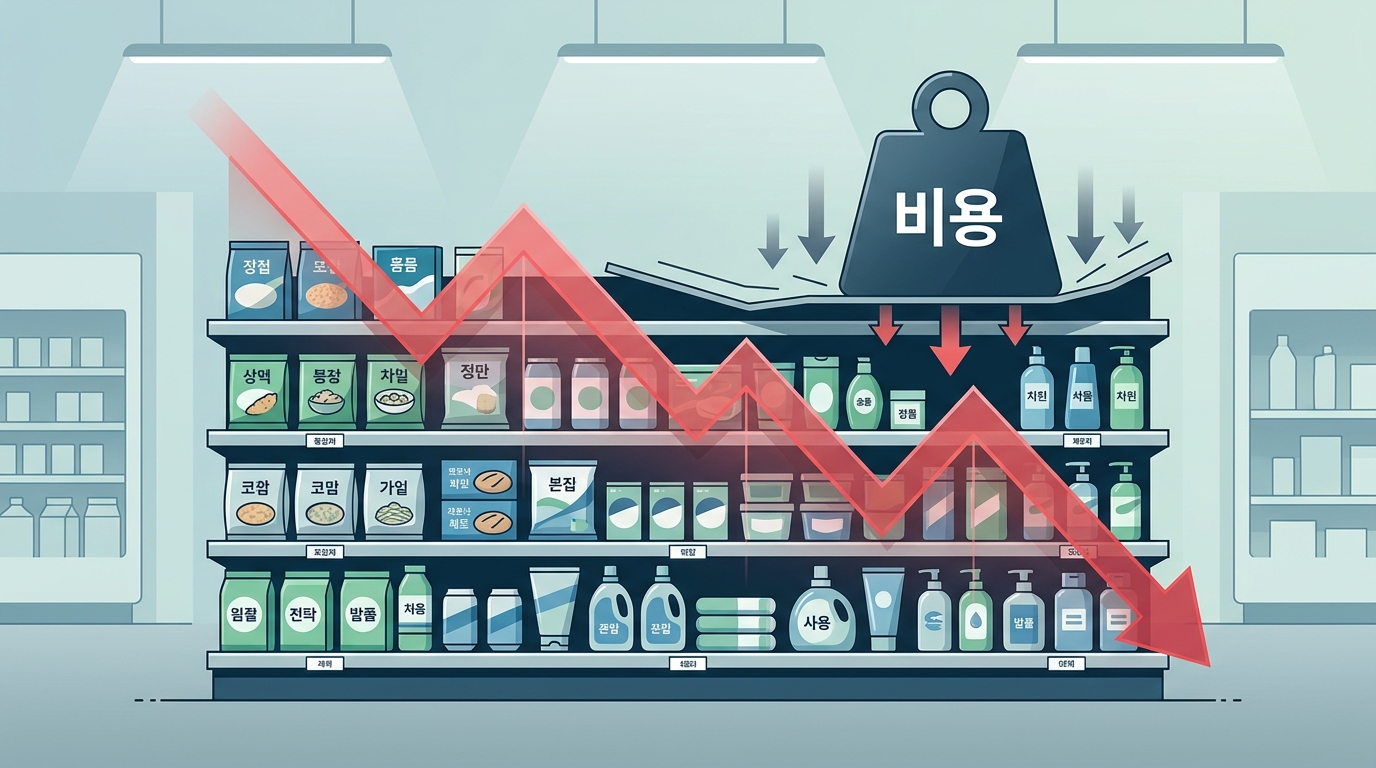
- Global crude oil prices, which have surpassed $100 per barrel due to geopolitical conflicts, are emerging as a major margin pressure factor for S&P 500 consumer staples companies.
- As households' disposable income shrinks, consumers are shifting toward cheaper private label (PB) products, indicating that companies' ability to pass on costs has reached its limit.
- Amid the recent preference for defensive stocks, valuations in the consumer staples sector have become pricier than their historical averages. Consequently, diversifying into alternative defensive sectors with lower exposure to energy costs is being suggested as a viable option.
Market Overview
Recently, the global financial markets encountered a major macro headwind in the form of intensifying geopolitical conflicts and surging oil prices.
In particular, the escalation of tensions in the Middle East and the practical closure of the Strait of Hormuz in late February 2026 pushed Brent crude prices above the $100 per barrel mark.
[Image: /stdaily/uploads/202606/gen_6a24c306e71954.40461354.png]
As a result, the US headline Consumer Price Index (CPI) rose to 3.3% as of March, and the core Personal Consumption Expenditures (PCE) price index also recorded 3.2% in the first quarter, indicating that inflationary pressures are mounting again.
Despite rising inflation, market investment sentiment has remained relatively calm.
As of June 7, 2026, major global and domestic indices stood at 25,709.43 points for the Nasdaq, 8,160.59 points for the Kospi, and 1,002.44 points for the Kosdaq, while the USD/KRW exchange rate closed at 1,559.70 won.
Daily Stock's proprietary Fear & Greed Index (0 to 100), which gauges market sentiment, registered Neutral (42.1) for the Nasdaq.
This is a step down from Neutral (59.5) a week ago and Greed (67.3) a month ago, remaining in a similar range to the Neutral (58) level seen three months ago.
The domestic Kospi Fear & Greed Index was also calculated at Neutral (51.8).
This suggests that Kospi investment sentiment has calmed down compared to Neutral (57.5) a week ago and Greed (66.5) a month ago, but continues to show a stable trend compared to the Fear (32.9) phase three months ago.
Financial Analysis
Although the Consumer Staples sector is traditionally classified as a defensive play that is resilient during downturns, the situation changes entirely when supply-side oil shocks occur.
This is because production costs—including packaging materials, grain, and chemical fertilizers—rise in tandem with oil prices, alongside transport fuel costs.
According to an analysis by Bloomberg Intelligence, if oil prices remain entrenched above $100 per barrel, the gross margins of major consumer staples manufacturers could be eroded by approximately 200 to 500 basis points (bps).
In fact, major packaged food companies such as Conagra Brands have begun to lower their full-year Earnings Per Share (EPS) guidance, proactively reflecting rising cost pressures and supply chain disruptions.
| Key Economic & Sector Indicators | Current Level (As of June 2026) | YoY Change & Characteristics |
|---|---|---|
| **Brent Crude Price** | Surpassed $100/barrel | Surging due to geopolitical crises; main driver of cost pressure |
| **US Headline CPI** | 3.3% (as of March) | Rebound in inflation rate year-over-year, reigniting inflation fears |
| **US Core PCE Price Index** | 3.2% (Q1) | Exceeds Fed's target (2%), supporting prolonged high interest rates |
| **S&P 500 Consumer Staples Index** | 930.22 (Closing on June 5) | Up 7.55% year-to-date, staging a short-term defensive stock rally |
| **XLP ETF Price** | $83.44 (Closing on June 5) | Continued inflow of defensive capital seeking dividend yields |
| **Sector Average Trailing PER** | Approx. 25.3x - 25.8x | Well above the 5-year average of 22.7x, increasing valuation burden |
Valuation
Currently, the S&P 500 Consumer Staples sector is experiencing an abnormal valuation phase.
While EPS forecasts are being revised downward due to concerns over rising costs, stock prices have climbed due to the inflow of defensive rotation capital since the beginning of the year, driving valuation multiples to elevated levels.
Indeed, the average Trailing PER of the consumer staples sector stands between 25.3x and 25.8x, which represents a significant valuation multiple burden when compared to the five-year average of 22.7x.
Under these circumstances, if companies fail to withstand margin pressures and further lower their earnings guidance for the second half of the year, it could lead to multiple compression accompanied by a sharp drop in stock prices. Thus, a highly cautious approach is warranted.
Expert & Institutional Analysis
Strategists at global investment bank J.P. Morgan advise that the historical formula of buying consumer staples unconditionally as an inflation hedge may not work in this cycle.
Instead of consumer staples, which are directly exposed to rising commodity and oil prices, they point to healthcare and utility sectors—which have relatively stronger cost controls and attractive valuations—as safer havens.
Goldman Sachs also noted that rising oil and fuel costs are directly reducing the disposable income of low-and-middle-income households.
Consequently, they expressed concern that consumers are switching in large numbers to cheaper private labels or discount specialty stores instead of big-brand products, which could significantly slow the organic sales growth of brand manufacturers.
Risk Factors
1. Potential for Prolonged High Oil Prices
If Brent crude continues to trade above $100 per barrel through the second half of this year, manufacturers' efforts to improve costs will inevitably hit a limit. This will lead to a sharp deterioration in operating margins and spark earnings shocks.
2. Resistance to Price Increases and Consumption Polarization
Consumers who are already exhausted by prolonged high inflation are strongly resisting further price hikes. If companies raise product prices again to survive, it could trigger a worst-case scenario of demand destruction, where sales volume plunges sharply.
3. Sustained High Interest Rates and Reduced Dividend Attraction
With the rebound in inflation delaying the timing of the Fed's interest rate cuts, treasury yields are soaring. Capital inflows into the consumer staples sector, which relies on the attractiveness of dividend yields, are likely to weaken as long as treasury yields remain high.
Investment Outlook
From a long-term perspective, S&P 500 consumer staples companies are undoubtedly stable dividend partners to prepare for an economic downturn.
However, in the current macro phase where skyrocketing costs and weakening consumer sentiment occur simultaneously, investors should avoid hastily increasing exposure solely based on their "defensive" label.
Now is the time to selectively invest in mega-cap retail platforms or globally diversified brands that demonstrate pricing power and expand their market share even in times of crisis.
Until the next earnings season clearly reveals who successfully defended margins, a wise approach would be to manage risk through a disciplined, split-buying strategy.
FAQ
Q1. Why do rising oil prices directly hit the margins of consumer staples companies?
A1. Oil is directly linked to manufacturing processes, packaging raw materials (plastics), and transport and trucking fuel costs for product delivery, thereby sharply increasing overall production costs.
Q2. Can consumer staples companies handle this by raising prices further?
A2. Due to the recent surge in energy and gasoline prices, the purchasing power of low-and-middle-income households has already been depleted. Aggressive price hikes may cause consumers to defect to cheaper private labels or alternatives, leading to lower sales volume.
Q3. Is the current price level of the S&P 500 Consumer Staples sector appropriate?
A3. Due to recent defensive capital flows, the sector's average PER has surpassed 25x. Since this is higher than historical or five-year averages (22.7x), a significant valuation burden exists.
Q4. Which companies are relatively safe even amidst this crisis?
A4. Large retail channels, such as Costco with its robust subscription membership model and Walmart which is expanding its market share by absorbing low-income consumers, are showing relative strength compared to manufacturers.
Q5. Are there other attractive defensive sectors besides consumer staples?
A5. Major institutions are recommending healthcare and utility sectors as alternative defensive plays, as they face less cost pressure from rising oil prices and carry lower valuation burdens.