Hello, this is Daily Stock. Today, based on the recent earnings of Apple (AAPL), a leading Big Tech company on Nasdaq, we will analyze in depth the change in its services revenue portion—transitioning from a hardware powerhouse into a high-margin services company—and its significance.
Key Summary
In its recently announced fiscal year 2026 second-quarter (January-March) results, Apple recorded an earnings surprise with total revenue of $111.2 billion, beating market expectations.
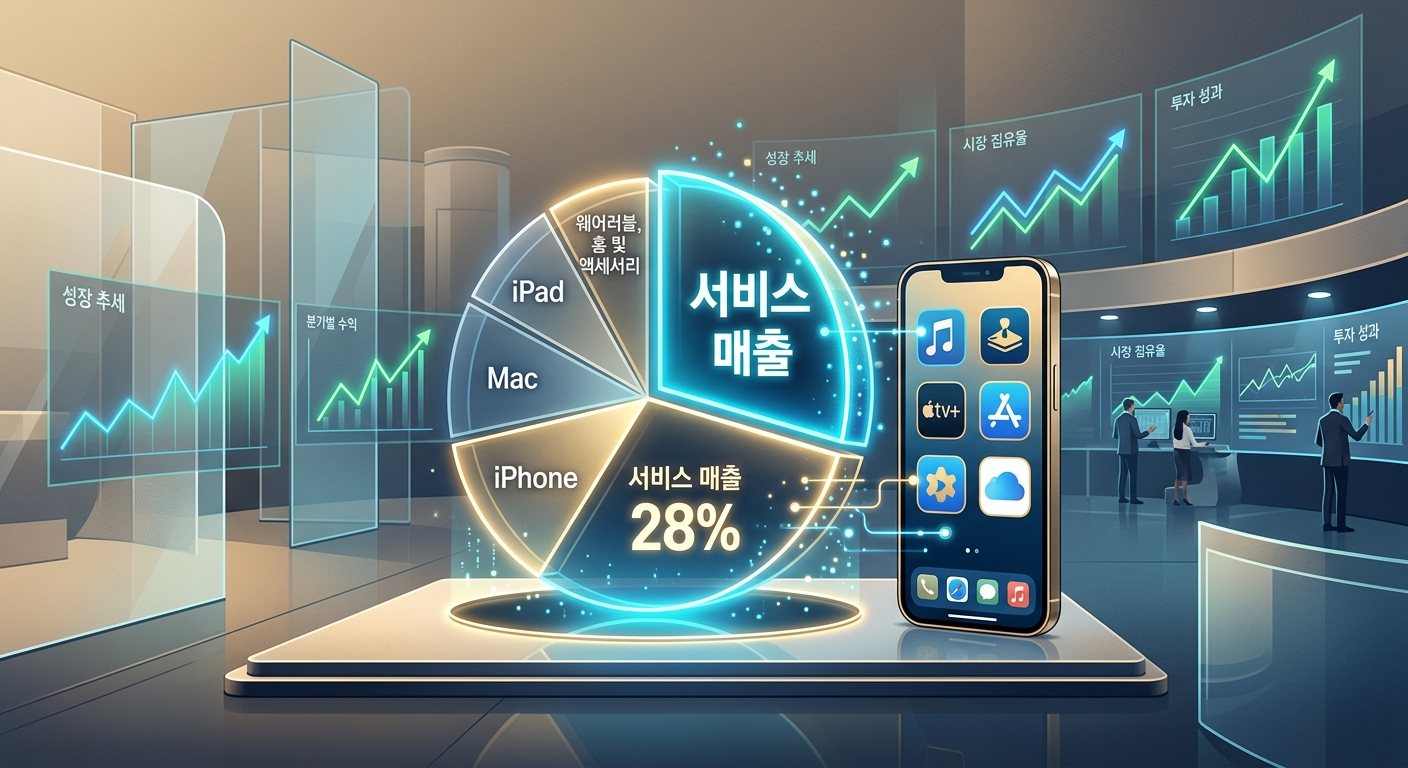
Notably, the high-margin Services division hit an all-time high of $30.98 billion, accounting for approximately 28% of total revenue.
[Image: /stdaily/uploads/202606/gen_6a1f6f24080e14.33872701.png]
This expansion of the services revenue share mitigates the risk of Apple's single-source reliance on iPhone hardware.
Furthermore, backed by an overwhelming gross margin of around 75%, it plays a pivotal role in significantly boosting Apple's overall profitability.
Market Summary
As of intraday on June 3, 2026 (provisional), the Nasdaq Index stands at 27,093.90 points, showing a robust trend centered on tech stocks.
Even in a macroeconomic environment where the US 10-year Treasury yield (US10Y) hovers around 4.45% and the US Dollar Index (DXY) remains somewhat high at 99.18, the fundamentals of major tech companies remain solid.
According to Daily Stock's own Fear and Greed Index, the KOSPI is at 58.3 (Neutral) and the Nasdaq is at 57 (Neutral).
The Nasdaq market is slightly calmer than a week ago (60.9, Greed), but Apple's record-breaking earnings and the announcement of a $100 billion share buyback program are establishing a strong support floor.
Particularly this quarter, Apple is further strengthening its platform lock-in strategy to maximize services revenue per user, leveraging its active installed base of over 2.5 billion devices.
Additionally, the announcement of the leadership succession to incoming CEO John Ternus on September 1, of this year, and Tim Cook's transition to Executive Chairman of the Board is highlighted as another key milestone that will accelerate Apple's services-led growth trajectory.
Financial Analysis
Looking at Apple's fiscal Q2 2026 revenue structure, the qualitative difference between hardware products and the services segment is clearly visible.
While iPhone revenue remains the core cash cow at $56.99 billion, the Services segment—which grew 16% year-on-year—has effectively come to the forefront in terms of profit contribution.
| Segment | FY 2026 Q2 Revenue | Year-on-Year Growth (YoY) | Revenue Share | Estimated Gross Margin |
|---|---|---|---|---|
| **iPhone** | $56.99 billion | +22% | ~51.3% | ~36% to 37% |
| **Services** | $30.98 billion | +16% | ~27.8% | ~75% or higher |
| **Other Products** | $23.23 billion | Continued growth | ~20.9% | ~35% range |
| **Total** | **$111.2 billion** | **+17%** | **100%** | **49.3% (Overall)** |
Services gross margin maintains a level of over 75%, boasting profitability more than twice that of the hardware division, which hovers around 36%.
As a result, Apple's overall gross margin for Q2 reached 49.3%, exceeding the upper band of its guidance (48.0%–49.0%), continuing a high margin improvement trend.
Valuation
Apple's 12-month forward P/E multiple is forming a stable band at around 32x for 2026.
Compared to the 15x–20x multiples from the days when Apple was classified merely as a hardware manufacturer, the expansion of the services revenue share has clearly been the core driver behind Apple's valuation rerating (re-evaluation).
In particular, the increasing portion of high-margin recurring revenues—such as iCloud, AppleCare, App Store fees, and Apple Music—acts as a defensive buffer that offsets interest rate sensitivity.
Even in a prolonged high-interest-rate scenario with US Treasury yields around 4.4%, the strong cash generation of the Services segment reduces downward pressure on the multiple.
[Image: /stdaily/uploads/202606/gen_6a1f6f2fce4339.62025134.png]
Expert & Institutional Analysis
Major Wall Street investment banks (IBs) evaluate that Apple's Services segment has evolved from a simple 'accessory' into a powerful 'independent growth engine' that buffers hardware replacement cycles.
Major institutions are focusing on the scenario where the advancement of Apple Intelligence leads to additional paid service subscriptions, given the ecosystem of 2.5 billion active devices.
However, analysts advise monitoring the initial market reaction to the executive transition (appointment of new CEO John Ternus) and tracking how hardware supply chain constraints—such as the next-generation MacBook Neo—could affect margins.
Risk Factors
The most significant risk factor is the strengthening of antitrust regulations by global watchdogs, such as the enforcement of the European Union's (EU) Digital Markets Act (DMA).
Legal disputes over the App Store's closed fee structure and pressure to allow third-party payment systems could negatively affect commission revenues, a core income stream of the Services segment.
There are also concerns that if technical dependence on external partnerships (e.g., Google) increases in the AI investment sector or if Apple's in-house development roadmap is delayed, the attractiveness of the services ecosystem could weaken.
In the long term, supply chain bottlenecks caused by rising memory and chip production costs could restrict hardware sales, potentially slowing down the influx of new service subscribers.
Investment Perspective Summary
Overall, Apple is solidifying its position not merely as a device seller, but as a massive subscription-based platform holder connecting 2.5 billion devices worldwide.
With services accounting for nearly 28% of revenue and poised to claim over half of the operating profit, this portfolio diversification provides a scenario that offers solid resilience amid future macroeconomic volatility.
Investors should look beyond the iPhone product cycle and treat quarterly services revenue growth and margin retention as the primary metrics for long-term investment attractiveness.
Investor Checkpoints Q&A
Q1. Why is Apple's Services gross margin so much higher than hardware?
A1. Because it utilizes digital goods and a platform ecosystem—such as App Store commissions, cloud storage, and subscription services—the marginal cost is extremely low, enabling a high margin of around 75%.
Q2. What were Apple's total revenue and services revenue this quarter?
A2. In fiscal Q2 2026, total revenue reached $111.2 billion, of which Services revenue recorded an all-time high of $30.98 billion.
Q3. Will the change in CEO affect the Services segment?
A3. John Ternus is set to take over as the new CEO on September 1, 2026. The existing services-focused business structure and shareholder return policies are highly likely to remain consistent.
Q4. What is the specific impact of regulatory risks on the Services segment?
A4. If pressure to lower in-app purchase commissions increases due to antitrust regulations by various governments, growth in App Store commission revenue, which is a high-yield source, could slow down.
Q5. Why should investors pay close attention to the services revenue share?
A5. Growth in the Services segment buffers the cyclical hardware replacement cycle, which is sensitive to economic conditions, and acts as a key rerating factor that raises Apple's stock multiple.