Hello, this is Daily Stock, delivering the macro shifts in global financial markets with sharp insights.
Key Highlights
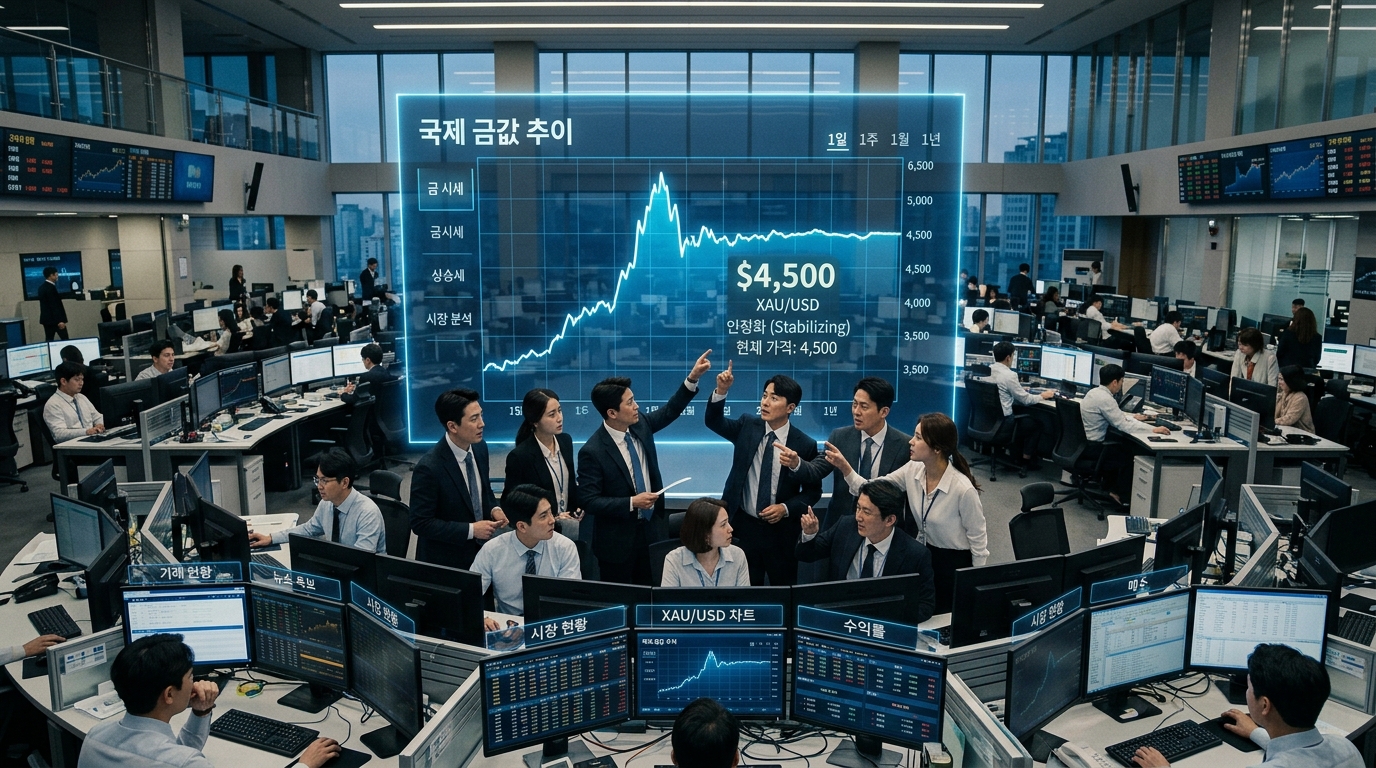
- After hitting an all-time high of the $5,600 level in early 2026, international gold prices (XAU) have entered a consolidation phase around $4,500 per ounce due to concerns over prolonged high interest rates.
- Amid the deepening fundamental decoupling among the three major regions (US, Europe, and Asia), differences in global monetary policies and liquidity flows are fueling asset price volatility.
- Strong physical gold purchases by central banks are serving as a robust downside support, but rising real interest rates are increasing the opportunity cost of holding gold, limiting short-term upside momentum.
Current Status Overview
As of intraday trading on June 3, 2026 (provisional), international gold prices are in a tight tug-of-war around the $4,500 per ounce level.
Today's real-time gold price remains unconfirmed (the latest confirmed price was approximately $4,529.54 per ounce on June 2), as safe-haven demand has slightly eased amid signs of geopolitical de-escalation in the Middle East.
Meanwhile, the Nasdaq index continues to fluctuate around 27,060.84, with its Fear and Greed Index currently in "Neutral" (57.1).
Compared to the "Greed" stage a week ago (60.9) and a month ago (71.2), this indicates that risk-on sentiment has cooled down significantly.
The KOSPI index has recovered to 8,801.49, with the KOSPI Fear and Greed Index currently at "Neutral" (58.3).
While this is similar to the "Neutral" state a week ago (57.1), it represents a consolidation compared to the "Greed" state a month ago (65.7) and the "Fear" state three months ago (37.4), demonstrating a wait-and-see market with less one-sided bias.
[Image: /stdaily/uploads/202606/gen_6a1f28b128e227.30879886.png]
Financial Analysis
Physical supply-demand dynamics and the marginal production costs of mining companies, which dictate gold market fundamentals, are supporting the long-term bull market's core strength.
According to data from the World Gold Council (WGC), global central banks recorded 863 tons of net gold purchases in 2025 alone, significantly exceeding the long-term average of 473 tons.
Influenced by high oil prices and rising labor costs, the average All-In Sustaining Cost (AISC) of major global gold mining firms surged to the $1,500 per ounce range, raising the mid-to-long-term physical supply floor.
Amid the tri-polar decoupling of the US, Europe, and Asia, the People's Bank of China (PBOC) and the European Central Bank (ECB) are steadily adjusting the share of physical gold in their reserve assets to reduce dependency on the US dollar.
| Category | Key Data and Forecast Figures | Market Impact and Evaluation |
|---|---|---|
| Central Bank Net Gold Purchases (2025) | 863 tons | Long-term support floor established by dollar hegemony diversification trends |
| Historical High (XAU) | $5,602.00 / oz (January 28) | Peak-out concerns remain due to geopolitical escalation |
| Recent Trading Price Level | Testing the $4,500/oz range | Today's quote unconfirmed (around $4,529.54 on June 2) |
| Global Economic Indicator (PMI) | Deepening US-EU-Asia fundamental decoupling | Diversified physical commodity demand due to uneven manufacturing recovery |
Valuation
Gold's current valuation is locked in a tight struggle with the rising trend of the US 10-year Treasury real yield (at around 4.51%) and the strong US dollar.
Since gold does not yield interest or dividends, it is difficult to avoid relative valuation discounts during tightening cycles when real yields rise.
Nonetheless, concerns over rising global sovereign debt and currency depreciation persist, keeping much of its premium as an alternative currency intact.
As valuation metrics for the Nasdaq (27,060.84) and the KOSPI (8,801.49) return to neutral levels, gold's price attractiveness relative to equities is gradually finding a neutral equilibrium.
[Image: /stdaily/uploads/202606/gen_6a1f28c2566174.22340999.png]
Expert and Institutional Analysis
Major global financial institutions note that while short-term correction pressures on gold exist, the mid-to-long-term structural uptrend remains intact.
UBS slightly lowered its year-end gold price forecast from $5,900 to $5,500, reflecting the headwind of US Treasury yields, but still recommended increasing allocations for portfolio diversification.
JPMorgan also revised its average gold price forecast for this year to $5,243, but maintained its scenario that a breakout past $6,000 by year-end is still possible under the long-term multipolar trend.
Goldman Sachs firmly maintained its target of $5,400, citing persistent buying by emerging market central banks and hedging demand against sovereign debt risks.
Risk Factors
The most direct risk is the potential evaporation of the geopolitical premium due to rapid progress in Middle East ceasefire negotiations and the reopening of the Strait of Hormuz.
In this scenario, oil shock concerns would ease, and short-term speculative capital parked in safe-haven assets could quickly flee, potentially triggering a breach of the $4,300 support floor.
Furthermore, a scenario where robust US inflation data revives talks of additional Federal Reserve rate hikes is also highly critical.
If real interest rates rise further due to elevated long-term rate expectations, it will inevitably deal a long-term blow to gold's valuation.
Additionally, amid the US-EU-Asia tri-polar decoupling, rapid depreciation of non-dollar currencies could drastically shrink physical demand (jewelry, fabrication, etc.) in Asia.
Investment Perspective Summary
Squeezed by macro monetary tightening, international gold prices are highly likely to trade sideways within a range of $4,400 to $4,600 per ounce in the short term.
As the USD/KRW exchange rate maintains high volatility around 1,516.50 won, domestic investors must carefully calculate the won-denominated price reflecting exchange rate changes.
From a portfolio construction standpoint, rather than chasing sudden surges, a dollar-cost averaging approach on dips to lower the average purchase price is more suitable for this market.
In particular, to maximize the diversification effect amid policy decoupling across the US, Europe, and Asia, a scenario of maintaining a controlled gold exposure of around 10% of total assets is recommended.
Investor Checklist Q&A
Q1. What is the primary reason behind the recent correction in international gold prices from their historic highs?
A1. It is due to the dilution of the safe-haven premium, triggered by rising US real yields, a strong dollar, and easing tensions in the Middle East.
Q2. If high interest rates persist, won't gold's investment appeal continue to decline?
A2. Yes, because gold yields no interest, high rates are a short-term headwind, but long-term inflation concerns provide solid support on the downside.
Q3. Why are central banks steadily buying gold instead of equities or bonds?
A3. It is to stabilize national foreign exchange reserves and diversify the potential risks of US dollar hegemony amid the deepening global tri-polar decoupling.
Q4. Is it more logical to buy physical gold bars or invest in gold-related ETFs?
A4. If you want to reduce taxes and storage costs, and prefer quick liquidity and agility to respond to volatility, investing in physical gold ETFs through a brokerage account is far more advantageous.
Q5. With the USD/KRW exchange rate in the mid-1,500 won range, what should domestic investors watch out for when investing in gold?
A5. Due to the weak Korean won, the won-denominated gold price might already be quite high. Therefore, investors must assess the foreign exchange loss risk that could arise if the exchange rate falls.