Hello, this is Daily Stock, delivering the most precise pulse of the global financial markets.
Summary
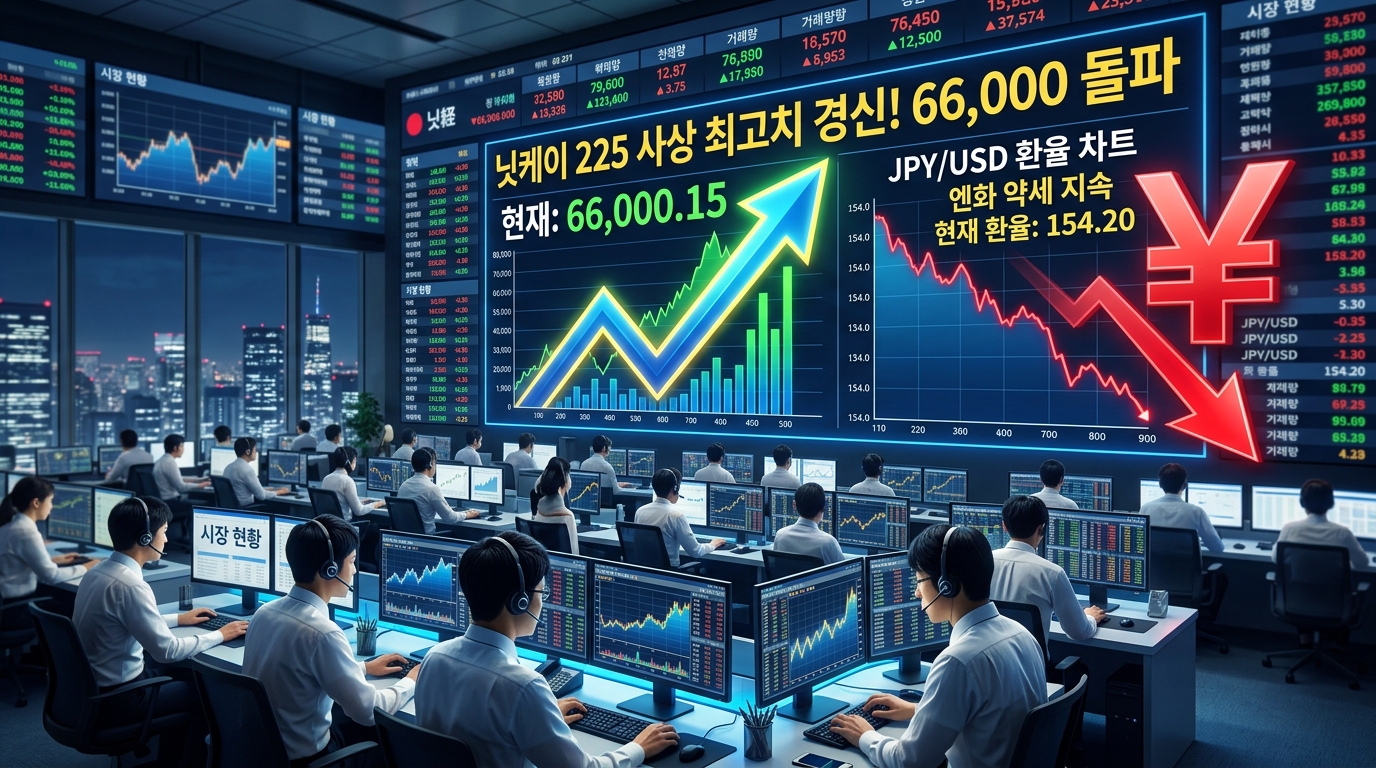
Japan's financial markets and global foreign exchange markets are experiencing intense friction between the ongoing depreciation of the yen and stock indices running at historic highs.
Although the Ministry of Finance (MOF) of Japan poured a record-breaking 11.7349 trillion yen of heavy ammunition into the foreign exchange market over the past month, the yen-to-dollar exchange rate has reverted back to the late 159-yen range.
This weakness in the yen is serving as the driving force pushing the Nikkei 225 index above the 66,000 mark by stimulating short-term earnings improvements for major Japanese exporting giants.
However, signs of sudden yen-carry unwinding and surging energy import prices are casting deep dark clouds over Japan's real economic recovery.
In this report, we deeply diagnose the valuation of the Japanese stock market and the ripple effects of yen volatility under the fundamental decoupling situation across three major regions: the US, Europe, and Asia.

Market Overview
On Tuesday, June 2, 2026, the Nikkei 225 index in the Tokyo stock market closed at 66,734.24, down 0.3% from the previous day.
After breaking through the 67,000 mark for the first time in history on the previous day, it entered a slight breathing space, but it continues an amazing rally compared to the beginning of the year.
On the other hand, the yen-to-dollar exchange rate soared to 159.73 yen during the day, threatening the psychological support level of 160 yen once again.
The Korean market closed today at KOSPI 8801.49 and KOSDAQ 1026.03, while the USD/KRW exchange rate is currently recorded at 1519.20 won.
The Nasdaq index is also moving around the 27,086.81 point level during the day, maintaining a strong rally centered on global tech stocks.
Amid these rapid stock price movements, looking at the Daily Stock Fear and Greed Index, the KOSPI is currently at 59.1 (58.1 a week ago) and the Nasdaq is at 59 (60.9 a week ago), maintaining a tight 'neutral' phase where neither market is overheated.
| Major Indices and Exchange Rates (As of June 2, 2026) | Value | Remarks |
|---|---|---|
| Nikkei 225 Index | 66,734.24 | Closed -0.3% after hitting an all-time high the previous day |
| USD/JPY | 159.73 yen | Rebound after Japanese authorities' 11tn yen intervention |
| KOSPI | 8801.49 | Domestic closing index |
| KOSDAQ | 1026.03 | Domestic closing index |
| Nasdaq Composite Index | 27086.81 | US stock market trading basis |
| USD/KRW | 1519.20 won | Domestic FX market close |
Financial Analysis
Currently, the Japanese macro environment is in a chaotic phase where the expansionary fiscal stimulus of Prime Minister Sanae Takaichi, dubbed 'Sanaenomics', and the Bank of Japan's (BOJ) policy tightening attempts are in head-on collision.
The new government's economic stimulus package worth approximately $137 billion is increasing the fiscal burden through government bond issues, stimulating upward pressure on Japanese government bond (JGB) yields.
As a result, the JGB market continues to experience tantrums, with the 10-year JGB yield touching the 2.8% level during the day, a 29-year high.
However, the interest rate differential between the US and Japan (more than ~2.5%p), which is the root cause of the weak yen, still strongly supports yen-selling (short-carry trade) sentiment.
In particular, on a Real Effective Exchange Rate (REER) basis representing real purchasing power, some shocking academic diagnoses have been raised that the yen is valued lower than the Turkish lira, virtually reaching the state of 'the weakest currency in the world'.
Due to this, there are coexisting concerns that raw material import prices, such as oil and copper, could soar, weakening the virtuous cycle between domestic consumption and real wage growth rates.
Valuation
The Nikkei 225 index reaching the 66,000 mark should be interpreted in a somewhat unique way amid the extreme fundamental decoupling trends of the three global regions (US, Europe, and Asia).
While the US Nasdaq (27,086.81) is increasing its valuation multiples backed by its dominant AI infrastructure hegemony, Europe's relative valuation attractiveness is shrinking due to energy supply chains and a slowdown in manufacturing.
Between the European Central Bank (ECB) entering an easing cycle and the People's Bank of China (PBOC) injecting expansionary liquidity, the global Purchasing Managers' Index (PMI) is showing a moderate expansionary phase.
Meanwhile, in Asia, the Japanese stock market has become a strong safe haven for foreign capital, thanks to the valuation attractiveness of dollar-denominated stock prices depressed by a weak yen, and the Tokyo Stock Exchange's (TSE) corporate value-up drive.
Amid the policy uncertainties of China's Shanghai Composite Index and the relative volatility of Korea's KOSPI in the past, the preference for the relative safety of the yen-denominated Nikkei 225 asset is prominent.
However, as the depreciation of the Korean won (1,519.20 won) and the depreciation of the yen occur simultaneously, the KRW/JPY arbitrage rate has stabilized downward, pointing to a trend where competition with Korean exporting companies in the global market is intensifying.
Expert & Institutional Analysis
Large overseas investment banks and local Japanese financial experts view the current situation as a test of the Bank of Japan's leadership.
Arihiro Nagata, head of global markets at Sumitomo Mitsui Financial Group (SMFG), Japan's second-largest financial group, pointed out, "The Bank of Japan must firmly raise interest rates at the policy meeting held on June 15-16 to soothe market anxiety."
He advised that rather than simply raising rates, the BOJ must clearly present a roadmap for future additional tightening and normalization to stabilize the surge in long-term government bond yields and FX concentration.
Analysts at Bank of America (BofA) and ING also observed that the yen will face continuous weakening pressure near the 160-yen range until the end of the year.
Although the US Fed is coordinating the timing of interest rate cuts, the narrowing of the interest rate gap is highly likely to occur slower than market expectations due to the downward rigidity of core inflation.
Experts agree that the 11 trillion yen intervention poured into the foreign exchange market by the Japanese government is merely a short-term defense, and it will be difficult to break speculative selling pressure in the market without a rate normalization roadmap.

Risk Factors
First is the tantrum of the global bond market due to pressure to sell US Treasuries.
It is strongly argued that the intervention funds deployed by the Japanese government to defend the weak yen were likely secured mainly by selling its holdings of US Treasury bonds.
This pressure to sell US Treasuries originating from Japan raises long-term US interest rates, which could have the counter-effect of shrinking global liquidity and encouraging capital outflows from emerging countries, including South Korea.
Second is geopolitical conflicts and disruptions in the energy supply chain.
Uncertainties in the Middle East and expanding oil price volatility could deal a critical blow to the current account balance and baseline inflation in Japan, which is extremely dependent on crude oil and natural gas imports.
Third is the loss of trust due to the policy conflict between Prime Minister Takaichi's Sanaenomics and BOJ Governor Kazuo Ueda.
If a rate-raising drive to curb inflation and large-scale expansionary fiscal policies are pursued simultaneously, the market could question monetary credibility itself, raising concerns over a government bond market crash and hyperinflation.
Investment Outlook Summary
Currently, the high-flying Nikkei 225 is in a position to fully enjoy the benefits of maximizing the accounting profits of exporting conglomerates.
However, it should be noted that even the historic scale of verbal and physical FX market interventions is losing effectiveness, hitting a huge wall known as the US-Japan interest rate gap.
In the short term, there is a high possibility that stock price strength will remain open for export-oriented IT and machinery sectors with global competitiveness, such as Toyota and Sony, which benefit from a weak yen.
However, the current phase where the real purchasing power of the yen is falling and the BOJ is considering a forced early tightening card (e.g., consecutive rate hikes in June) could be an inflection point for volatility.
Therefore, investors are advised to take a conservative approach by confirming the rate hike decision and the speed of the additional rate hike roadmap at the BOJ monetary policy meeting scheduled for mid-June before scaling in.
Investor Checkpoint Q&A
Q1. Why did the yen return to weakness even after the Japanese FX authorities intervened on an unprecedented scale?
A1. This is because FX market interventions only control short-term supply and demand, and fail to narrow the real interest rate differential between the US and Japan, which is wider than approximately 2.5%p. Market participants still find it advantageous to buy the high-yielding dollar and sell the low-yielding yen.
Q2. What is the main reason behind the Nikkei 225 index surging past the 66,000 mark?
A2. The historic weakness of the yen has caused overseas sales conversion profits for large exporting companies to surge. Additionally, the Tokyo Stock Exchange's active shareholder return improvement policies and the value-up drive are absorbing global hedge fund capital.
Q3. If the interest rate is raised at the Bank of Japan (BOJ) policy meeting in June, will it immediately switch to a strong yen?
A3. The market has already partially priced in about two additional interest rate hikes within the year. Rather than simply raising it by 0.25%p, the scenario where the transition to a strong yen is determined by how hawkishly they present the future tightening pace and the roadmap for reducing government bond purchases is highly likely.
Q4. Is the continuous weakness of the yen good or bad news for the Korean stock market and exporting companies?
A4. South Korea and Japan have highly overlapping competition in core export sectors such as automobiles, shipbuilding, and IT in the global market. If the weak yen persists, the price competitiveness of Japanese exporting companies will rise, which could create a somewhat disadvantageous competitive environment for domestic KOSPI exporting companies.
Q5. Why are concerns over the sale of US Treasuries emerging?
A5. For the Japanese government to carry out FX interventions exceeding 11 trillion yen, a large amount of dollar liquidity is required. To achieve this, they have no choice but to sell their massive holdings of US Treasury bonds, which could raise long-term US interest rates and act as a macroeconomic headwind pressing down global asset prices.