[Image: /stdaily/uploads/202606/gen_6a1e8de2bba764.62520582.png]
Hello, this is Daily Stock.
Key Summary
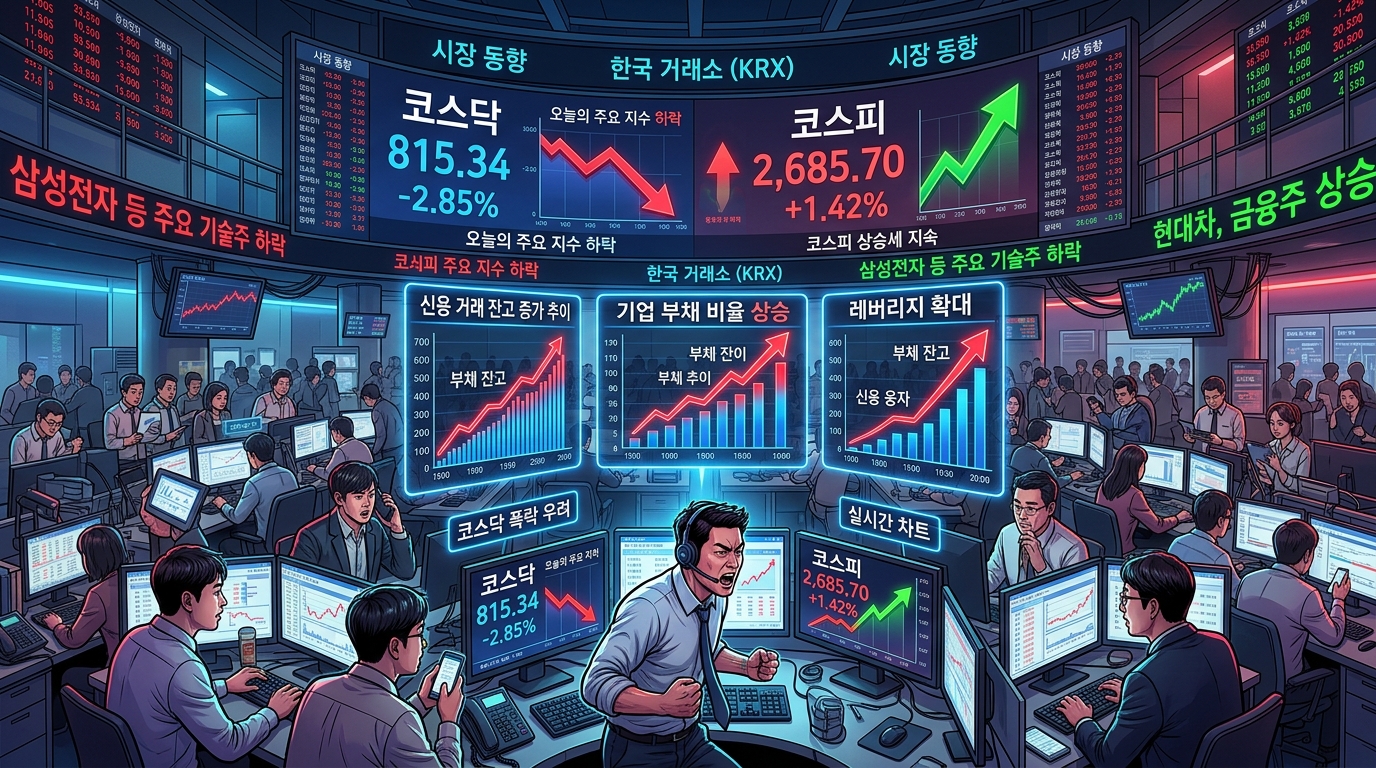
The credit transaction balance of the domestic stock market has surpassed 38 trillion won for the first time in history, reaching an all-time high.
However, even amidst this "debt-investing" boom, the trajectories of the KOSPI and KOSDAQ markets are completely diverging.
While the KOSPI's credit balance is surging due to capital concentrating in semiconductors and large-cap AI stocks, the KOSDAQ's credit balance has fallen below the 10 trillion won threshold.
This liquidity outflow is cited as a key factor worsening short-term market volatility alongside the KOSDAQ index's five-consecutive-day decline.
Current Situation Summary
On June 2, 2026, the KOSDAQ market closed at 1,026.03 points, down 2.29% from the previous trading day, showing weakness for five consecutive trading sessions.
On the other hand, the KOSPI market surpassed the 8,900 level for the first time intraday before digesting profit-taking volume to close higher at 8,801.49 points.
According to the Korea Financial Investment Association, the total credit transaction balance of the domestic stock market stood at 38.0226 trillion won as of May 29.
Of this, the KOSPI credit balance surged to 28.0244 trillion won, while the KOSDAQ credit balance fell to 9.9982 trillion won, slipping below the 10 trillion won mark.
According to today's Daily Stock Fear and Greed Index, the KOSPI Fear and Greed Index is currently in the Neutral (59.1) stage.
This indicates that the overheating signal has calmed down slightly compared to Neutral (58.1) a week ago and Greed (75) a month ago, but caution is still required.
The Nasdaq Fear and Greed Index is currently in the Neutral (59) stage, showing a gradual easing of sentiment compared to Greed (60.9) a week ago and Greed (71.2) a month ago.
The KRW/USD exchange rate rose to close at 1,518.30 won, increasing the supply and demand burden for foreign investors.
Financial Analysis
The increase in KOSPI's debt-fueled investing was driven by ultra-large semiconductor and AI-related stocks such as Samsung Electronics and SK Hynix.
Samsung Electronics' single-stock credit balance surpassed 4 trillion won for the first time in history, and SK Hynix is also reaching the mid-3 trillion won range.
In sharp contrast, the KOSDAQ market's credit balance, which reached 11.022 trillion won in early May, decreased to 9.9982 trillion won in about a month.
This is interpreted as a "deleveraging (debt reduction)" phenomenon occurring as retail investors sold KOSDAQ growth stocks and moved capital to KOSPI leading stocks.
| Classification | KOSPI Market | KOSDAQ Market |
|---|---|---|
| **Closing Price (2026-06-02)** | 8,801.49 pt (+0.15%) | 1,026.03 pt (-2.29%) |
| **Credit Balance (as of 5/29)** | 28.0244 trillion won | 9.9982 trillion won |
| **Recent Trend & Characteristics** | Concentrated on large-cap semi, hitting all-time highs | Decreasing for 5 consecutive days, falling below 10T won |
| **Major Drivers** | Concentration of leverage on AI and HBM | Liquidity outflow and retail capital exit |
[Image: /stdaily/uploads/202606/gen_6a1e8defc2f339.24447098.png]
Valuation
The exodus of the credit balance from the KOSDAQ market may be the combined result of a lack of leading themes and valuation burdens.
As stock price corrections continued in top-cap KOSDAQ sectors such as secondary batteries and biotech, the attractiveness of leverage investment seems to have temporarily halved.
As the credit balance decreases, the multiples (PER, PSR) themselves may have entered a lower range compared to past overheated periods.
However, a drop in valuation without liquidity support could act as a "liquidity trap" rather than an undervalued attraction, so caution is required.
On the other hand, the KOSPI market's profit growth is materializing around leading stocks even amid record highs, which somewhat justifies the concentration of capital.
However, if credit financing excessively concentrates on specific sectors, the shock could be multiplied during a supply/demand collapse, regardless of valuation figures.
Expert & Institutional Analysis
Financial investment industry experts diagnose the recent stock market capital flow as a typical "K-shaped polarization" and "AI concentration" phenomenon.
In past liquidity-driven markets, the warmth spread to small and mid-cap stocks after large-caps rose, but currently, the semiconductor monopoly system seems to be hardening further.
Major institutions, including the Korea Capital Market Institute, project that the phenomenon of retail investors leaving KOSDAQ and moving to KOSPI large-caps may continue for the time being.
This is because large AI-related events, such as Samsung Electronics' unveiling of physical HBM5 chips, continue to block capital dispersion to small and mid-cap stocks.
At the same time, some argue that while the decrease in KOSDAQ's credit balance increases downward pressure on the index in the short term, it is a process of absorbing bad debt over the mid-to-long term.
If the credit balance is sufficiently cleared and builds a bottom, rebound momentum could form for solid KOSDAQ small and mid-cap stocks backed by valuation appeal.
Risk Factors
The most concerning part is the rapid volatility risk arising under high interest rates and a high exchange rate environment.
With the KRW/USD exchange rate soaring to the 1,518.30 won level, net selling by foreigners in the KOSPI market for 18 consecutive trading days is a supply/demand instability factor.
KOSPI's historic credit balance of over 38 trillion won is a potential time bomb that could turn into a barrage of margin calls if the stock market faces a sudden correction.
If margin calls are executed, a sharp drop in stock prices triggers credit liquidation, which in turn can cause a vicious cycle of further stock price declines.
In the case of KOSDAQ, as the credit balance drops sharply, a liquidity gap occurs, exposing the market to volatility where even small selling pressure can push stock prices down excessively.
In periods where trading volume itself stagnates or shrinks, investors must prepare for the possibility that individual stock volatility could be much larger than expected.
[Image: /stdaily/uploads/202606/gen_6a1e8e023c5b44.31449202.png]
Investment Perspective Summary
The concentration of retail credit balances is an indicator that clearly shows the current irregular supply and demand landscape of the domestic stock market.
Opposing scenarios—overheating of KOSPI's leverage and depletion of KOSDAQ's liquidity—are unfolding simultaneously.
Rather than simply chasing the rise and fall of the index, investors should closely observe trends in credit balances and customer deposits.
For the KOSDAQ market to stabilize, the concentration of capital into large-cap semiconductor stocks must ease, and a support line for the KOSDAQ credit balance must first be secured.
This is a time when a strategy of avoiding excessive leverage, maintaining an appropriate cash portion, and defending against volatility seems effective.
It is worth considering a conservative, split-purchase approach focusing on solid KOSDAQ small giants that are clearly backed by growth and solid earnings.
Frequently Asked Questions
Q1. What caused the credit loan balance to reach an all-time high?
A1. As KOSPI continued its historic rally driven by strong expectations for AI and HBM (High Bandwidth Memory) semiconductors, retail investors aiming to participate in the upward rally actively used securities company loans to buy stocks (debt-investing).
Q2. Why did the KOSDAQ credit balance fall below 10 trillion won?
A2. It is analyzed that due to KOSDAQ's sluggishness amid a lack of leading themes, retail investors reduced leverage or sold KOSDAQ stocks to move their capital to KOSPI semiconductor large-cap stocks that show strong upward momentum.
Q3. Is the decrease in KOSDAQ's credit balance good or bad for the stock market?
A3. In the short term, it is highly likely to act as a negative factor causing index declines and increased volatility due to capital exit and selling pressure. However, over the mid-to-long term, there is a positive aspect as the credit bubble deflates, reducing margin call risks and lightening the burden of overhang volume.
Q4. What is the impact of the exchange rate surpassing 1,510 won on credit transactions and KOSDAQ?
A4. A high exchange rate dampens overall stock market investment sentiment by causing rising import prices and outflows of foreign capital. If downward pressure on stock prices increases due to this, the collateral maintenance ratio of investors using credit financing is threatened, compounding the pressure of margin calls.
Q5. What volatility indicators should retail investors watch out for in the future?
A5. Investors should first be wary of "individual stocks with high credit loan balance ratios," where margin call volumes can flood the market during sudden stock price changes. Additionally, it appears necessary to monitor trends in customer deposits, which represent standby funds for the stock market, alongside foreign program trading trends.