Hello, I am an expert writer at Daily Stock.
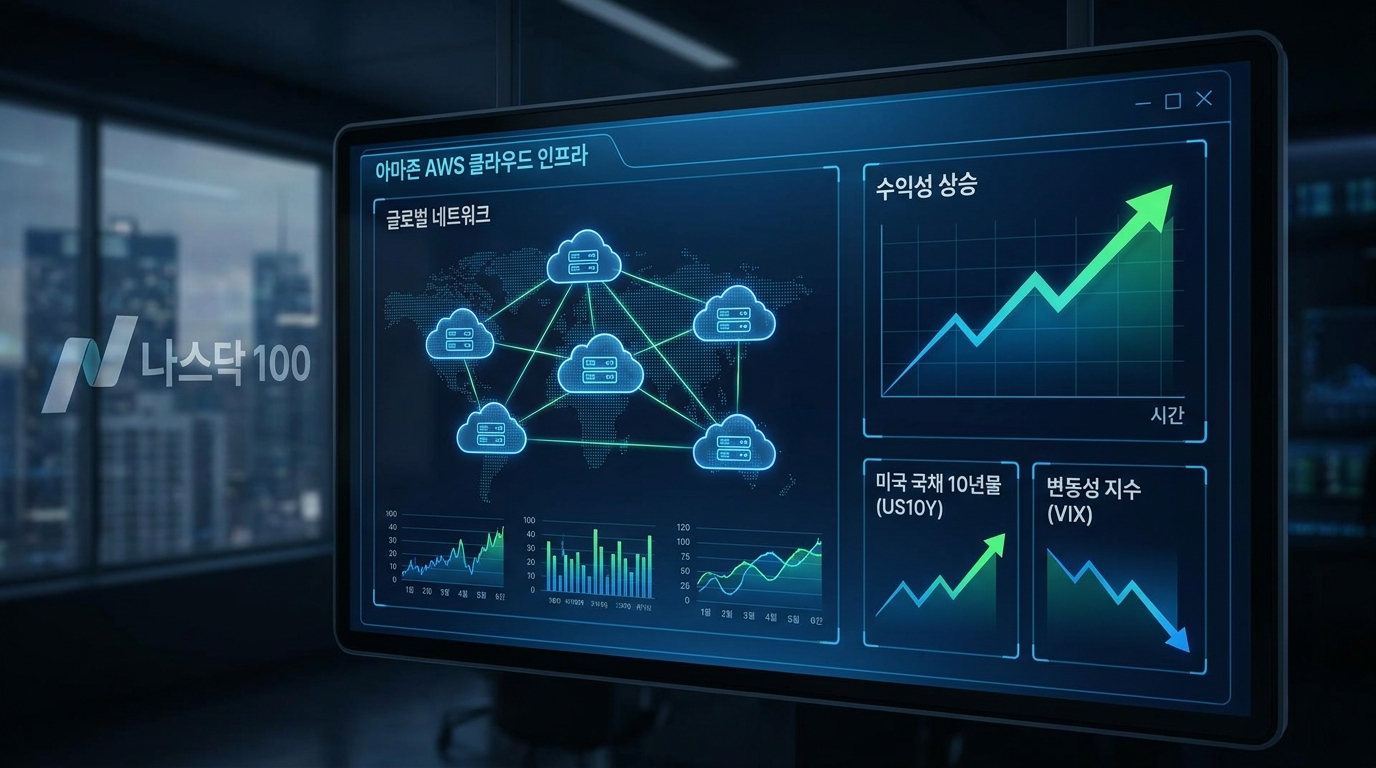
Today, we will examine the significance of the operating margin of Amazon (AMZN) AWS, which has established itself as a core pillar in the era of the Nasdaq 26,000 mark during intraday trading, and its dynamic relationship with macro indicators.
Core Summary
[Image: /stdaily/uploads/202605/gen_6a14e32a276bc4.20821215.png]
As of Q1 2026, AWS surpassed an annual run-rate of $150 billion, recording an explosive revenue growth of 28% [1].
This solid trend in cloud operating margins is excellently serving as a fundamental defense wall for large-cap stocks in the Nasdaq 100, even amid the upward pressure of the Dollar Index (DXY) and the VIX.
However, with its deepening correlation to the Philadelphia Semiconductor Index (SOX), the impact of massive data center CAPEX on the company's future free cash flow is a key variable to watch [2].
Current Situation Summary
As of 09:01 (KST) on May 26, 2026, on an intraday provisional basis, the Nasdaq index stands at 26343.97, continuing a Big Tech-led rally despite macro volatility.
According to Daily Stock's proprietary Fear & Greed Index, the Nasdaq is currently in the Neutral (58.6) zone, a period where investor sentiment has somewhat cooled compared to Greed (68.5) a month ago, as the market explores fundamentals.
Even in a strong dollar (DXY strength) phase where the USD/KRW exchange rate has risen to 1,513.50 KRW, Amazon is making an all-out effort to defend its margins, driven by the explosive demand for custom silicon (Trainium, Graviton) [3].
Despite some concerns that the timeline for Big Tech's AI monetization might be delayed, market participants are showing a strong sense of relief at the 28% high growth rate demonstrated by AWS.
Financial Analysis
[Image: /stdaily/uploads/202605/gen_6a14e341a6efa4.14183393.png]
According to Amazon's recent earnings report, total operating income reached $23.9 billion, achieving a company-wide record-high operating margin of 13.1% [1].
Among its segments, the core cash cow, AWS, generated $37.6 billion in quarterly revenue and maintained a robust operating margin of around 37%, which is evaluated to have strongly driven the company's overall profit growth [1].
Interestingly, despite capital expenditures (CAPEX) reaching $43.2 billion in Q1, the economies of scale from the expansion of AI services excellently defended against margin degradation [2].
This suggests how much the semiconductor hardware-focused SOX index relies on the capital investments of cloud companies, and it can be seen as a prime example of the virtuous cycle of AI infrastructure build-out being proven through financial statements.
Valuation
The macroeconomic environment where the US 10-Year Treasury yield (US10Y) remains at a high level has historically acted as a major factor suppressing the multiple expansion of growth stocks.
However, Amazon is demonstrating differentiated cash-generating capability compared to simple software subscription stocks or other competitors in the Nasdaq 100, as the efficiency improvements in its e-commerce sector and the high margins of AWS mesh together like cogwheels.
Based on estimated earnings for 2026, Amazon's price-to-earnings ratio (PER) is trading at a certain premium compared to its historical long-term average, but there is a perspective that the cost-saving effects through its own infrastructure, such as AI chips (Trainium), partially justify this [4].
While average growth stocks in the S&P 500 are greatly shaken by interest rate sensitivity, AWS's structural profit stamina is acting as a strong safety net that absorbs valuation downside risks.
| Indicator | Current Value (As of 2026-05-26 Intraday Provisional) | 1-Month Trend | Notes |
|---|---|---|---|
| KOSPI Index | 8043.53 | Dropped from Greed (64.8) | Fear & Greed: Neutral (57.3) |
| KOSDAQ Index | 1191.60 | Overall volatile market | - |
| Nasdaq Index | 26343.97 | Dropped from Greed (68.5) | Fear & Greed: Neutral (58.6) |
| USD/KRW Rate | 1513.50 KRW | Continued upward trend (Linked to DXY) | Foreign supply and demand variable at play |
Expert and Institutional Analysis
[Image: /stdaily/uploads/202605/gen_6a14e3552ec5b3.11968194.png]
Global investment banks analyze that AWS's achievement of a $150 billion run-rate is a signal indicating that its proprietary AI chip ecosystem has successfully landed in the market, going beyond a simple expansion of cloud service adoption [4].
In particular, even looking at the custom-designed silicon division alone, it has achieved a run-rate scale of over $20 billion annually, which is evaluated as a clever strategic move to reduce dependence on external GPUs and maximize long-term operating margins [1].
Some institutional investors foresee that even if the VIX index spikes temporarily due to macro issues, defensive funds from passive ETFs could concentrate on companies that have proven visible AI monetization, such as Amazon.
In other words, the prevailing analysis is that the greater the market uncertainty, the more solid the premium will become for the #1 cloud company that has proven itself with numbers.
Risk Factors
The first risk to check is the possibility of a temporary negative shift in free cash flow (FCF) due to massive CAPEX investments [2].
If investments for the future do not directly translate into actual cash generation from operating activities, investors could face the market's harsh multiple contraction pressure at any time.
The second risk is the possibility of strengthening surveillance by global regulatory authorities toward Big Tech and the emergence of antitrust issues related to cloud security and AI technology monopolies.
Lastly, if expectations for interest rate cuts retreat in the market and the US 10-Year Treasury yield spikes again, no matter how robust the operating margin is, the stock cannot be completely free from the mechanical selling pressure across the broader Nasdaq.
Investment Perspective Summary
Ultimately, the margin defense capability of Amazon AWS functions as one of the most important fundamental indicators supporting the overall downside of the Nasdaq 100 index.
The massive capital investments executed under the clear blueprint of expanding AI infrastructure are also providing continuous momentum to equipment and semiconductor companies within the SOX index.
Even if macroeconomic uncertainties (DXY strength, VIX volatility) expand further in the future, the polarization of stock prices between companies with proven profit stamina and those without is highly likely to deepen.
Therefore, rather than being swayed by short-term stock price fluctuations, investors should continuously track whether AWS can structurally maintain its margin rate at the 35% level in future quarterly earnings.
Investor Checkpoint Q&A
Q1. What is the level of Amazon AWS's operating margin for Q1 2026?
While recording an integrated operating margin of 13.1%, the highest level company-wide, the core cash cow AWS segment maintained a high margin of around 37%, driving overall performance [1].
Q2. What is the core significance of AWS's performance in the era of the Nasdaq 26,000 mark?
It serves as a case proving that related capital investments are translating into actual revenue and profit, going beyond mere expectations for AI technology, and plays a positive role in mitigating the debate over peak valuations of large-cap growth stocks in the Nasdaq 100.
Q3. Does the exchange rate of 1,513 KRW and the strong dollar (DXY) environment have a negative impact on Amazon?
Due to the nature of multinational Big Tech companies with a high proportion of overseas revenue, a strong dollar can be a factor for foreign exchange losses, but the explosive cloud demand centered on the North American market, including AWS, is structuring to offset a significant portion of this.
Q4. Is there no risk that the massive increase in CAPEX will act as a negative factor for the stock price?
Excessive spending raises concerns about a short-term deterioration in free cash flow, but the market interprets it as a long-term growth driver, given that it is an essential survival investment for expanding AI data centers and securing volume for its custom chips (Trainium) [4].
Q5. What is the connection between the SOX Index (Philadelphia Semiconductor Index) and Amazon AWS's performance?
Since Amazon purchases massive amounts of semiconductors and networking equipment to expand data center servers, the continued rise in AWS's run-rate acts as a strong leading indicator that directly supports the performance of companies in the SOX index.