
Hello, this is Daily Stock greeting you on May 25, 2026.
Today, we will cover the clash between the macroeconomic environment and the changes in leading stocks within the 11 sectors of the S&P 500 as of today's intraday (provisional) trading.
Core Summary
Entering 2026, the S&P 500 Energy sector has risen about 25% year-to-date, recording an overwhelming return among all sectors.
As Brent crude oil surpassed $105 per barrel, growing concerns about reigniting inflation have emerged as a key topic in the market.
Energy companies have achieved a qualitative structural improvement by focusing on maximizing capital efficiency and shareholder returns rather than past top-line growth.
However, as the surge in oil prices hinders the U.S. Federal Reserve's (Fed) path to interest rate cuts, the possibility of a valuation readjustment between value and growth stocks must be kept in mind.
Current Situation Summary
As of 10:00 AM on the 25th (provisional), the Nasdaq index recorded 26,343.97, digesting fatigue from the tech-driven rally.
The KOSPI is trading at 7,847.71 and the KRW/USD exchange rate is at 1,515.00 KRW, showing increased volatility in foreign supply and demand amid a high exchange rate environment.
According to the Fear & Greed Index calculated in-house by Daily Stock, the Nasdaq is currently at Neutral (58.6), showing somewhat calmed investor sentiment compared to Greed (68.5) one month ago.
The KOSPI also recorded Neutral (57.3) currently, entering a volatility alert zone from the Greed (63.4) level three months ago.
Looking at the rotation of the 11 S&P 500 sectors this year, there is an observable trend of capital dispersing from the AI-centric tech stock market to energy and materials sectors, which possess inflation hedge characteristics.
Key leading indicators like the Atlanta Fed's GDPNow (intraday market price unconfirmed, based on the latest confirmed value) are also closely monitoring the impact of the oil price shock on the second-quarter growth rate.
Financial Analysis
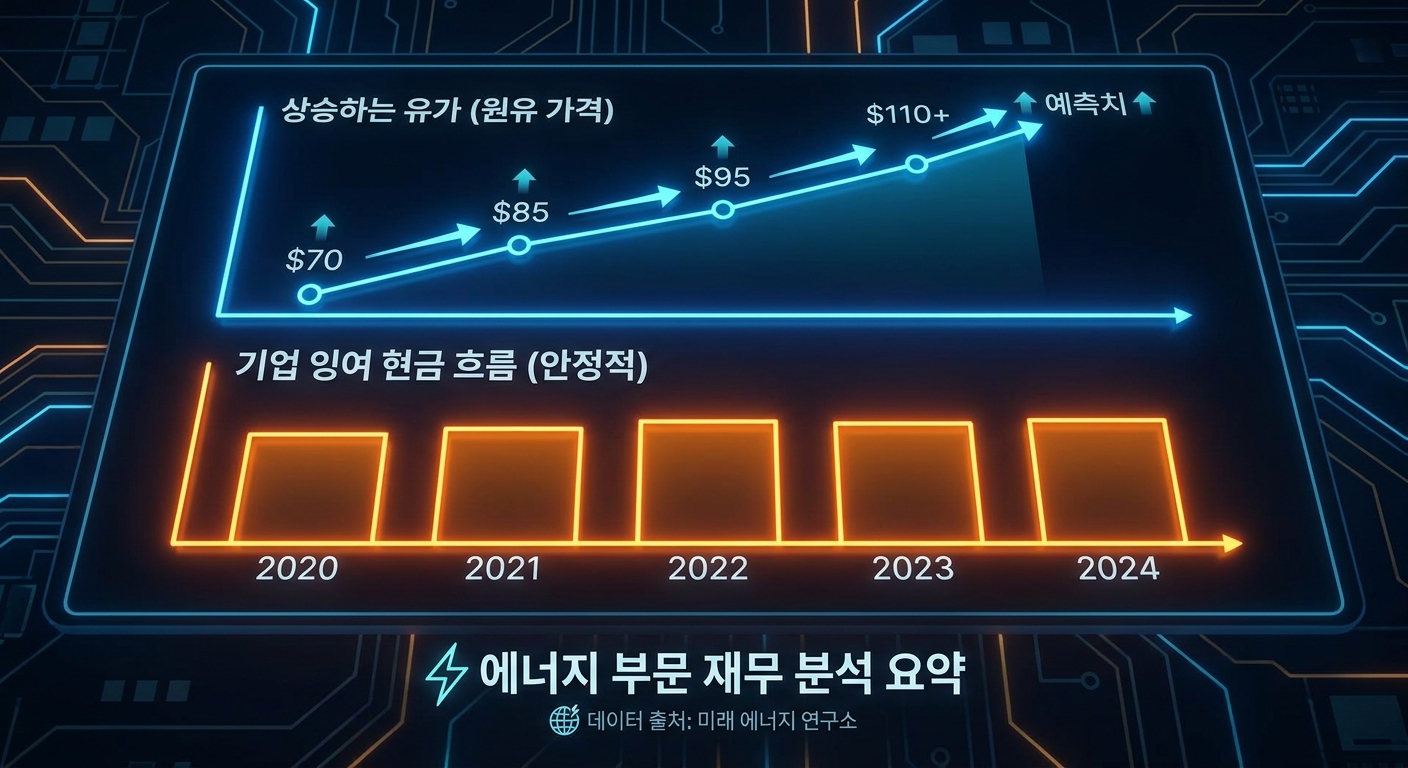
The current financial structure of S&P 500 energy companies is fundamentally different compared to the 2014 oil price plunge cycle.
Rather than increasing production through reckless capital expenditures (CAPEX), they are focusing on improving return on invested capital (ROIC) and generating free cash flow (FCF).
This strengthened capital discipline has created a structural resilience to defend stable profits even if oil prices fall.
During the recent earnings season, major energy companies met upgraded EPS estimates and are actively implementing shareholder return policies, such as share buybacks and special dividends.
Valuation
While the forward P/E ratio of large-cap growth stocks, including the Nasdaq, is currently at historical highs, the energy sector still retains relative appeal as a value stock.
High dividend yields based on strong cash generation can serve as an attractive margin of safety in a prolonged high interest rate environment.
In contrast to small-cap stocks represented by the Russell 2000, which face downward pressure on EPS due to rising debt financing costs, earnings estimates for large energy companies are in an upward trend linked to rising oil prices.
Ultimately, this could act as a key driver triggering capital rotation from growth to value stocks within the S&P 500.
| Indicator/Sector | S&P 500 Technology (IT) Sector | S&P 500 Energy Sector | Russell 2000 (Small-cap) |
|---|---|---|---|
| **YTD Return** | Continued market outperformance | Up approx. 25% (Top pick) | Relative weakness |
| **Key Driver** | AI capex and margin defense | Rising oil prices & shareholder returns | Interest rate sensitivity & debt risk |
| **Valuation Feature** | High forward P/E (Growth premium) | Low forward P/E, high cash flow | Persistent downward pressure on earnings estimates |
| **Macro Sensitivity** | Duration risk when Treasury yields rise | Inflation hedge function | Worsening interest burden in prolonged high-rate environment |
Expert & Institutional Analysis
Global investment bank Barclays warned that the upside risk is greater, forecasting the average Brent crude price for 2026 at $100 per barrel due to geopolitical risks and declining global inventories.
Goldman Sachs also diagnosed that global crude oil inventories are rapidly depleting at an unprecedented pace due to the aftermath of crude export restrictions.
Meanwhile, within the Fed, voices cautioning against the ripple effect of surging energy prices on inflation are growing.
Fed Governor Waller hinted at a hawkish stance in a recent lecture, stating that rising oil prices are stimulating headline inflation, making it appropriate to delay interest rate cuts.
Risk Factors
The biggest risk is the potential for widespread stagflation triggered by rising energy prices or the undermining of a soft-landing scenario.
If the core PCE price index and employment indicators, which the Fed pays close attention to, show a sticky trend, the high interest rate stance could turn into a recession signal that destroys demand.
Additionally, the International Energy Agency (IEA) issued a forecast that global crude oil demand could contract in 2026.
If high oil prices and high interest rates coincide, leading to actual demand destruction in the global real economy, the possibility of oil prices undergoing a sharp correction cannot be ruled out.
Investment Perspective Summary

The recent rally in the energy sector can be seen as a result backed by companies' strict capital discipline and cash flow generation capabilities, beyond a simple geopolitical theme.
Therefore, rather than betting on short-term oil price volatility, a strategy of selecting blue-chip companies with excellent dividend growth rates and ROIC can be effective.
However, if oil prices remain excessively high, there is a persistent possibility that they will burden the overall macroeconomy and pressure valuations across the entire stock market.
Investors should adjust the weight of the energy sector in their portfolios as an inflation defense tool while continuously monitoring the risk of a delay in the Fed's monetary policy pivot.
Q&A with Daily Stock
Q1. What is the reason for the recent strength in the S&P 500 Energy sector?
A1. Along with the benefits of rising oil prices, such as Brent crude surpassing $105, it is because companies have improved their fundamentals by focusing on generating free cash flow and returning value to shareholders, such as share buybacks.
Q2. What impact do rising oil prices have on the US Fed's interest rate decisions?
A2. Surging energy prices increase headline inflation and stimulate the prices of other goods, acting as a key factor causing the Fed to delay the timing of interest rate cuts.
Q3. Should I immediately switch my tech-heavy portfolio to energy stocks?
A3. Rather than an extreme portfolio replacement, a strategy of diversifying risks by properly allocating between high-growth tech stocks and energy stocks with inflation hedge characteristics can be considered.
Q4. Between large-cap energy companies and small-to-mid-cap drilling companies, which is more resilient to the macroeconomy?
A4. In a high interest rate environment, large Integrated Majors with low debt ratios and stable dividend payments have relatively higher fundamental defensive capabilities compared to small-to-mid-cap companies.
Q5. What macro indicators should be watched most carefully when investing in the energy sector in the second half of the year?
A5. You should comprehensively monitor whether the US Core PCE price index rebounds, changes in the growth rate forecast of the Atlanta Fed's GDPNow, and signals of demand destruction in the real economy due to high interest rates.