Hello, I am an expert writer at DailyStock.
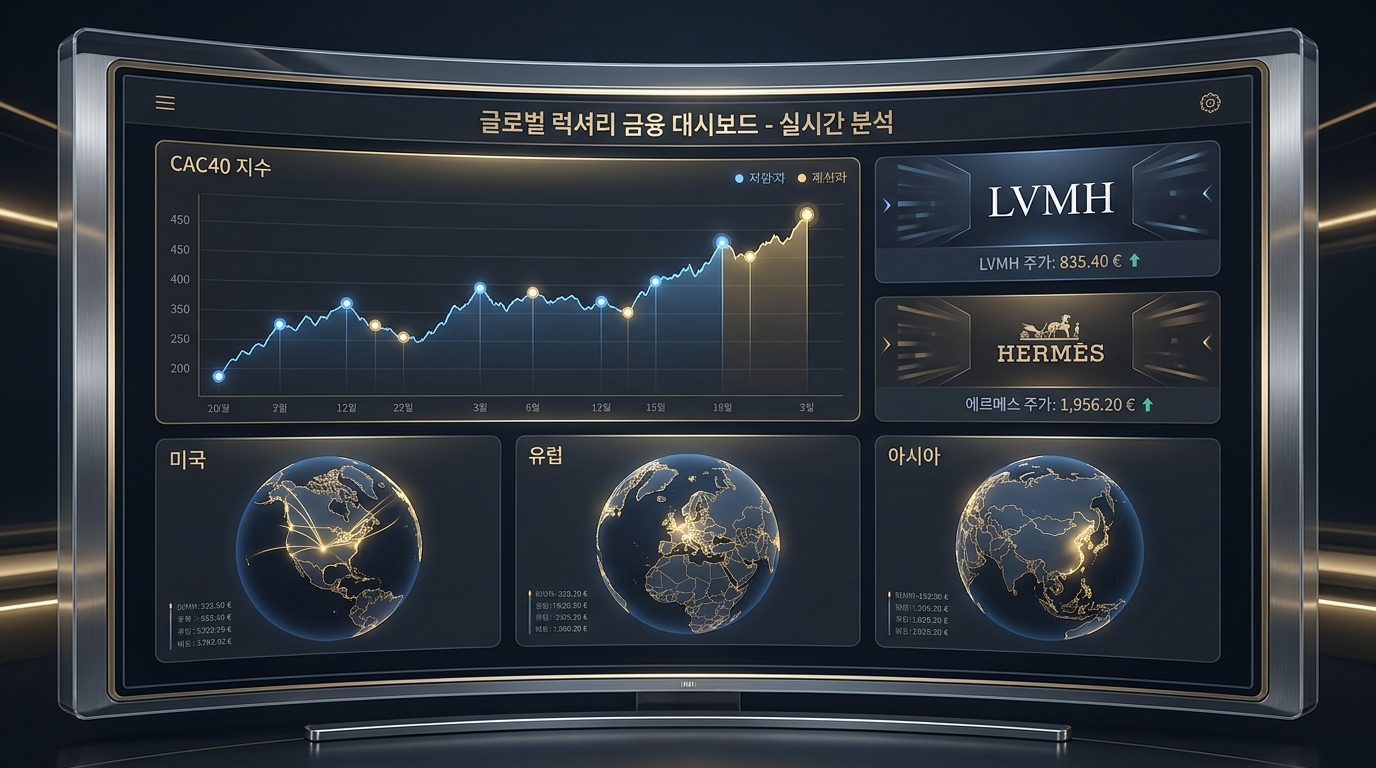
Today, we will deeply analyze the global tri-polar decoupling and macro environment based on the latest trends in the CAC40 luxury sector driving the European stock market.
[Image: /stdaily/uploads/202605/gen_6a11f98fa9cd53.80894042.png]
Core Summary
The Q1 2026 earnings of the leading luxury stocks representing the CAC40 (LVMH, Kering, Hermes) show stark polarization.
While Hermes successfully defended its performance backed by VVIP demand, Kering and LVMH took a direct hit from the global consumption slowdown.
The fundamental decoupling of the US, Europe, and Asia (US-EU-Asia) is shaking up the landscape of the luxury market.
The US is absorbing liquidity with strong economic indicators, while China's consumption slump is showing a prolonged trend.
The KRW/USD exchange rate reaching 1,519.00 KRW and the volatility of raw material prices such as oil and copper are highly likely to act as a cost burden for luxury companies.
Furthermore, the differentiation in monetary policies among the ECB (European Central Bank), BOJ (Bank of Japan), and PBOC (People's Bank of China) is making global capital flows even more complex.
Current Situation Summary
Currently, global stock markets are in an unusual situation where extreme index rallies and regional fundamental disparities coexist.
As of the market close on May 24, 2026, the KOSPI continued its rally to record 7,847.71, and the NASDAQ reached 26,343.97.
In contrast, European stock markets are moving within a box range due to geopolitical risks in the Middle East and concerns over sluggish demand from China.
Particularly, the CAC40 index, the core of European stock markets, faced downward pressure immediately following the disappointing earnings announcements of luxury brands.
Global liquidity is showing a 'black hole phenomenon,' being strongly drawn to the US market led by the NASDAQ.
The NASDAQ Fear & Greed Index is currently Neutral (58.6), somewhat stabilized compared to Greed (63.2) a week ago, but still maintains strong momentum.
The KOSPI Fear & Greed Index is also currently Neutral (57.3), catching its breath at a level similar to a week ago (58.9).
Amid this, global PMI indicators simultaneously show an expansion phase in the US and contraction phases in Europe and Asia, clearly proving the tri-polar decoupling.
[Image: /stdaily/uploads/202605/gen_6a11f9a37abf09.51786482.png]
Financial Analysis
The recently announced Q1 2026 earnings of Europe's top 3 luxury companies clearly demonstrate the global consumption polarization.
Declining retail sales in the Middle East and slowing demand in Asia played out differently depending on each company's portfolio.
| Company Name | Q1 2026 Key Earnings Highlights | Regional Sales Trends |
|---|---|---|
| **Hermes** | Revenue €4.1 billion (6% increase at constant exchange rates) | Strong in US (+17%), Japan (+10%); Europe (-3%) |
| **LVMH** | Revenue €19.121 billion (6% decrease YoY) | Sluggish demand in Asia including China; hit in Fashion/Leather Goods division |
| **Kering** | Stock price plunged as core brand Gucci missed revenue estimates | Middle East dropped 11%; overall turnaround delayed |
Hermes saw a 1% decrease based on floating exchange rates, but proved its superior defensive capabilities against competitors backed by ultra-high-priced, scarce models (such as the Birkin bag).
By recording double-digit growth in the US and Japanese markets, it showed the underlying strength to offset the stagnation in the Chinese market.
Conversely, Kering experienced a significant negative growth due to the delayed turnaround of its biggest brand, Gucci, combined with geopolitical headwinds originating from the Middle East.
LVMH also announced earnings that fell short of analysts' estimates, struggling in its core profit axis, the Fashion and Leather Goods division.
Financially, notable points are the strong dollar trend reaching 1,519 KRW and the volatility of raw material prices.
The surging prices of key raw materials like gold and copper could become a long-term pressure factor on the Cost of Goods Sold (COGS) structure for groups possessing high-end jewelry and watch lineups.
Valuation
Currently, the US-centric global liquidity black hole phenomenon is forcing a relative valuation readjustment.
While the P/E multiples of Big Tech companies listed on the NASDAQ (26,343.97) remain at the historical upper end, the multiples of European luxury stocks have entered a downward stabilization phase.
Hermes continues to receive the highest premium within the peer group based on its overwhelming brand dominance.
However, for Kering and LVMH, stock price discounts are deepening as concerns over declining demand in the Asian region are reflected.
Amid the US-EU-Asia tri-polar decoupling, the relative strength of Asian stock markets, especially China's Shanghai Composite Index, is lagging significantly.
Since the growth of European luxury companies heavily relied on China's high growth in the past, the weakening of Asian fundamentals directly acts as a valuation cap for key European indices.
[Image: /stdaily/uploads/202605/gen_6a11f9b9869f45.42628857.png]
Expert & Institutional Analysis
Global investment banks define 2026 as a 'year of realignment' for the luxury sector and are lowering their expectations.
Major IBs like Barclays are approaching short-term earnings recovery scenarios conservatively and recommending portfolio diversification.
From a macro perspective, experts are paying attention to the differentiation in monetary policies of the ECB, BOJ, and PBOC.
Amid the prolonged high interest rates of the US Fed, if the ECB initiates independent interest rate cuts, there are suggestions that a weaker euro could provide a currency momentum for European exporting companies.
However, concerns over a so-called 'liquidity trap'—where the PBOC's liquidity supply fails to stimulate domestic consumption in the real economy—are holding them back.
The possibility of policy changes by the Bank of Japan (BOJ) is also analyzed as a key variable that will impact purchasing power in Japan, which has recently driven the boom in luxury consumption.
Experts agree that the era where all luxury brands rise together ("a rising tide lifts all boats") is over.
The dominant assessment is that only companies that have secured brand scarcity and loyal ultra-high-net-worth customers will be able to protect their margins.
Risk Factors
The biggest risk factor is the prolonged geopolitical conflicts in regions like the Middle East and subsequent supply chain disruptions.
Since the outbreak of war, tourism and retail consumption in the Middle East, including the global hub Dubai, have plummeted, dealing an immediate blow to the earnings of luxury companies.
The second is polarized consumer sentiment and the deepening of global fundamental decoupling.
Amid global economic uncertainty, middle-class consumption of 'entry-level luxury goods' is shrinking significantly, which could aggravate the inventory burden for mass luxury lineups.
The third is the possibility of reigniting inflation triggered by a strong dollar and raw materials.
The stubbornly high prices of key raw materials like oil and copper raise manufacturing costs across consumer goods, which could undermine the operating profit margins of brands facing resistance to price hikes.
Investment Perspective
The current global market is in a complex phase where the historical level-up of the NASDAQ and KOSPI intersects with the stagnation of European indices.
As the fundamental gap among the US, Europe, and Asia widens, it is necessary to closely scrutinize the relative strength by country and sector when managing a global portfolio.
When approaching the European CAC40 index or the luxury sector, you should thoroughly separate each company's dependence on Asian sales from its brand dominance.
Under a scenario of a prolonged domestic consumption slump in China, only high-end luxury goods with solid demand in North America and among ultra-high-net-worth individuals can secure a margin of safety.
The fact that DailyStock's Fear & Greed Index is hovering in the neutral territory for both the KOSPI (57.3) and NASDAQ (58.6) implies that the market is reassessing fundamentals following a greedy rally.
It is a time that requires flexible adjustment of the cash portion while keeping an eye on the direction of the exchange rate (1,519.00 KRW) and the outcomes of monetary policy meetings by central banks of major countries.
Q&A with DailyStock
Q1. How large is the proportion of luxury stocks in the CAC40?
In the CAC40 index of the Paris stock market, the market capitalization proportion of luxury and cosmetic companies such as LVMH, Hermes, Kering, and L'Oreal is extremely vast.
They play such a core role that the performance of these companies determines a significant part of the index's direction.
Q2. What exactly does the US-EU-Asia tri-polar decoupling mean?
It refers to a phenomenon where economic trends move differently in each region: the US leads with tech and AI innovation, Europe experiences stagnant growth in traditional manufacturing and luxury industries, and Asia faces an economic slump centered on China's real estate and domestic demand.
Unlike the past when the global economy was synchronized (coupled), currently, the fundamentals and monetary policy directions of each region are completely diverging.
Q3. The USD/KRW exchange rate is 1,519 KRW. How should we view the exchange rate risk when investing in European luxury stocks?
If the US dollar remains super-strong and the euro weakens relatively, the perceived price for US consumers buying European luxury goods lowers, which can contribute to revenue growth.
However, from the perspective of a Korean investor, when investing in euro-denominated assets, the volatility of the KRW/EUR exchange rate must be hedged or factored in to calculate returns.
Q4. Could China's PBOC stimulus package be the key to a rebound for European luxury stocks?
Theoretically, liquidity supply by the People's Bank of China (PBOC) leads to a boost in domestic consumption, acting as favorable news for the luxury industry.
However, due to China's current structural real estate crisis and employment insecurity, the released funds fail to translate into consumption. Thus, many evaluate it as somewhat insufficient to serve as a short-term rebound momentum.
Q5. How does the recent rise in raw material prices, such as copper, relate to the luxury industry?
The luxury industry, especially high jewelry and high-end watch manufacturing, is directly exposed to the prices of precious metals and raw materials like gold and copper.
When raw material prices surge, the Cost of Goods Sold (COGS) increases. In a situation where it is not easy to raise consumer prices due to an economic slowdown, there is a risk that corporate profit margins will be undermined.