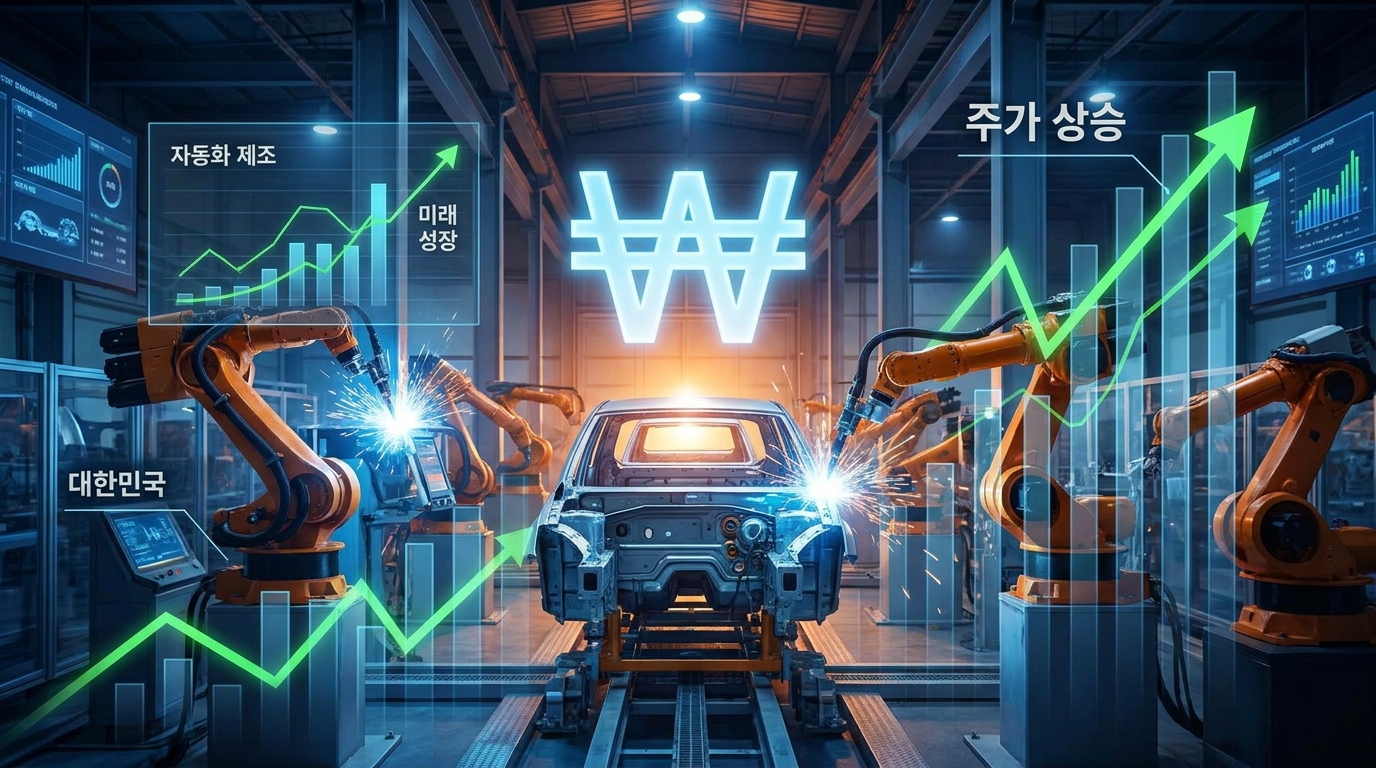
Hello, I am a professional writer at Daily Stock.
Today, we will examine the fundamentals of a large auto parts stock drawing attention for its solid FX gains and new robotics business amid the ultra-strong 1,500 won/dollar environment.
Core Summary
As the high exchange rate trend of 1,514 KRW/USD continues, the translation profit defense of auto parts stocks with a high proportion of overseas sales is being highlighted.
In particular, Hyundai Mobis effectively offset the initial investment costs of its electrification business based on the high margins of its A/S (After-Sales) parts division as of the first quarter of 2026.
With the possibility of joining the robotics value chain linked to Boston Dynamics, the company's future mobility value beyond a simple parts manufacturer is currently drawing attention.
Although variables such as the risk of a 15% tariff imposed by the US and the slowdown in EV demand exist, the operation of the new US plant (HMGMA) in the second half of the year could serve as a barometer for an earnings turnaround.
Current Situation Summary
As of May 24, 2026, the KOSPI closed at 7,847.71, KOSDAQ at 1,161.13, and NASDAQ at 26,343.97, maintaining solid index levels.
However, with the KRW/USD exchange rate soaring to 1,514.00 KRW, the differentiation of foreign supply and demand by sector is intensifying.
According to Daily Stock's proprietary Fear & Greed Index, the KOSPI is currently at a Neutral (57.3) level, cooling down somewhat compared to Neutral (58.9) one week ago, Greed (64.8) one month ago, and Greed (63.4) three months ago.
The NASDAQ Fear & Greed Index also currently records Neutral (58.6), stepping down from Greed (63.2) a week ago, Greed (68.5) a month ago, and Greed (66.8) three months ago, indicating a deepening wait-and-see attitude.
[Image: /stdaily/uploads/202605/gen_6a12a2aa3b3975.00334048.png]
Financial Analysis
Hyundai Mobis achieved top-line growth with its consolidated sales in the first quarter of 2026 reaching 15.5605 trillion KRW, a 5.5% increase year-over-year (YoY).
Operating profit provisionally tallied at 802.6 billion KRW, up 3.3% YoY, while net income decreased by 14.4% to 883.1 billion KRW.
These results can be interpreted as the strong performance of the A/S parts division driven by the high exchange rate offsetting the deficit in the electrification sector.
Although the initial investment costs from the new operations of the Slovakia and Spain plants were reflected, the supply of high value-added electronic parts combined with R&D capabilities defended profitability.
| Company | Q1 2026 Sales | Q1 2026 Operating Profit | Q1 2026 Net Income |
|---|---|---|---|
| Hyundai Mobis | 15.5605 trillion KRW (+5.5%) | 802.6 billion KRW (+3.3%) | 883.1 billion KRW (-14.4%) |
* Figures in parentheses represent year-over-year (YoY) growth rates.
Valuation
Currently, the auto parts industry is experiencing a valuation discount compared to finished automakers, but it is increasing its attractiveness through shareholder return policies such as high dividends and share cancellations.
Hyundai Mobis announced plans to newly purchase and cancel 500 billion KRW worth of treasury shares this year, while also maintaining its cash dividend policy at around 6,500 KRW per share.
The ultra-strong dollar in the 1,500s can boost the profit strength of export parts makers, acting as a factor that highlights short-term stock valuation appeal.
However, for major valuation indicators to undergo a full-fledged revaluation, the timing of the electrification sector's turnaround to a surplus is highly likely to serve as a crucial key.
[Image: /stdaily/uploads/202605/gen_6a12a2bc4ccf79.29369651.png]
Expert & Institutional Analysis
The securities industry estimates that Hyundai Mobis enjoys a structural benefit where its annual operating profit increases by approximately 30 billion KRW for every 10 KRW increase in the KRW/USD exchange rate.
While a rise in the period-end exchange rate hovering around 1,500 KRW may cause temporary valuation losses, the fundamental FX gain effect is clear since the proportion of overseas sales of A/S parts is absolute.
Additionally, the possibility of in-house development of core components like actuators installed in Boston Dynamics' robots is being highlighted among future mobility experts.
In the short term, there is also an analysis that if the operation of the North American EV-dedicated plant (HMGMA) gets on track in the second half of this year, a turnaround in the sluggish module division is expected.
Risk Factors
If the stagnation in global EV demand prolongs, fixed cost burdens could persist due to a drop in the utilization rates of electrification parts plants that have undergone massive investments.
The recent resurgence in prices of key raw materials, such as automotive semiconductors, raises concerns about upward pressure on costs.
In particular, the US government's 15% tariff policy on Korean automobiles and parts is considered a core risk that could directly hit profitability in the second half.
Although the high exchange rate is offsetting some costs, the possibility of structural profit strength deterioration for parts makers cannot be ruled out if the tariff rate is applied long-term.
[Image: /stdaily/uploads/202605/gen_6a12a2d14f8e56.15096976.png]
Investment Perspective Summary
Currently, large auto parts stocks are in a position to silently defend against the uncertainties of downstream industries, backed by a solid cash cow (A/S business) and the strong dollar.
Specifically, the dollar exchange rate of 1,514 KRW acts as a sturdy umbrella that temporarily supplements the financial structures of export companies.
From a long-term perspective, it is necessary to track whether their constitution is improving into comprehensive mobility companies centered on robotics and AI, beyond simply supplying auto parts.
A strategy of approaching conservatively while monitoring the expansion of mass production volumes at the new US EV plant and the execution of shareholder returns in the second half could be reasonable.
Investor Checkpoints Q&A
Q1. Is the ultra-strong dollar in the 1,500s good news for auto parts stocks?
It acts as a short-term boon that increases KRW translation profits due to the nature of parts makers with a high proportion of overseas sales.
However, it can be a double-edged sword with rising imported raw material prices and expanded exchange rate volatility.
Q2. When can Hyundai Mobis' electrification division deficit be resolved?
Experts predict that the turnaround timing could be advanced once the yields of new plants like the North American EV-dedicated plant (HMGMA) stabilize and mass production volumes increase in the second half.
Q3. How significant is the impact of the US tariff imposition (15%)?
While the tariff imposition is a direct cost burden factor, it is estimated that profit damage can be partially defended through the current high exchange rate effect and hikes in A/S parts prices in the second half.
Q4. Why is robotics recently being highlighted in auto parts stocks?
This is because the likelihood of Hyundai Mobis joining the value chain of core driving components, such as actuators used in Boston Dynamics' robots, has increased in line with Hyundai Motor Group's AI robotics ecosystem expansion.
Q5. What is Hyundai Mobis' shareholder return policy for 2026?
It is known that the company plans to newly purchase and cancel 500 billion KRW worth of treasury shares this year and maintain a dividend of around 6,500 KRW per share, similar to the previous year.