[Image: /stdaily/uploads/202605/gen_6a0f5694e34dd0.44691731.png]
Hello, this is Daily Stock, where we highlight today's key stock market issues amidst the changing global macro environment.
We provide objective market analysis based on complex macroeconomic indicators and the latest corporate trends.
Core Summary
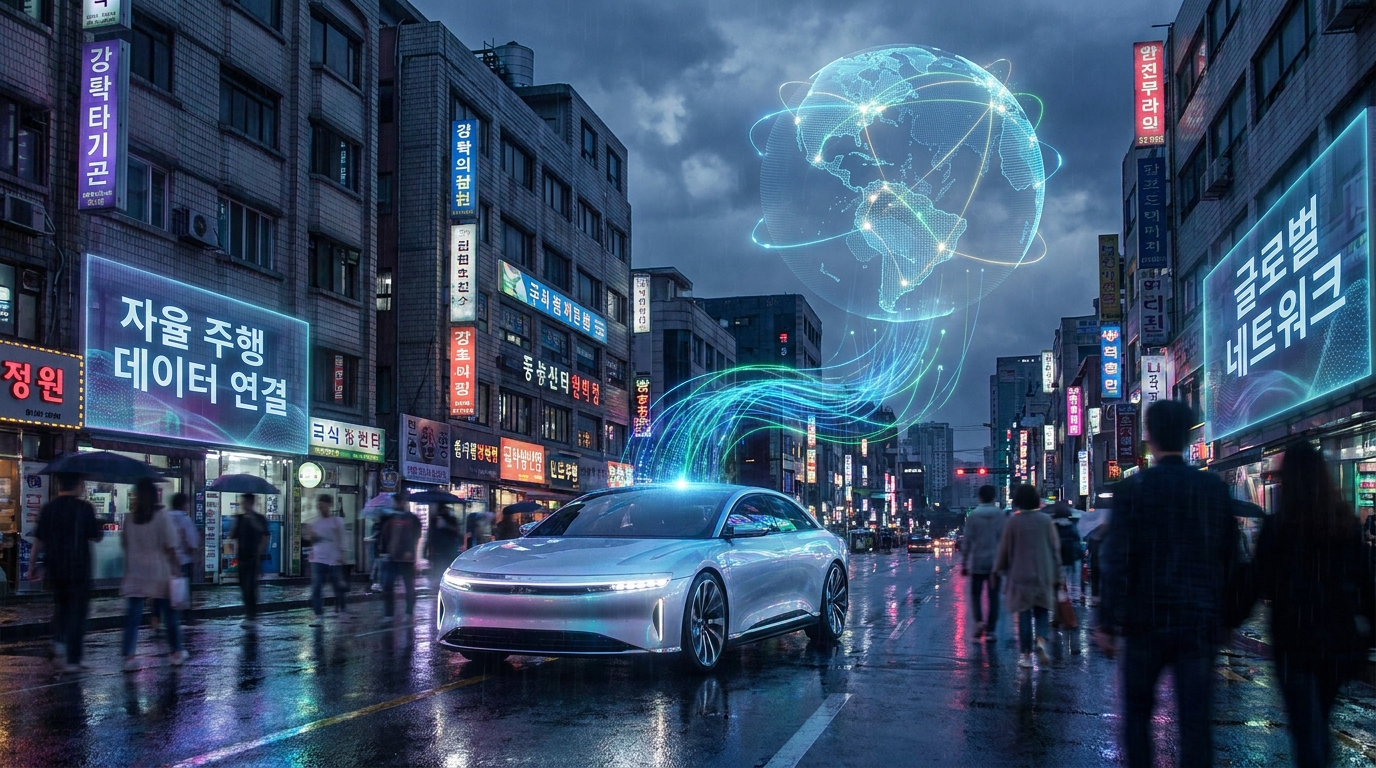
Tesla has officially announced its 'Supervised Full Self-Driving (FSD)' service in global markets, including China and South Korea.
This raises the possibility of it acting as a new software-driven revenue generation momentum amidst concerns over slowing demand in the global EV market.
On the global macro front, fundamental decoupling between Europe and Asia is deepening, while US-centric AI and software capital expenditures remain strong.
Accordingly, global liquidity spillover effects and the divergence of monetary policies among central banks are emerging as key variables across the stock market.
Current Situation Summary
As of intraday trading today (provisional), KOSPI is recording 7815.59, KOSDAQ 1105.97, and NASDAQ 26187.93.
The KRW/USD exchange rate is trading around the 1508.40 won level, reflecting a phase of increased exchange rate volatility in the Asian region.
According to Daily Stock's proprietary Fear & Greed Index, the KOSPI Fear & Greed is currently Neutral (58.6), similar to Neutral (58.5) 1 week ago, and showed Greed (65) 1 month ago and Neutral (58.1) 3 months ago.
On the other hand, the NASDAQ Fear & Greed is currently Greed (60.8), slightly cooled down compared to Greed (65) 1 week ago, Greed (67.6) 1 month ago, and Greed (66.2) 3 months ago, but investment sentiment remains hot.
On May 21, 2026 (local time), Tesla announced via its official X account that it will support the Supervised FSD service in 10 countries, including China, South Korea, and Australia.
This announcement came about a week after Tesla CEO Elon Musk accompanied US President Donald Trump on his state visit to China.
Currently, Tesla is urgently hiring Autopilot test engineers and real-world driving personnel not only in 9 major Chinese cities like Beijing and Shanghai, but also in South Korea.
This is interpreted as a stepping stone to enhance global autonomous driving algorithms by collecting edge case data generated in actual road environments.
Financial Analysis
Tesla's EV market share in China has noticeably declined from the 16% level in 2020 to the 6% range in 2026.
Fierce price cut offensives and technological pursuits by mainland Chinese companies like Xiaomi and Huawei have acted as major causes of the sluggish performance.
In response, Tesla is securing FSD software revenue in the Chinese market through a lump-sum purchase method of around 64,000 yuan (approx. 14 million KRW) instead of a monthly subscription plan.
Attention is on whether the eventual official introduction of monthly subscription services in China will increase the portion of recurring software revenue (Recurring Revenue), thereby defending against the decline in hardware sales margins.
| Indicator Category | Tesla (TSLA) Global Core Financials & Market Share Trends |
|---|---|
| **Market Share in China** | Declined from 16% in 2020 → Current 6% level in 2026 |
| **FSD Price in China** | Lump sum 64,000 yuan (Subscription not introduced) |
| **Core Challenge** | Defend against vehicle unit price cut competition pressures & expand software revenue share |
| **Competitive Environment** | Advancement of autonomous driving by local companies like Xiaomi, Xpeng, and Huawei |
Valuation
Currently, Tesla's valuation reflects a premium not just as a simple manufacturing (hardware) company, but as a global AI infrastructure and software platform company.
Amidst the bull market led by US Big Tech (NASDAQ 26187.93), Tesla securing vast data from China can act as a factor for valuation re-rating.
Global stock markets are currently experiencing a fundamental decoupling phenomenon among the three poles of the US, Europe, and Asia.
While the US maintains premium value due to solid employment and AI factory-focused capital expenditures (CAPEX), Europe continues to see the ECB's independent policy moves and a value stock-oriented market.
In the case of the Asian market, it remains in a relative valuation discount zone due to the divergence of monetary policies between the BOJ of Japan and the PBOC of China, along with the burden of the KRW/USD exchange rate breaking the 1500 won mark.
In such a macroeconomic environment, Tesla's localization strategy is evaluated as an attempt to maximize valuation by breaking through global geopolitical barriers.
[Image: /stdaily/uploads/202605/gen_6a0f56a74766a2.56041292.png]
Expert & Institutional Analysis
Gary Ng, Senior Economist at French investment bank Natixis, analyzed, "President Trump's visit to China seems to have expedited the long-delayed approval process."
He also predicted, "Tesla's introduction of FSD will serve as an opportunity to further promote innovation and competition in the Chinese autonomous driving market."
From a global macro perspective, institutions are keeping a close eye on the ripple effects that regional deviations in manufacturing PMIs and volatility in raw material prices, such as oil and copper, have on the mobility value chain.
Amid surging prices of essential electrification raw materials like copper, the dominant analysis is whether securing margins centered on software technological prowess will serve as a key indicator determining the relative strength of companies.
In particular, the widening interest rate gap between the US Fed and central banks of Asian emerging countries is fueling a concentration of global funds.
Because of this, a decoupling pattern is prominent, where foreign capital is only limitedly flowing into select tech and value stocks with solid fundamentals in Asian stock markets.
Risk Factors
Geopolitical conflicts and data security issues between the US and China remain significant risk factors standing in Tesla's way.
According to local Chinese regulations, driving data must be stored in data centers within China, and its transfer overseas is strictly prohibited, which could restrict integrated algorithm training.
Furthermore, due to the US government's export controls on advanced AI semiconductors, there are physical limitations to building large-scale AI supercomputer infrastructure locally in China.
Technically, the fact that it is still a 'Supervised' version requiring driver intervention, rather than completely 'Unsupervised' full self-driving, may cause a gap with consumer expectations.
The market preemption effect by native Chinese companies like Xpeng and BYD, which have already internalized advanced driving assistance systems, cannot be ignored either.
Their fierce price competitiveness and technological leaps are considered potential threats slowing down the pace of Tesla's market share recovery.
Investment Perspective Summary
Tesla's FSD launch in China and global markets is an important turning point to break through the slowed hardware-centric growth curve with software.
However, in a US-Europe-Asia tri-polar decoupling environment where country-specific data security regulations and domestic industry protectionism are intensifying, diplomatic and regulatory response capabilities beyond technical progress are required.
Amid high exchange rates and global liquidity upheavals, investors must comprehensively consider the impacts of macroeconomic environment changes in addition to the fundamentals of individual companies.
This analysis is written based on various macroeconomic variables and scenarios, and under no circumstances is it intended as investment solicitation or stock recommendation.
Investor Checkpoint Q&A
Q1. What is presumed to be the decisive background for Tesla receiving FSD approval in China?
It is widely discussed that CEO Elon Musk recently accompanying the US economic delegation to China and accelerating consultations with regulatory authorities is the main background.
Q2. Is the FSD introduced in China and South Korea this time fully unmanned autonomous driving?
No.
The current system is a 'Supervised' version that requires the driver's continuous attention and intervention.
Q3. What does the global US-Europe-Asia tri-polar decoupling phenomenon mean?
It refers to the phenomenon where the economic fundamentals and stock market directions of the three regions appear differently: the US shows tech and AI-driven strength, Europe a gradual recovery centered on value stocks, and Asia relative weakness due to geopolitics and exchange rate burdens.
Q4. What is the FSD competition situation between native Chinese companies and Tesla?
Xiaomi, Huawei, and Xpeng have already equipped their EVs with their own urban assisted driving functions, rapidly increasing their market share and fiercely chasing Tesla.
Q5. What is the geopolitical risk investors should be most aware of?
It is the point that due to bilateral data export regulations and AI semiconductor export controls, it may be difficult for Tesla to fully utilize the vast driving data collected in China for the advancement of its global AI models.