Welcome readers to DailyStock, where we delve into tech stock fundamentals amidst macroeconomic volatility.
Key Summary
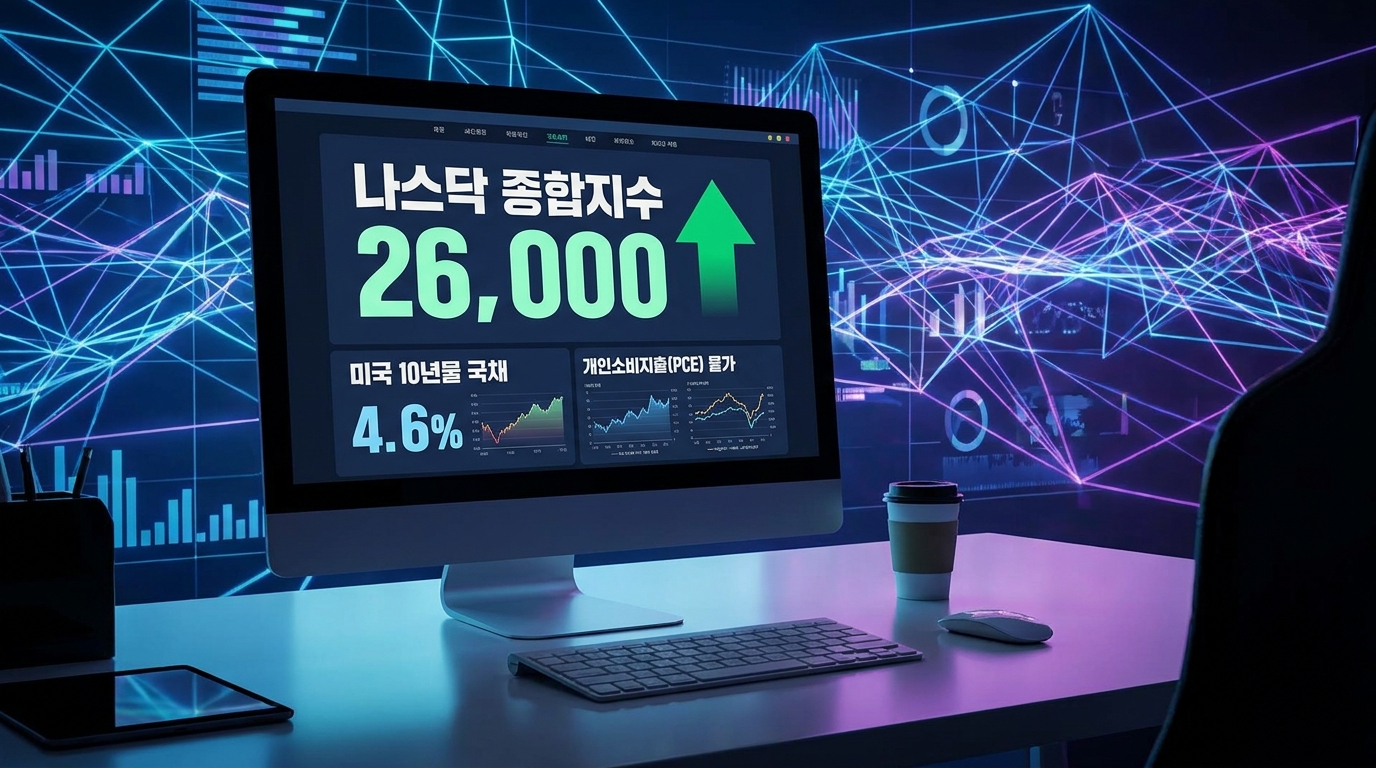
With the recently released US Personal Consumption Expenditures (PCE) price index showing stickiness primarily in the services sector, discussions regarding the revaluation of Nasdaq multiples are highly active.
Even though the 10-year Treasury yield (US10Y) has entered the 4.6% range, the aggressive AI CAPEX investments by major Big Tech companies appear to be supporting the downside of the index.
Current Situation Overview
As of intraday (provisional) on May 21, 2026, the Nasdaq index recorded 26,270.36, continuing its solid trend.
At the same time, the KOSPI traded at 7,489.77, the KOSDAQ at 1,084.09, and the USD/KRW exchange rate at 1,498.50 won, showing synchronized movements with global macro trends.
According to DailyStock's own Fear & Greed Index, the KOSPI Fear & Greed is currently Neutral (47.7), 1 week ago Greed (65), 1 month ago Greed (60.2), and 3 months ago Neutral (57.3).
On the other hand, the Nasdaq Fear & Greed is currently Greed (60.9), 1 week ago Greed (64), 1 month ago Greed (70), and 3 months ago Greed (69.2).
Financial Analysis
While the core PCE, a key inflation indicator, remains at a high level, the market is paying attention to super-core inflation, which excludes energy and housing costs.
As service sector prices, which have a high proportion of labor costs, do not easily subside, expectations for early interest rate cuts by the Federal Reserve are largely retreating.
Nevertheless, Big Tech companies raised their annual AI infrastructure CAPEX guidance by tens of billions of dollars during their earnings announcements last quarter.
This can be interpreted as financial confidence to guarantee growth based on their own free cash flow even under macro pressure.
| Key Indicator | Current Value (Intraday Provisional) | Recent Trend | Market Implication |
|---|---|---|---|
| **Nasdaq Index** | 26,270.36 | Sideways after rising | Confirmation of AI value chain earnings defense |
| **US 10-Year Yield (US10Y)** | 4.6% range | Fluctuating near peak | Tech stock valuation pressure factor |
| **Dollar Index (DXY)** | Around 98.6 | Maintaining slight strength | Growing concerns of emerging market capital outflows |
| **Volatility Index (VIX)** | Around 15.0 | Stabilization phase | Absence of extreme fear in the options market |
Valuation
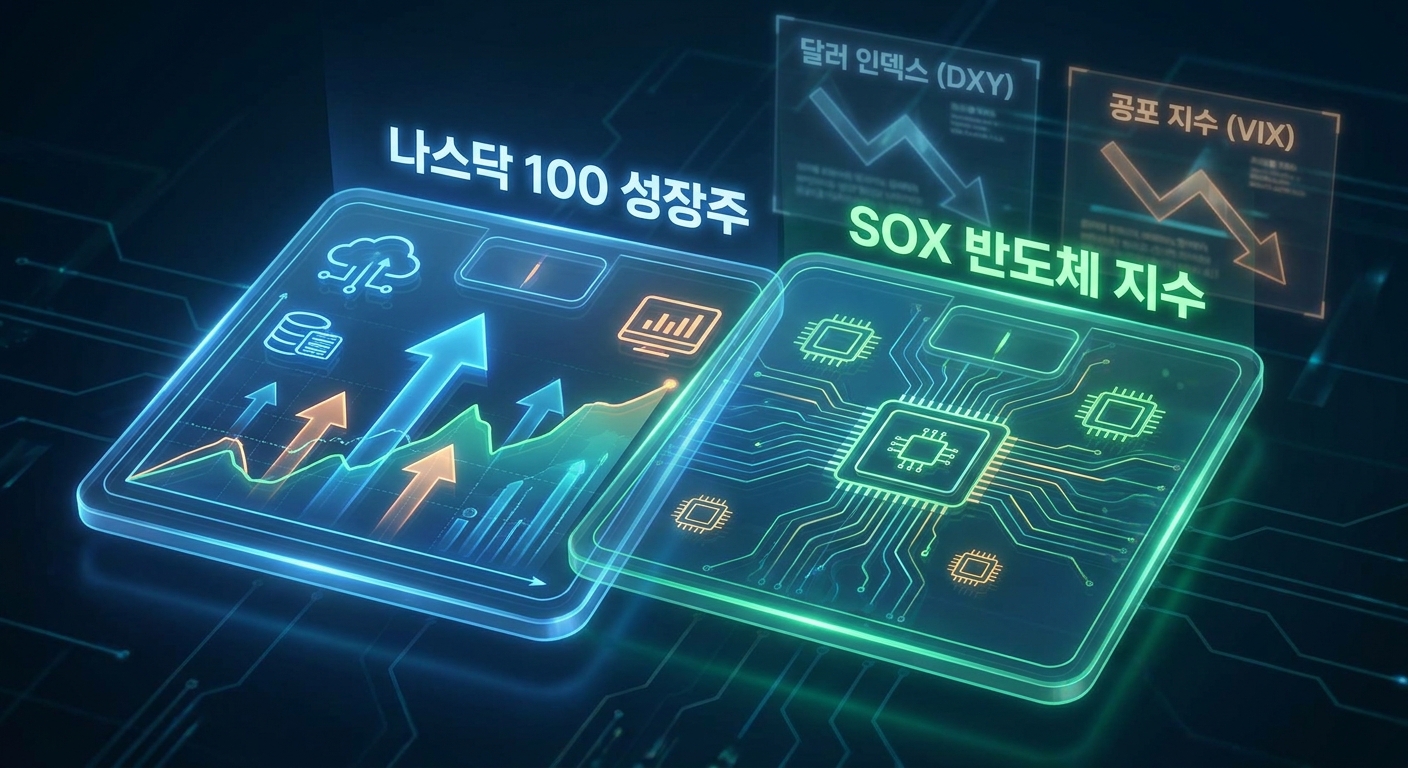
In the past, the Nasdaq 100 index tended to experience rapid multiple contractions in its Price-Earnings Ratio (PER) when the US10Y exceeded 4.5%.
However, it is now suggested that the Philadelphia Semiconductor Index (SOX), centered on AI chips, is generating solid earnings and may defend against a multiple decline across the entire Nasdaq.
Compared to traditional growth stocks in the S&P 500, if the earnings growth rate of core Nasdaq companies exceeds the extent of the interest rate hikes, the overvaluation controversy can be resolved.
Ultimately, how much the upward revision of earnings estimates offsets the discount rate burden caused by rising interest rates is the core axis of valuation.
Expert & Institutional Analysis
Global investment banks diagnose that the sticky PCE indicator could induce a short-term strengthening of the dollar (DXY), which could burden tech stock supply and demand.
In particular, under a prolonged high interest rate scenario, the prevailing forecast is that capital will increasingly flow toward Big Tech companies with excellent cash-generating capabilities rather than small and mid-sized tech stocks with high debt ratios.
Some experts note that the VIX index is stable around 15.0, mentioning the possibility that the market has already largely priced in the interest rate risk.
However, there is also a cautious view that if macro indicators deteriorate further, portfolio rebalancing by institutional investors could increase volatility.
Risk Factors

The biggest risk is the possibility that astronomical AI CAPEX may not lead to distinct monetization in the short term.
If AI revenue growth is delayed in B2B software and other areas, there is a risk that multiples will contract rapidly in conjunction with the high interest rate environment.
In addition, the accelerating pace of the introduction of AI regulatory bills by major global countries could also cause cost increases across the entire value chain.
If expectations for the Fed's interest rate cuts are completely extinguished, the liquidity-driven market that has supported the Nasdaq could rapidly shift to a fundamentals-driven market, causing growing pains.
Investment Perspective Summary
The US PCE indicator and the 4.6% range Treasury yields have room to act as short-term resistance levels for the Nasdaq market.
However, as long as strong cash flows and infrastructure investments by major Big Tech companies continue, it is highly likely that the long-term growth narrative will remain intact.
Investors should take an approach of closely examining the earnings visibility and capital allocation strategies of individual companies rather than simply betting on the index direction.
As macro uncertainties persist, conservative risk management through split purchases and cash proportion adjustments is required at this time.
Frequently Asked Questions
Q1. What is the difference between Core PCE and Headline PCE?
Headline PCE includes all consumer items, while Core PCE excludes highly volatile energy and food, showing the underlying trend of inflation.
The Federal Reserve tends to refer to this Core PCE as the most important indicator when making monetary policy decisions.
Q2. Why is a rising US10Y yield a burden on the Nasdaq?
Treasury yields serve as the benchmark for the discount rate used to convert a company's future earnings into present value.
Since growth stocks concentrated in the Nasdaq have high expectations for future earnings, a higher discount rate can cause their present value to drop relatively significantly.
Q3. What is the relationship between the Philadelphia Semiconductor Index (SOX) and the Nasdaq 100?
The SOX is an index comprising major semiconductor design and equipment companies, and it acts as a core upward driver for the Nasdaq 100.
Recently, due to the explosive demand for AI semiconductors, the phenomenon where the SOX trend dictates the overall investment sentiment of the Nasdaq has become stronger.
Q4. How does the rise in the DXY (Dollar Index) affect foreign supply and demand?
When the value of the dollar rises, the value of emerging market currencies relatively falls, increasing the likelihood of foreign capital outflows due to concerns over foreign exchange losses.
This means that while global liquidity concentrates on US assets, it can act as a supply and demand burden on the domestic stock market.
Q5. How long will the AI CAPEX cycle last?
Although it depends on companies' free cash flows and the pace of AI technology development, experts expect long-term investments to continue given the initial infrastructure build-out phase.
However, the possibility of investment scales gradually shrinking cannot be ruled out if substantial returns on investment are not proven.