Hello, this is an expert writer for Daily Stock.
Key Summary
The small-cap rally anticipated in early 2026 has been put to a critical test due to the upward trend of the US 10-year Treasury yield.
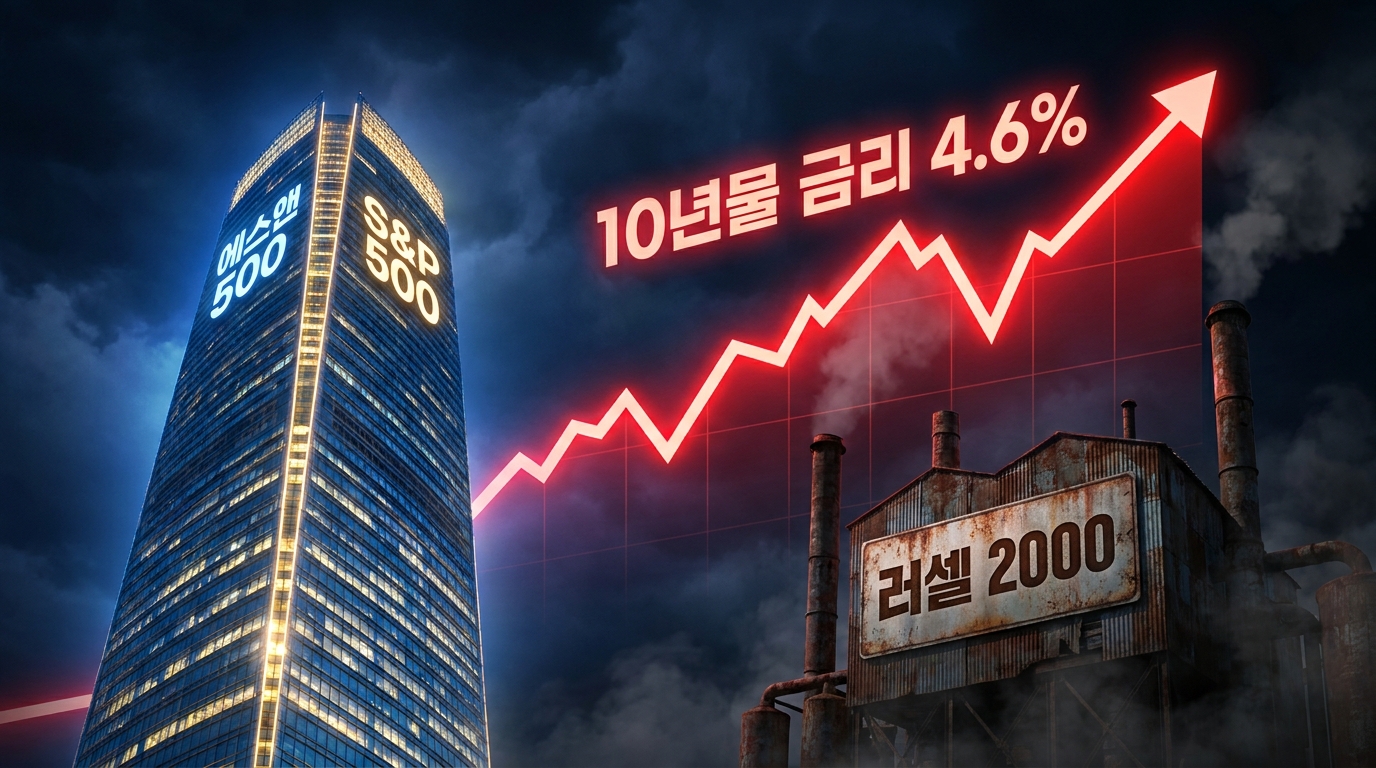
As the interest burden mounts on marginal companies within the Russell 2000 index that have a high proportion of floating-rate debt, the concentration of funds into S&P 500 large-caps is being re-evaluated as a quality premium.
[Image: /stdaily/uploads/202605/gen_6a0d08410848b7.12298609.png]
Current Situation Summary
As of intraday on May 20, 2026 (provisional), the domestic stock market records KOSPI at 7175.53 and KOSDAQ at 1057.69, with the KRW/USD exchange rate trading at 1511.50.
The Nasdaq index, based on the latest confirmed intraday figure from the previous day's US session, shows high volatility around 25870.71, paying close attention to macro indicators.
According to Daily Stock's proprietary Fear & Greed Index, the KOSPI currently shows a neutral level at 49.1.
Investor sentiment has cooled somewhat compared to the Greed level of 1 week ago (64.7) and 1 month ago (61.5).
The Nasdaq Fear & Greed Index is currently at 60.4, still maintaining the Greed zone.
However, compared to 1 week ago (65.1) and 3 months ago (69.7), the index has undergone a correction, partially slowing its momentum.
With the US 10-year Treasury yield recently threatening the 4.6% range, the market's complexion is becoming clearer.
Polarization is deepening between small caps taking a direct hit from rising interest rates and cash-rich large-cap tech stocks.
Financial Analysis
Concerns have been raised that nearly 40% of the companies included in the Russell 2000 index are so-called 'zombie companies' unable to cover their interest expenses with operating profit.
As the refinancing period approaches for debt raised during the past low-interest-rate era, prolonged high interest rates are mechanically compressing the free cash flow (FCF) of small and medium-sized enterprises.
In contrast, S&P 500 companies are proving their robust earnings and margin defense capabilities.
Growth-oriented large-cap tech stocks are executing massive capital expenditures, such as AI infrastructure, while remaining free from interest expense burdens due to their massive cash-generating capabilities.
This phenomenon goes beyond the traditional comparison of value vs. growth stocks.
While value stocks in the Russell 2000 suffer from deteriorating fundamentals like declining interest coverage ratios, the S&P 500's earnings growth offsets interest rate risks.
[Image: /stdaily/uploads/202605/gen_6a0d0854ab4cd4.13782121.png]
Valuation
Currently, the S&P 500's forward P/E ratio is around 21x, exceeding its historical average.
Based on the trailing P/E ratio, it has reached 30x, fueling ongoing overvaluation controversies, but this reflects the market's strong conviction in earnings growth.
The Russell 2000 is also hovering above a 23x forward P/E, showing an even more expensive valuation than large-caps.
While market consensus optimistically projects the Russell 2000's EPS growth rate at over 60% this year, analysts express doubts about the likelihood of this figure materializing.
In terms of dividend yields, an environment where the 10-year Treasury offers a 4.6% risk-free return halves the appeal of equities.
In addition, as economic growth indicators such as the Atlanta Fed's GDPNow show strong performance, expectations for a Fed rate cut have retreated, increasing the pressure for valuation readjustments.
| Index Classification | Latest Trailing P/E (Estimate) | Market's Key Assessments & Risk Factors |
|---|---|---|
| S&P 500 | Approx. 30x | High earnings visibility, but multiple contraction risks exist if rates rise |
| Russell 2000 | Many companies with no profit | Debt refinancing risks and excessively high EPS growth consensus |
| Nasdaq 100 | Approx. 24~25x | AI investment momentum justifies valuation, but profit-taking burden exists |
Expert·Institutional Analysis
Earlier this year, major investment banks like Goldman Sachs predicted that 2026 would be the year of the small-cap rotation.
However, as the hawkish Fed stance is maintained and inflation (CPI/PCE) indicators come out stickier than expected, institutional perspectives are gradually turning conservative.
Wall Street analysts warn that currently passively tracking the entire Russell 2000 index is dangerous.
Instead, they advise that an active 'alpha generation' strategy is essential, capitalizing on the widening gap between the S&P 500 and the Russell 2000 to uncover specific small caps with solid financial structures.
In terms of sector rotation, a concentration of funds is observed in the IT sector and banking stocks (financials), which boast excellent cash generation among the 11 sectors.
Conversely, high-dividend defensive stocks like utilities and REITs, once considered alternatives to bonds, are taking a direct hit from rising Treasury yields.
[Image: /stdaily/uploads/202605/gen_6a0d0869f25a47.28564078.png]
Risk Factors
The biggest risk is the undermining of the US economy's soft landing scenario due to prolonged high interest rates.
Despite solid employment indicators, if a chain of defaults by rate-sensitive marginal companies materializes, the shock could transfer to the real economy.
Additionally, if inflation (CPI/PCE) fails to converge to the target, the Fed's pivot (policy shift) will be further delayed.
This could act as an overall market downturn signal that drags down even the valuation multiples of large-cap growth stocks.
Investment Perspective Summary
It is difficult to dismiss the concentration in large caps simply as the market's irrational greed.
In an environment of high borrowing costs reaching 4.6%, it is rational that a premium is granted to quality companies that can grow without external funding.
If considering relative value investments in the Russell 2000, one must thoroughly verify the interest coverage ratio of individual companies rather than taking an index-level approach.
Until a rate cut becomes visible, a strategy of increasing portfolio defensiveness and compressing it around sectors backed by solid earnings will be effective.
Investment Checklist
- **Is your portfolio's interest coverage ratio safe?**
You must check financial statements to ensure that the small and medium-sized enterprises you are investing in can cover their interest expenses with operating profits.
- **Are you tracking the trend of the 10-year Treasury yield?**
If it crosses 4.6% and heads toward 5%, it poses a significant threat to the overall stock market, especially to high-multiple tech stocks and highly leveraged small caps.
- **Have you questioned whether EPS estimates are realistic?**
The 60% earnings growth consensus for the Russell 2000 is a fragile figure that could be the first to be downgraded if the macro environment deteriorates.
- **Have you included defensive sectors with good cash flows?**
You need to select companies with excellent actual cash-generating capabilities that can withstand a period of rising interest rates, rather than simple dividend stocks (REITs/utilities).
- **Are you planning split trading utilizing the Fear & Greed Index?**
Since the Nasdaq index remains in the Greed zone (60.4), a conservative approach leveraging market volatility is necessary rather than chasing purchases.