Hello. This is Daily Stock, delivering sharp insights into daily financial market trends.
Executive Summary
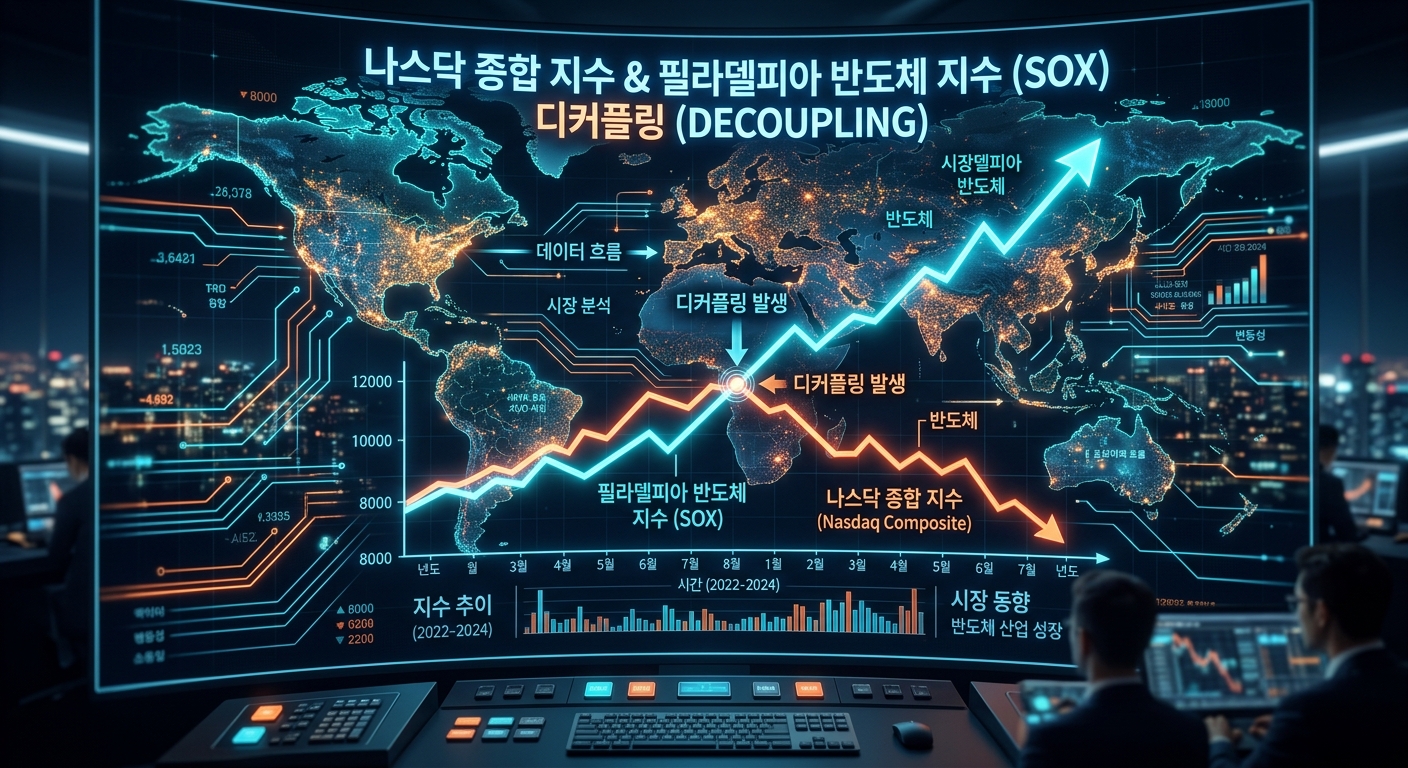
Recently, the Nasdaq market has displayed a decoupling trend, hitting historic highs despite macroeconomic pressures of a prolonged high-interest-rate environment, heavily driven by the sole rally of the Philadelphia Semiconductor Index (SOX).
However, on June 23, 2026, cracks began to show in this decoupling formula as the SOX index plummeted 7.8% on 'Black Tuesday' amid concerns over AI investment overheating and the emergence of low-cost AI models from China.
This report closely compares and analyzes the hawkish policy path of the newly appointed Fed Chair Kevin Warsh and the fundamentals of the semiconductor value chain that have reached ultra-high valuation multiples.
Current Situation Summary
[Image: /stdaily/uploads/202606/gen_6a3c6fd93226f7.05852942.png]
Today (as of intraday on June 25, 2026), domestic and international markets are digesting unprecedented volatility.
As of June 25, 2026, the KOSPI is trading at 8,948.14 and the KOSDAQ at 920.84 during the session, while the KRW/USD exchange rate stands at 1,543.00, facing strong upward pressure from a strong dollar.
On the previous trading day, the Nasdaq closed at 25,476.64, reflecting macroeconomic concerns.
According to Daily Stock's proprietary Fear & Greed Index, the Nasdaq Fear & Greed has entered the 'Current Fear (25.9)' stage, contracting further from 'Fear (32.2)' a week ago.
Meanwhile, the KOSPI Fear & Greed shows 'Current Neutral (41.6)', slightly escaping the 'Fear (27.1)' phase from three months ago, but still keeping market participants on edge.
In particular, the 'Black Tuesday' crash on June 23 exposed the technical vulnerabilities of the SOX index, which had previously been climbing solo despite interest rate pressures.
| Index and Indicator | June 25, 2026 Intraday Value | Nasdaq Fear & Greed Index (Proprietary) | KOSPI Fear & Greed Index (Proprietary) |
|---|---|---|---|
| **KOSPI** | 8,948.14 | - | Current Neutral (41.6) |
| **KOSDAQ** | 920.84 | - | - |
| **NASDAQ** | 25,476.64 | Current Fear (25.9) | - |
| **KRW/USD** | 1,543.00 | - | - |
Financial Analysis
The core driver that had been leading the decoupling of the semiconductor index was the robust capital expenditure (CAPEX) flow from global tech companies.
According to forecasts by major global investment banks (IBs), global cloud and hyperscaler AI-related CAPEX in 2026 is estimated to reach $820 billion, representing a massive 68% year-on-year increase.
This astronomical influx of capital was proven by actual figures, such as Micron's outstanding earnings surprise (reporting an EPS of $12.20 in the recent quarter, beating the market consensus of $8.65).
However, warning signs have emerged that big tech's monopolistic margins could be dented by China's self-reliance efforts in semiconductors and the release of ultra-low-cost AI models.
Furthermore, on Black Tuesday (June 23), Micron plunged 13% just before its earnings release, dragging down major semiconductor stocks such as NVIDIA, AMD, and Qualcomm, leaving investors deeply concerned.
If the actual pace of AI revenue conversion fails to meet the market's high expectations relative to the rapid expansion of investment costs, a slowdown in the profit margins of the semiconductor value chain is deemed inevitable.
Valuation
[Image: /stdaily/uploads/202606/gen_6a3c6fe215be80.12768120.png]
Currently, the average Price-to-Earnings (P/E) ratio of the SOX index components is 37.62x, and the Price-to-Book (P/B) ratio is 14.23x, reaching the upper bound of historical valuations.
Some global asset managers are raising pessimistic views, suggesting that the overheating level of the SOX index is similar to technical indicators seen just before the dot-com bubble in June 2000.
Particularly, under mounting pressure from the Fed's interest rates, these high multiples are acting as a catalyst for extreme stock price volatility.
On the macroeconomic front, the US 10-year Treasury yield remains high, and a technical distortion where the US 2-year Treasury yield exceeds the benchmark rate has become entrenched.
This suggests that high interest rates will persist for much longer than the market expects. An increase in the risk-free rate raises the discount rate for future cash flows of highly valued tech stocks, applying downward pressure on multiples.
Consequently, even in the absence of fundamental damage, the continuous strength of interest rates and the US Dollar Index (DXY) itself is adding downward pressure on both the SOX and the Nasdaq.
Expert & Institutional Analysis
Global financial institutions are sharply divided on whether the recent plunge in the semiconductor index is a temporary technical correction or the beginning of a structural decline.
UBS evaluated, "Companies' capital expenditures on AI remain strong, and pent-up demand exceeds supply. This correction is a temporary breathing spell to normalize valuations after a high-growth rally." They recommend maintaining a semiconductor-heavy portfolio, citing the strong investment will of hyperscalers.
Conversely, conservative global research institutions, including Bank of America (BofA), are focusing on the strongly hawkish stance of Fed Chair Kevin Warsh.
Chair Kevin Warsh completely abolished forward guidance at the June FOMC meeting and made his stance as an inflation fighter clear, blocking the interest rate cut path that the market had anticipated.
Accordingly, they warn that as long as macroeconomic tightening pressures persist, the extremely narrow market breadth and concentration on semiconductors could eventually trigger systemic risks.
Risk Factors
First is the risk of a prolonged Return on Investment (ROI) period for AI infrastructure. Although big tech companies pour hundreds of billions of dollars into semiconductors and data centers every year, if actual software revenue and service diversification fail to meet expectations, it could lead to pressure to cut capital expenditures.
Second is the dramatic contraction of macroeconomic liquidity and exchange rate instability. Due to the new Fed Chair's ultra-hawkish stance, the KRW/USD exchange rate has broken past the 1,540 won level, worsening the dollar liquidity drought in emerging markets and global financial markets. This accelerates foreign capital outflows from the Asian semiconductor supply chain, dragging down multiples across the global semiconductor ecosystem.
Third is the surging cost of supply chain diversification and geopolitical risks due to US-China conflicts. While China pursues aggressive self-sufficiency policies in semiconductors, US-led regulations are becoming more sophisticated, ballooning the supply chain reorganization costs for global semiconductor companies.
Investment Outlook Summary
The recent decoupling and increased volatility of the SOX semiconductor index and the Nasdaq Composite are not just simple stock corrections, but rather the result of a collision between two massive forces: macroeconomic tightening and the verification of AI earnings.
While the mid-to-long-term growth potential of AI infrastructure is unquestionable, in a high-interest-rate environment where liquidity is contracting, it is essential to be highly selective, focusing on stocks backed by actual cash-generation capabilities.
Therefore, rather than indiscriminately chasing leveraged products or aggressively buying oversold stocks, a conservative approach is recommended—monitoring macroeconomic indicators (US Treasury yields, DXY) and changes in corporate quarterly guidance to accumulate positions in installments.
FAQ
Q1. What exactly does the decoupling between the Philadelphia Semiconductor Index (SOX) and the Nasdaq mean?
A1. It refers to the phenomenon where, amid macroeconomic headwinds of high interest rates and sticky inflation, general Nasdaq stocks corrected while only the SOX index stocks, benefiting from monopolizing AI semiconductor demand, surged alone, breaking the usual correlation.
Q2. What was the direct cause of the recent 'Black Tuesday' crash?
A2. The SOX index plunged 7.8% in a single day due to a combination of market doubts over AI investment overheating, concerns over big tech profitability being damaged by low-cost AI models from China, and massive profit-taking ahead of Micron's earnings announcement.
Q3. What is the impact of the new Fed Chair Kevin Warsh's policies on tech stocks?
A3. Chair Kevin Warsh has taken a hawkish stance, reducing market communication (forward guidance) and prioritizing inflation control, raising concerns over prolonged high interest rates. This increases the discount rate for high-valuation tech stocks, acting as pressure on stock prices.
Q4. What is the future CAPEX outlook for global semiconductor companies?
A4. According to major investment institutions, global AI-related CAPEX in 2026 is expected to grow by about 68% year-on-year to approximately $820 billion, which is projected to support solid infrastructure demand in the long term.
Q5. What strategy should individual investors adopt at this point?
A5. As high interest rates persist and volatility increases, indiscriminate investment in leveraged products (such as SOXL) should be avoided. It is advisable to take a gradual approach, focusing on core profitable stocks while verifying the stabilization of US Treasury yields and the US Dollar Index.