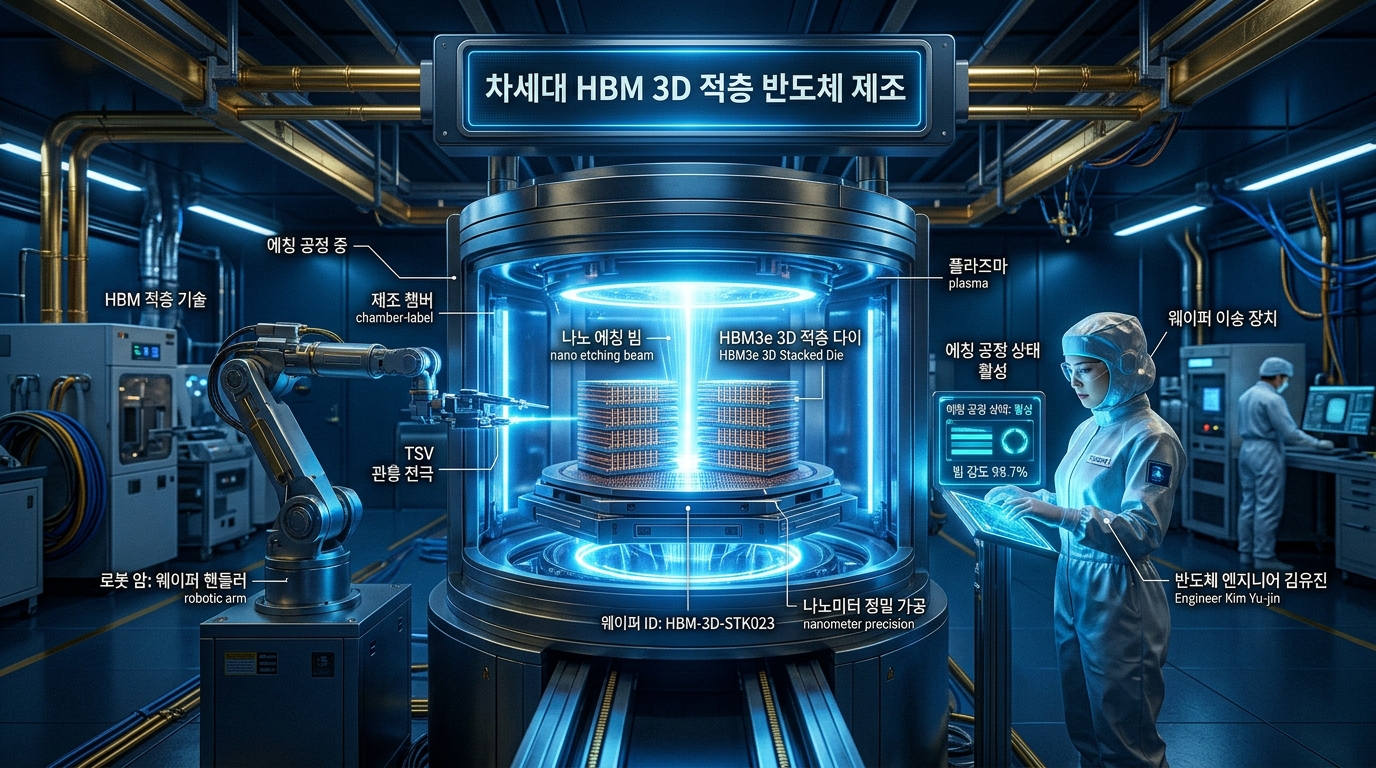
We provide an in-depth analysis of the latest technological competitiveness and structural growth drivers of Lam Research (LRCX), a core pillar of the global semiconductor processing equipment industry.
Key Takeaways
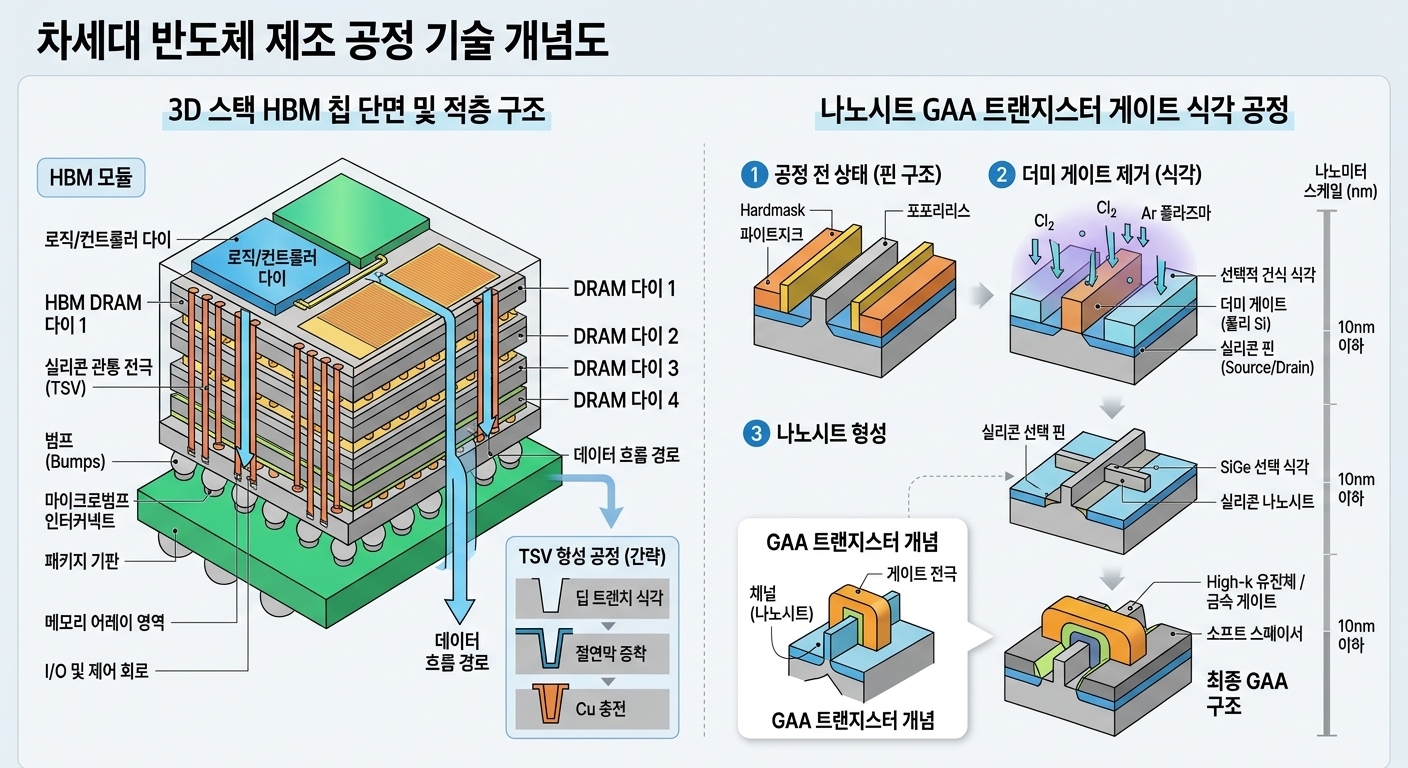
Lam Research is a major beneficiary in High Bandwidth Memory (HBM) stacking—the key bottleneck in artificial intelligence (AI) chips—by virtually monopolizing Through-Silicon Via (TSV) etch and copper plating equipment.
The memory industry's transition to 1-beta (1b) and 1-gamma (1c) nanometer nodes, along with deeper HBM multi-layer stacking (12-layer and 16-layer), serves as a prime catalyst significantly expanding demand for High Aspect Ratio (HAR) etch equipment.
In the foundry space, the adoption of Gate-All-Around (GAA) architectures at 3nm and below is driving rapid demand for high-selectivity isotropic etch tools, simultaneously expanding Lam's non-memory revenue share.
From a macro perspective, despite volatility in the U.S. 10-year Treasury yield (US10Y) and the Dollar Index (DXY), Lam Research continues to demonstrate unmatched Free Cash Flow (FCF) generation within the Philadelphia Semiconductor Index (SOX).
Current Market Context
Explosive global demand for AI accelerators has led NVIDIA and Big Tech to expand their proprietary ASIC production, requiring broad capacity expansions across memory and advanced packaging.
Lam Research maintains an overwhelming global market share of over 80% in TSV deep etching, the cornerstone of HBM manufacturing.
Even amid unconfirmed intraday prices (based on the latest validated figures), Lam Research has maintained solid performance after successfully securing trading liquidity following its 10-for-1 stock split.
Looking at market sentiment as of November 28, 2026, Daily Stock's proprietary Fear & Greed Index recorded KOSPI Fear & Greed at 18.4 (Extreme Fear, up from 10.9 a week ago, 28.6 a month ago, and 47.9 three months ago), while Nasdaq Fear & Greed stood at 24.9 (Fear, up from 18.6 a week ago, down from 32.9 a month ago, and up from 17.7 three months ago).
On the same day, the Nasdaq closed at 24,129.50, KOSPI at 4,915.68, KOSDAQ at 708.99, and the USD/KRW exchange rate settled at 1,336.50, reflecting divergent performance driven by macro volatility.
Financial Analysis
In its most recent quarter, Lam Research delivered explosive top-line growth, generating $8.22 billion in quarterly revenue and setting a record for the fifth consecutive quarter.
Wafer Fab Equipment (WFE) revenue surged 62% year-over-year to $5.73 billion, while Customer Support Business Group (CSBG) revenue, which covers equipment maintenance and upgrades, expanded to $2.49 billion.
Notably, the company proved its top-tier profitability across the semiconductor equipment sector, posting a gross margin of 52.4% and an operating margin of 40.2%.
Quarterly Free Cash Flow (FCF) reached $3.24 billion, complemented by aggressive shareholder return policies, including a $25 billion share repurchase authorization approved by the board.
| Key Financial Metric | Most Recent Quarter | YoY Change | Notes / Key Drivers |
|---|---|---|---|
| **Quarterly Revenue** | $8.22B | +54.0% | 5th consecutive quarter of record revenue |
| **Gross Margin (Non-GAAP)** | 52.4% | +4.2%p | Improved product mix & higher share of premium HBM tools |
| **Operating Margin (Non-GAAP)** | 40.2% | +9.3%p | Operating leverage pushes margins above 40% |
| **Quarterly Free Cash Flow (FCF)** | $3.24B | +78.0% | Strong cash generation fueling share repurchases |
| **Next Quarter Revenue Guidance** | $8.60B (Midpoint) | +35.2% | Solid backlog despite component supply chain constraints |
Valuation
Lam Research's 12-month forward price-to-earnings (Forward P/E) ratio trades in the 28x to 32x range, commanding a premium compared to historical downcycle averages.
This premium is supported by massive AI infrastructure CAPEX from Big Tech and leading-edge foundry node transitions, which are structurally shortening equipment replacement cycles.
The valuation multiple remains sensitive to movements in the U.S. 10-year Treasury yield (US10Y), tending to expand its premium over the Nasdaq 100 and the Philadelphia Semiconductor Index (SOX) when yields stabilize downward.
Conversely, periods marked by a strengthening Dollar Index (DXY) or rising VIX levels trigger profit-taking pressures over late-cycle concerns, temporarily compressing the multiple.
Expert & Institutional Analysis
Major Wall Street investment banks view Lam Research as the "most direct beneficiary" of the AI memory and advanced logic process transitions.
Morgan Stanley and Goldman Sachs project that as base dies integrate into leading-edge foundry nodes with the rollout of HBM4 and HBM4E, etch process steps will increase by more than 40% compared to previous generations.
While ASML dominates photolithography, the growing complexity of 3D architectures substantially increases the reliance on etch and deposition, expanding Lam Research's serviceable addressable market (SAM).
In particular, cryogenic etch and nanosheet selective etch technologies are considered critical, indispensable gateways for next-generation 3D DRAM and GAA 2nm processes.
Risk Factors
The foremost risk is the potential tightening of U.S. export controls on semiconductor equipment shipped to China.
With China accounting for approximately 34% to 35% of Lam Research's revenue, an expansion of restrictions into legacy equipment could cause near-term revenue volatility.
Additionally, if market concerns intensify regarding delayed monetization relative to Big Tech's massive AI CAPEX, memory manufacturers might scale back equipment orders, prioritizing node transitions over fab capacity expansions.
From a macroeconomic perspective, persistent inflation and fading expectations for interest rate cuts pose a potential threat that could trigger a valuation reset across high-multiple tech stocks.
Investment Perspective
Lam Research stands at the center of structural AI hardware innovation, extending far beyond a routine memory cycle recovery.
HBM height expansion, the stabilization of GAA processes, and the commercialization of Backside Power Delivery Networks (BSPDN) collectively elevate technical entry barriers while boosting average selling prices per tool.
In the short term, with the Nasdaq Fear & Greed Index at 24.9 (Fear territory), investors should remain mindful of volatility tied to macroeconomic data and geopolitical export controls.
Over the medium to long term, as the WFE market heads toward a supercycle projected to exceed $200 billion by 2027, Lam's technological moats make dollar-cost averaging an attractive strategy.
FAQ
Q1. Why does Lam Research have such a strong advantage in the HBM process?
HBM stacks multiple DRAM dies vertically, requiring Through-Silicon Via (TSV) processes to create microscopic vertical interconnects through the chips. Lam Research holds a near-monopoly in the High Aspect Ratio (HAR) etch and copper plating equipment needed to drill and fill these deep, narrow channels with high precision.
Q2. Why is the foundry GAA transition favorable for Lam Research?
Transitioning from FinFET to Gate-All-Around (GAA) architectures at 3nm and below significantly increases the number of precision selective etch steps required to carve out nanosheet channels. Lam Research pre-emptively secured atomic-layer selective etch capabilities, driving steady growth in its foundry revenue share.
Q3. How does Lam Research compare against ASML and Applied Materials (AMAT)?
While ASML is the undisputed leader in photolithography, Lam Research is the dominant force in dry etching with an overall market share exceeding 50%. As architectures shift toward 3D stacking and vertical transistors, etch equipment represents an increasing proportion of wafer fab spending relative to lithography.
Q4. Are China export restrictions a fatal threat to earnings?
Because China accounts for mid-30% of total revenue, regulatory actions do cause near-term headwinds. However, surging demand for advanced leading-edge nodes in regions such as the U.S., South Korea, and Taiwan has substantially offset lower legacy spending in China.
Q5. How are U.S. 10-year Treasury yields (US10Y) correlated with semiconductor equipment stocks?
Semiconductor equipment companies are high-growth, high-multiple tech stocks whose valuations reflect significant future cash flows. Rising Treasury yields increase discount rates, often putting downward pressure on multiples, whereas stabilizing, lower rate environments facilitate valuation re-ratings.