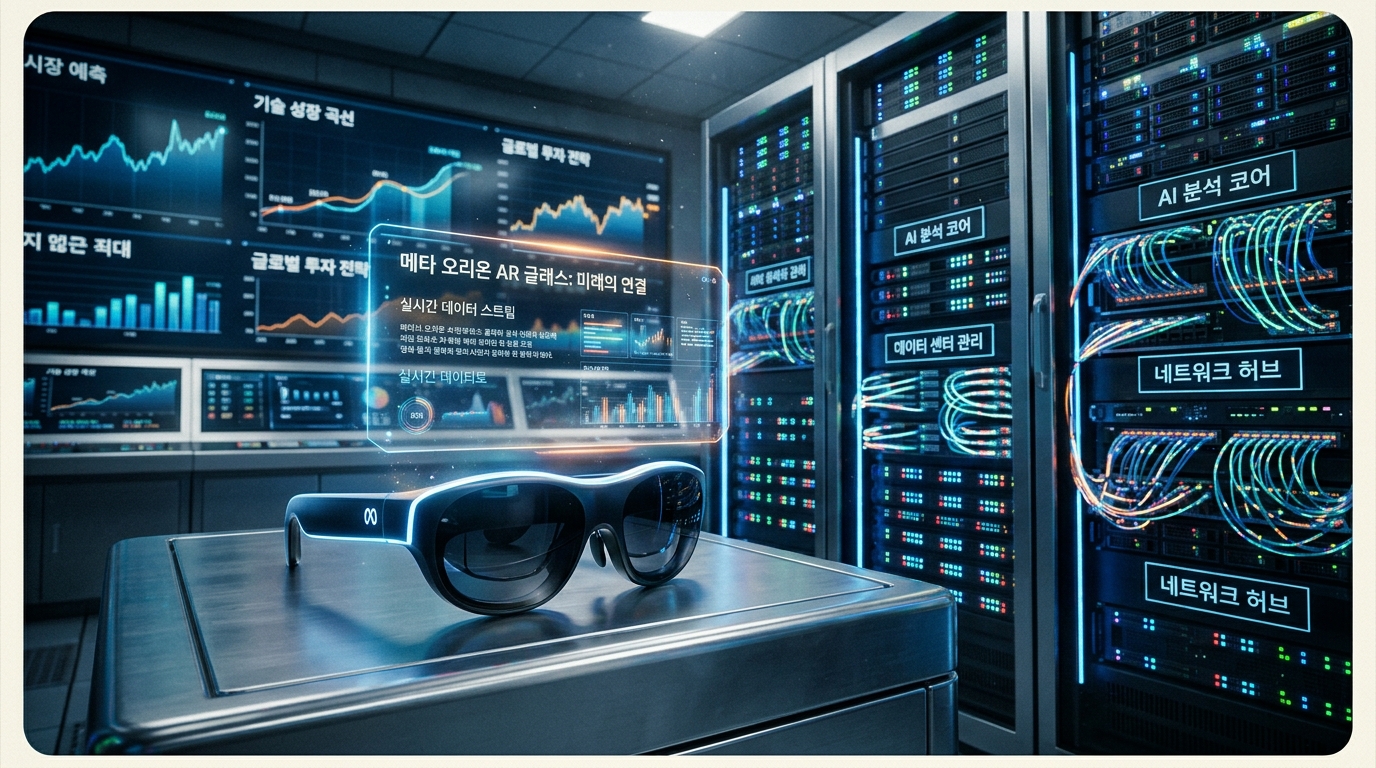
Hello, this is Daily Stock, in-depth tracking infrastructure investment cycles and value chain transformations among global tech leaders.
Executive Summary
The next-generation augmented reality (AR) glasses prototype 'Orion' unveiled by Meta Platforms goes beyond a simple hardware reveal, formally igniting the competition among Big Tech for dominance over next-gen computing form factors.
The innovative optical architecture combining silicon carbide (SiC) diffractive waveguides and MicroLED (LEDoS) suggests the potential standard for on-device AI interfaces aimed beyond smartphones.
At the same time, as Meta's annual capital expenditure (CAPEX) guidance expands to $135 billion–$145 billion, establishing a virtuous cycle between massive artificial intelligence data center construction and wearable ecosystem expansion has emerged as a crucial benchmark for evaluation.
Amid volatility in the 10-year US Treasury yield (US10Y) and the US Dollar Index (DXY), a clear multiple synchronization with the Nasdaq 100 and the Philadelphia Semiconductor Index (SOX) has been observed.
As of intraday trading on November 26, 2026 (provisional), the Nasdaq index stands at 23,585.80, and the KRW/USD exchange rate is trading at 1,345.00 KRW.
On Daily Stock's proprietary Fear & Greed Index, the Nasdaq currently sits at 'Extreme Fear' (15.2), signaling further contracted investor sentiment compared to 'Fear' (29.9) a week ago.
Current Status Overview
Meta's Orion AR glasses achieve a 70-degree field of view (FOV), substantially broadening the visual boundaries of existing wearable devices.
The magnesium alloy frame, optical-grade silicon carbide lenses, and electromyography (EMG) wristband provide the operational environment for next-generation multimodal AI agents.
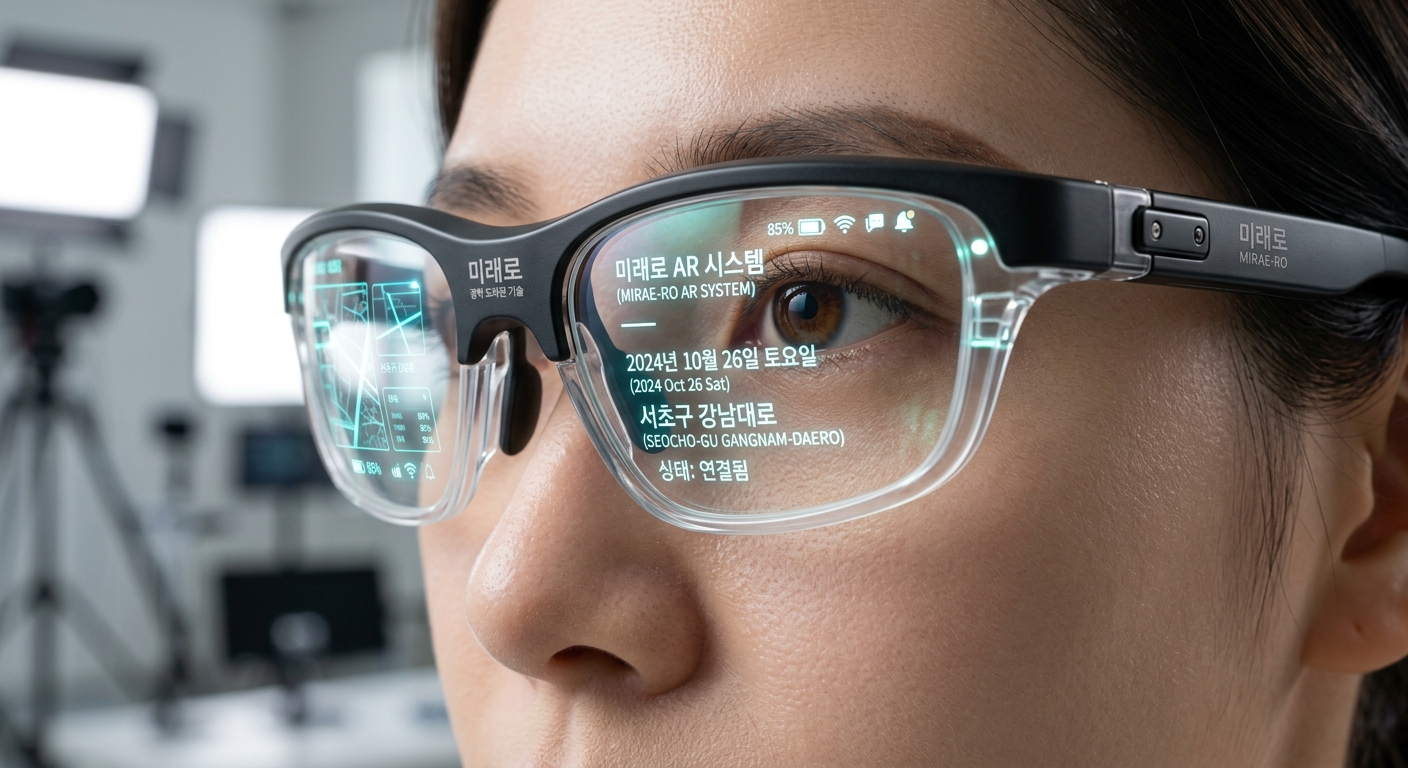
The market is focusing on how Orion's high production cost at the prototype stage (estimated at around $10,000 per unit) will decrease toward 2027 and beyond, which is viewed as the timeframe for full consumer commercialization.
While solid digital advertising cash flow from the Family of Apps (FoA) supports astronomical AI infrastructure buildout costs, the timing of the hardware ecosystem transition is determining stock price trajectories.
As of intraday trading on November 26, 2026 (provisional), domestic equity indices stand at KOSPI 4,745.36 and KOSDAQ 656.52.
The Fear & Greed Index representing domestic market sentiment also points to 'Extreme Fear' (16.4) for the KOSPI, remaining in a deep risk-averse zone following 'Extreme Fear' (13.9) a week prior.
Financial Analysis
Meta's financial structure intersects high-margin cash generation from its digital advertising business (Family of Apps), R&D operating losses from Reality Labs, and AI infrastructure CAPEX.
The company has guided full-year fiscal 2026 CAPEX to $135 billion–$145 billion, aggressively executing data center investments for training and inference across its proprietary large language models (LLMs).
Meanwhile, Reality Labs' annual operating loss is converging to the $18 billion–$19 billion range, testing the company's ability to rein in the scale of losses compared to the previous year.
In the short term, free cash flow (FCF) faces pressure from quarterly spikes in capital expenditures, but improved conversion rates driven by more precise ad targeting are serving as a defense barrier for top-line revenue.
| Indicator | 2025 Actual | 2026 Guidance & Estimates | Trends & Characteristics |
|---|---|---|---|
| **Total Annual CAPEX** | Approx. $72B | $135B – $145B | Expansion of data centers and custom AI chips (MTIA) |
| **Reality Labs Operating Loss** | Over approx. $19B | $18B – $19B range | Entering phase of hardware R&D spending rationalization |
| **Core Hardware Specs (Orion)** | Legacy Quest Series | SiC diffractive waveguides / 70° FOV | Prototype cost reduction and yield improvement challenges |
| **Financing & Cash Flow** | Solid free cash flow (FCF) | Reinvestment of operating cash amid short-term FCF pressure | Rising ad pricing and on-device ecosystem linkage |
Valuation
Meta's forward 12-month price-to-earnings (Forward P/E) ratio maintains a premium relative to its 5-year historical average, but sensitivity to macroeconomic interest rate conditions has heightened significantly.
Whenever the 10-year US Treasury yield (US10Y) fluctuates near the upper band of its range, discount rates across growth stocks rise, causing multiple compression among major Big Tech names in the Nasdaq 100.
Comparing the Nasdaq 100 and the Philadelphia Semiconductor Index (SOX), Meta's CAPEX trajectory—purchasing high-performance computing and advanced packaging chips in massive volumes—acts as a direct order catalyst for the semiconductor index.
Conversely, Meta's own valuation may experience diverging strengths of re-rating depending on when these colossal capital expenditures are recouped through tangible software subscription fees or hardware margins.
Under conditions where the global FX Dollar Index (DXY) remains strong, translational earnings for platform companies with significant overseas ad revenue can be diluted.
When the Volatility Index (VIX) spikes, hyperscalers with heavy capital outlays tend to experience steeper stock price swings than broader S&P 500 growth equities.

Expert & Institutional Analysis
Major Wall Street investment banks generally rate the technical maturity of Orion smart glasses highly.
Institutions such as Morgan Stanley and Goldman Sachs view Meta's long-term endeavor to break free from smartphone operating system (OS) dependence and establish its own personal computing platform as a favorable strategic positioning.
On the other hand, supply chain research firms like TrendForce point out that MicroLED panel pricing and the supply limits of silicon carbide materials—used in military radar and high-spec applications—represent key bottlenecks in lowering mass-production costs.
A cautious view also coexists, noting that without resolving battery life limitations (around 2 hours) and production yields, the full consumer adoption cycle could be delayed.
Institutional investors are focusing less on immediate hardware unit sales and more on the maturity of the data loop: Meta AI agents gathering real-time voice and visual data via smart glasses and feeding it into ad optimization.
Whether the payback horizon for CAPEX becomes visible within data center depreciation timelines is a major variable determining the sustainability of institutional capital flows.
Risk Factors
The foremost risk factor is the potential delay in the commercialization timeline due to failure to secure production yields for next-gen hardware and component supply chain bottlenecks.
Exacting fabrication processes for silicon carbide wafers and high costs for full-color MicroLED microdisplays could slow device penetration rates.
A second risk is delayed AI monetization relative to massive capital expenditures.
If advertising price growth decelerates while colossal capital expenditures around $140 billion per year continue, operating margin erosion and deteriorating free cash flow could accelerate.
Lastly, global regulatory scrutiny and prolonged macroeconomic tightening pose challenges.
In addition to privacy regulatory risks stemming from always-on cameras and sensors on smart glasses, should the 10-year US Treasury yield stay elevated due to delayed policy rate cuts, profit-taking pressure on high-valuation Big Tech could intensify.
Investment Takeaway
Meta occupies a unique position, aggressively pairing on-device AI and next-gen form factor R&D on the foundation of robust cash generation from its existing social media platforms.
In the short term, concerns over margin compression from heavy CAPEX execution may cap equity upside; however, in-house AI infrastructure continues to drive efficiency gains in its advertising engine.
From an investor's perspective, it is essential to closely track the detailed progress of the AR smart glasses mass-production roadmap scheduled around 2027, along with the defense of quarterly free cash flow.
A multi-dimensional strategy is warranted, linking Meta's CAPEX deployment pace with the direction of the US 10-year Treasury yield and order cycle shifts in the Philadelphia Semiconductor Index.
Investor Checkpoint Q&A
Q1. What is the key technological differentiator of Meta's Orion smart glasses?
Unlike conventional smart glasses, Orion incorporates optical-grade silicon carbide (SiC) waveguides and full-color MicroLEDs to achieve a holographic display with a 70-degree field of view.
Combined with an electromyography (EMG) wristband and eye-tracking sensors, it enables intuitive UI navigation using subtle hand gestures.
Q2. Why is Orion's consumer commercialization expected after 2027?
Currently, prototype production costs reach roughly $10,000 per unit due to the high cost of MicroLED panels and silicon carbide processing.
It will take at least several years to improve battery life (currently around 2 hours), control heat dissipation, stabilize high-volume production yields, and bring retail pricing down to smartphone levels.
Q3. Where is the massive $135B–$145B annual CAPEX primarily being deployed?
The majority of capital spending is directed toward hyperscale data centers, GPU clusters, and proprietary silicon (MTIA) for next-generation LLM training and multimodal inference.
Hardware device R&D is being managed within Reality Labs, with operating losses targeted within the $18B–$19B range.
Q4. Through what transmission channel does a rise in the 10-year US Treasury yield (US10Y) affect Meta's stock price?
As a growth stock, higher discount rates are applied when converting Meta's future cash flows into present value, putting downward pressure on its valuation multiple (P/E).
Additionally, rising borrowing costs and overall valuation burdens on tech equities create a chain reaction that stirs volatility in the Nasdaq 100.
Q5. What does the current Fear & Greed Index imply?
As of intraday trading on November 26, 2026 (provisional), the Nasdaq Fear & Greed Index reading of 15.2 (Extreme Fear) reflects heightened market wariness over Big Tech's heavy capital investments and macroeconomic uncertainties.
During phases where investment sentiment is significantly depressed, stock price volatility can amplify even on minor earnings noise or guidance adjustments, making a phased accumulation approach advisable.