Hello, this is Daily Stock, delivering precise insights into the core context of the global tech value chain and the Nasdaq market.
Executive Summary
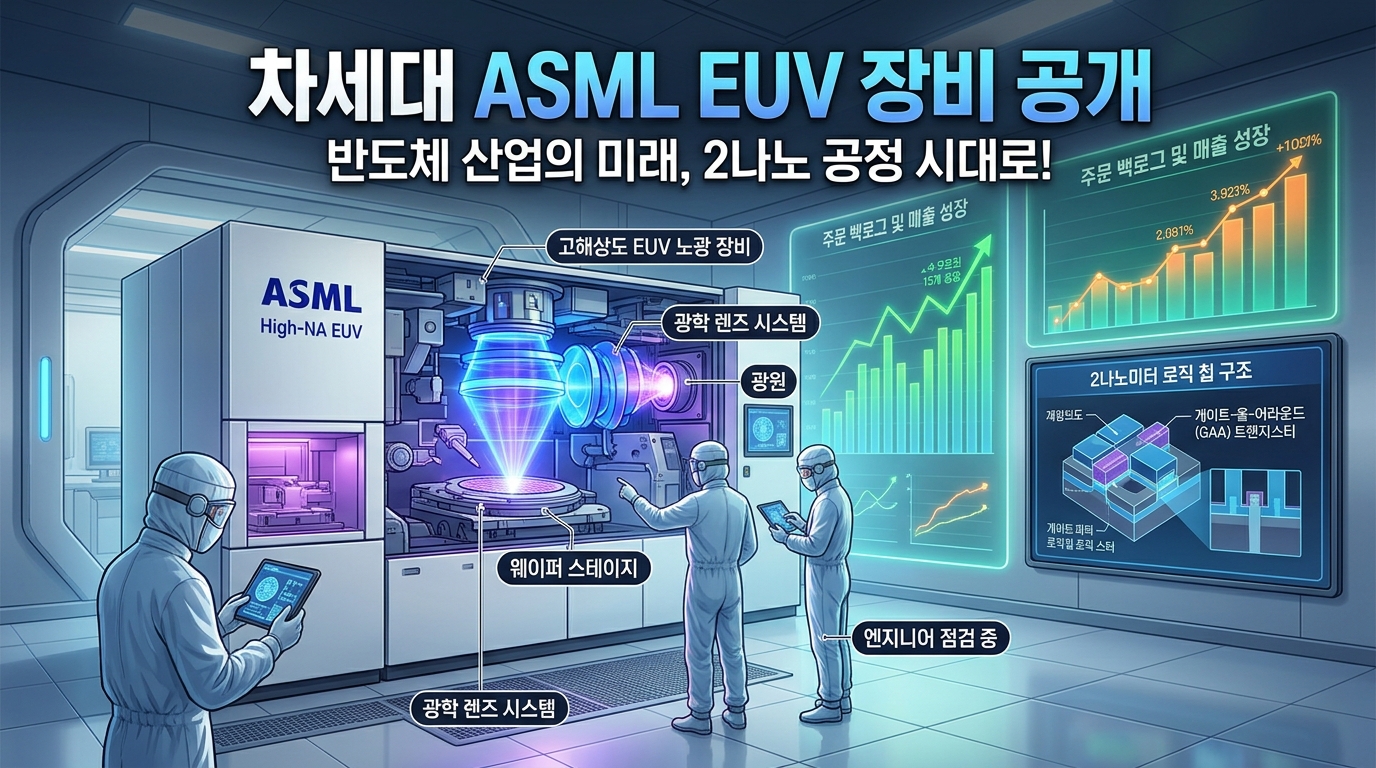
ASML's next-generation lithography systems, High-NA (0.55 NA) EUV, are transitioning beyond pilot R&D stages and accelerating shipments toward leading-edge mass production lines.
Following the TWINSCAN EXE:5000, site acceptance testing (SAT) for the mass-production model EXE:5200B is progressing, signaling a full-scale infrastructure shift in the race to enter 2nm and 1.4nm nodes.
As advanced process capital expenditure (CAPEX) competition intensifies across foundry and memory sectors, ASML's order backlog is rapidly booking up production slots through 2027–2028.
With revenue recognition gradually taking place for these ultra-high-end tools priced over $350 million per unit, attention is focusing on the potential for long-term gross margin expansion.
As of intraday trading on November 25, 2026 (preliminary), key market indicators stand at Nasdaq 23,733.54, KOSPI 4,725.24, KOSDAQ 647.01, and the USD/KRW exchange rate at 1,343.00 KRW.
Daily Stock's proprietary Fear & Greed Index reads Extreme Fear for both the Nasdaq (17.4) and KOSPI (16.4), heavily reflecting psychological risk aversion driven by macroeconomic uncertainties.
Current Market Situation
The top three global foundries are aggressively securing ASML's High-NA equipment to deploy sub-2nm nodes.
While Intel has proactively taken delivery of the EXE:5000 and the mass-production EXE:5200B at its Oregon R&D fab to lay the foundation for its 14A process, Samsung Electronics and TSMC are also expanding tool introduction and testing schedules.
Furthermore, EUV layer penetration is increasing in HBM4 and advanced 1c/0a-class DRAM production lines, prompting memory manufacturers to join the order queue.
With overlapping demand from both logic and memory segments, structural bottlenecks are emerging, extending ASML's production lead times further compared to the past.
Currently, the Nasdaq market faces elevated valuation sensitivity amid US 10-year Treasury yield (US10Y) volatility and mild upward pressure on the US Dollar Index (DXY).
The Philadelphia Semiconductor Index (SOX) has shown higher volatility relative to the Nasdaq 100, while Big Tech's AI infrastructure CAPEX execution strength continues to drive stock price divergence across hardware supply chains.
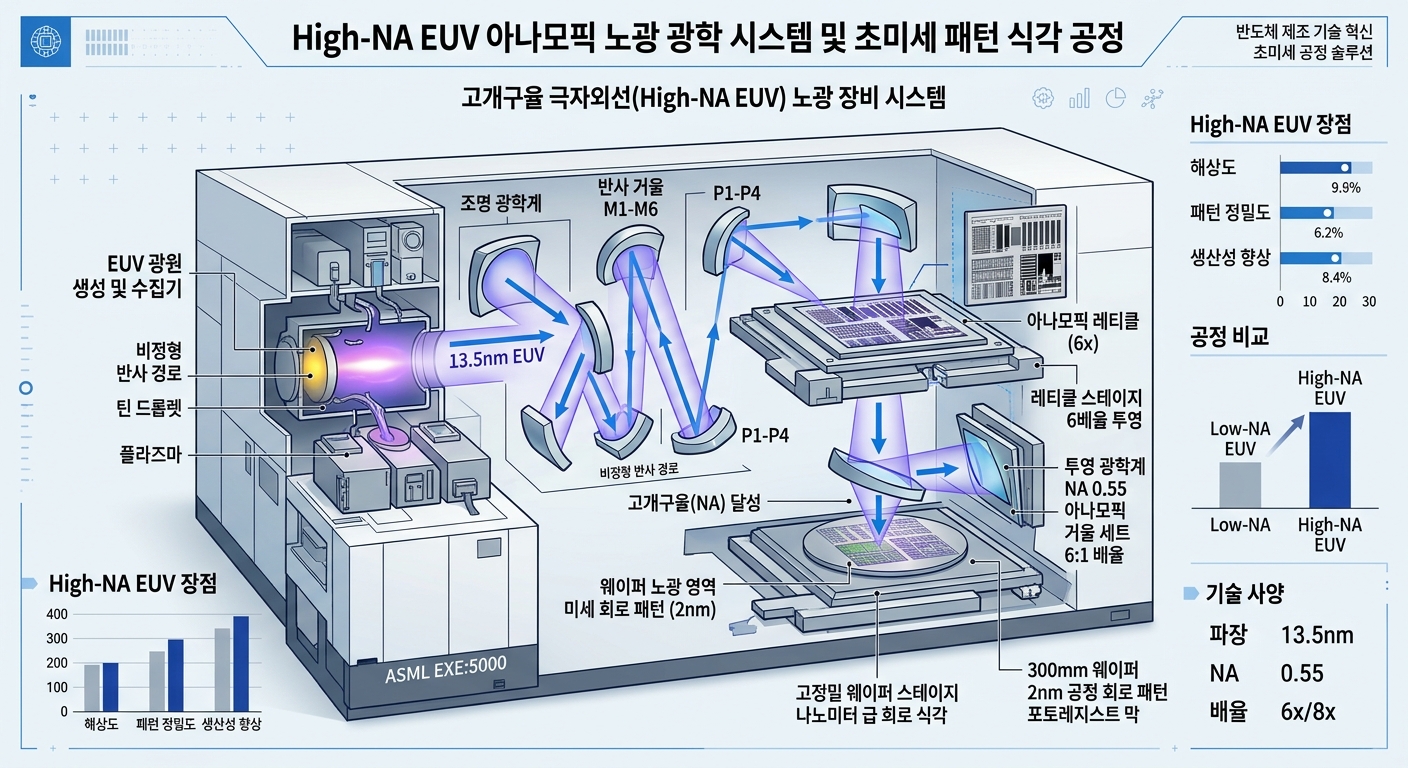
| Classification | Key Specs & Timeline | Target Deployment Node | Estimated Throughput (WPH) |
|---|---|---|---|
| TWINSCAN NXE:3800E (Low-NA) | 0.33 NA, 13.5nm wavelength | 3nm / Advanced DRAM | Approx. 230 wph |
| TWINSCAN EXE:5000 (High-NA R&D) | 0.55 NA, Anamorphic optics | 2nm R&D Pilot | Approx. 135 wph |
| TWINSCAN EXE:5200B (High-NA HVM) | 0.55 NA, Precision overlay control | Sub-2nm / 14A / Next-gen DRAM | Approx. 175 wph |
Financial Analysis
ASML's annual revenue base is moving past the low-€30 billion range and targeting an expansion toward the high-€30 billion to low-€40 billion bracket as next-generation shipments ramp up.
In particular, steady revenue growth from Installed Base Management services and upgrades continues to reinforce downside stability in baseline revenue.
Regarding the order backlog, EUV systems consistently account for more than half of quarterly net bookings.
Because a single High-NA system generates revenue equivalent to nearly two Low-NA systems, favorable COGS leverage is expected to help gross margins converge toward the upper end of the 53–56% band over time.
As of November 25, 2026, ASML's intraday share price status is 'Intraday price unconfirmed (based on latest confirmed data)'.
Nevertheless, reinforced long-term free cash flow (FCF) generation capabilities continue to support ongoing share buybacks and steady dividend payouts as the cornerstone of its shareholder return policy.
Valuation
Within the Nasdaq 100 and the Philadelphia Semiconductor Index (SOX), ASML has traditionally commanded a forward P/E multiple in the mid-to-high 30s due to its monopolistic economic moat.
In an environment where the US 10-year Treasury yield fluctuates in the low-to-mid 4% range, growth stocks generally face multiple compression, yet ASML's status as a sole supplier partially cushions the discount rate burden.
At present, the market's valuation debate centers on whether the economics of High-NA tools can align effectively with high-volume manufacturing yields.
Once chipmakers observe tangible cost-reduction advantages in High-NA single patterning compared to 0.33 NA multi-patterning, the stage will be set for both ASP increases and valuation multiple re-ratings.
Conversely, if prolonged macroeconomic tightening dampens Big Tech's CAPEX growth rate, scenarios involving multiple compression may emerge.
ASML's relative multiple compared to large-cap S&P 500 growth peers is typically dictated less by near-term quarterly earnings and more by order visibility covering the next 2 to 3 years.
Wall Street & Institutional Perspectives
Major Wall Street research institutions maintain a favorable long-term view on ASML, while monitoring short-term fluctuations in shipping schedules.
Firms such as Goldman Sachs and Morgan Stanley evaluate that leading-edge foundry expansions for AI accelerator production will inevitably pull forward High-NA adoption.
Some analysts point out that TSMC has maintained a conservative stance, aiming to maximize performance improvements of existing 0.33 NA systems up through the A16 node.
However, semiconductor equipment analysts widely agree that reaching the 1.4nm (A14) threshold will leave chipmakers with an indispensable reliance on High-NA tools due to physical patterning limits.
Moreover, analysts highlight that overlapping investments by memory majors in 3D DRAM and extreme fine-pitch lithography are diversifying ASML's order backlog quality.
Reduced reliance on any single customer structurally bolsters ASML's resilience across macroeconomic and semiconductor cycles.
Risk Factors
The most direct risk stems from intensifying US-China export controls amidst ongoing technological hegemony disputes.
Should restrictions expand on deep ultraviolet (DUV) equipment shipments to China, legacy tool revenue streams—which historically represent a notable share of overall sales—could face near-term contraction.
A second risk is the potential monetization delay of Big Tech's AI capital investments.
If enterprise return on investment (ROI) from generative AI models takes longer to materialize, hyperscalers could recalibrate server procurement orders, potentially prompting foundry CAPEX cuts.
Lastly, yield stabilization progress at customer fab sites remains critical.
Given that a single system costs hundreds of millions of dollars, any delay in achieving target defect densities during initial line integration could defer subsequent equipment delivery timelines.
Investment Perspective
ASML represents an irreplaceable asset, preserving an unchallenged 'super subcontractor' position within the global semiconductor supply chain.
Under Daily Stock's Fear & Greed Index, prevailing readings of Extreme Fear for both the Nasdaq (17.4) and KOSPI (16.4) suggest that current weakness can be interpreted as temporary valuation contraction triggered by souring macro sentiment.
During periods of elevated volatility, closely tracking the stabilization of the VIX index and the trajectory of the US 10-year Treasury yield remains a prudent operational approach.
Over the medium to long term, investors should prioritize tracking 2nm mass production ramp-up schedules and the burn rate of High-NA EUV backlogs as primary fundamental indicators.
Investor Checkpoint Q&A
Q1. How does High-NA EUV lithography fundamentally differ from existing systems?
A1. It increases the numerical aperture (NA) of the projection optics from 0.33 to 0.55, pushing past traditional light diffraction limits. The enhanced resolution allows chipmakers to replace complex, multiple-exposure steps (multi-patterning) with single exposures on sub-2nm nodes, reducing process complexity.
Q2. How do the High-NA adoption timelines differ among Intel, Samsung, and TSMC?
A2. Intel is pursuing the most aggressive schedule, taking early delivery of the EXE:5000 and EXE:5200B to seize technological leadership for its 14A node. In contrast, TSMC is maximizing the cost-efficiency of 0.33 NA tools before phasing in High-NA around the 1.4nm threshold, while Samsung is assessing phased deployments across advanced foundry and next-generation DRAM production.
Q3. What is the actual impact of US export controls against China on ASML's financial performance?
A3. Cutting-edge EUV tools have already been banned from export to China, meaning recent restrictions primarily target immersion DUV (ArFi) systems. While the share of revenue from China may experience near-term normalization, strong demand from leading-edge logic and advanced memory customers globally provides a partial offset.
Q4. Why is the US 10-year Treasury yield (US10Y) particularly significant for ASML's equity performance?
A4. As a high-growth, premium-multiple technology company, a substantial portion of ASML's discounted cash flows resides in the medium-to-distant future, making its valuation sensitive to the discount rate. Rising long-term benchmark yields place downward pressure on equity valuation multiples, requiring continuous monitoring of macro discount rate trajectories.
Q5. What single metric should investors scrutinize most closely in quarterly earnings reports?
A5. Net bookings and the specific proportion of EUV systems within the total order backlog. This serves as the most reliable leading indicator, offering advance visibility into revenue volume and gross margin trajectory over the following 12 to 24 months.