
Hello, this is Daily Stock, delivering in-depth tracking of global tech earnings and macro developments.
Key Takeaways
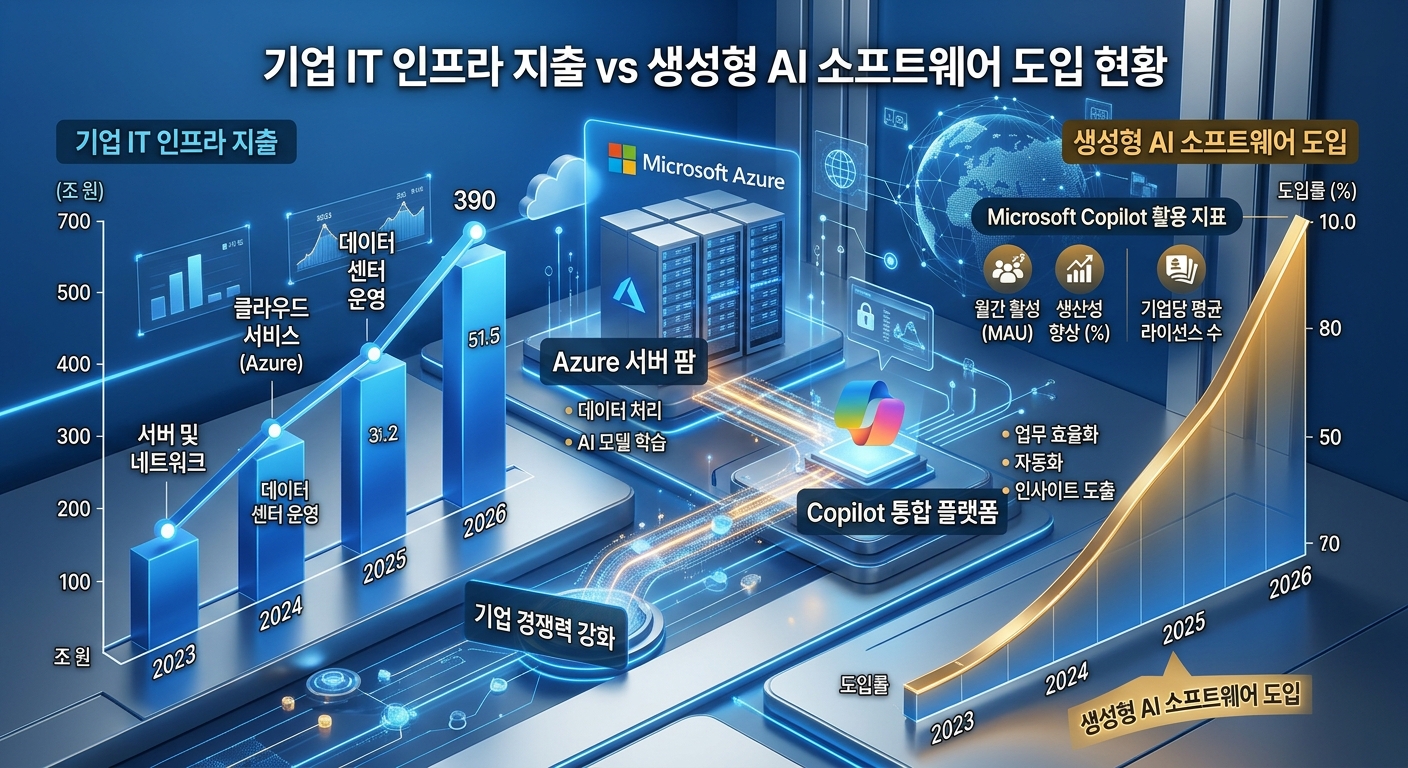
Microsoft's Azure cloud revenue growth reached 48% year-over-year in the latest quarter, proving its technological edge across the hyperscaler market.
Paid seats for Microsoft 365 Copilot for Enterprise surpassed 30 million, yet the paid conversion rate relative to the broader commercial Office base remains in the low single digits.
With quarterly capital expenditures (CAPEX) exceeding $45 billion, the market's standards for AI infrastructure return on investment (ROI) speed have become increasingly stringent.
As of intraday trading on November 24, 2026 (preliminary), the Nasdaq index was at 24,089.56 points, while Daily Stock's proprietary Nasdaq Fear & Greed Index stood at 17 (Extreme Fear), heavily reflecting caution around tech valuations.
Current Market Situation
Across the global enterprise landscape, Microsoft Azure is positioning itself as the central hub for large language model (LLM) inference and AI workloads beyond conventional cloud hosting.
Total cloud revenue in the latest quarter climbed 30% year-over-year to $63.9 billion, beating market consensus.
Conversely, the paid adoption rate of Microsoft 365 Copilot, a core growth driver at the software layer, continues to show gradual expansion amid tightening enterprise IT budgets.
Of the approximately 450 million commercial Office users, the portion subscribing to paid Copilot is estimated at roughly 6% to 7%, with departmental pilot testing taking precedence over comprehensive enterprise-wide rollouts.
At the same time, simultaneous moves in the 10-year U.S. Treasury yield (US10Y), the Dollar Index (DXY in the 104 range), and the Cboe Volatility Index (VIX) continue to exert downward pressure on Big Tech multiples.
Financial Analysis
Microsoft's total quarterly revenue increased 19% year-over-year to $92.3 billion, while operating income grew 21% to $45.9 billion.
However, quarterly CAPEX surged to $45.2 billion on the expansion of AI servers and data center infrastructure, causing free cash flow (FCF) to contract by roughly 27% year-over-year.
| Key Financial and Operating Metrics | Latest Quarter Results (FY2026) | YoY Change | vs. Consensus |
|---|---|---|---|
| Total Revenue | $92.3B | +19.0% | Beat |
| Azure & Cloud Growth Rate | Quarterly Revenue ~$33.2B | +48.0% | Significantly Beat |
| Commercial Cloud Revenue | $63.9B | +30.0% | Beat |
| Net Income | $36.6B | +32.0% | Beat |
| Capital Expenditures (CAPEX) | $45.2B | Sharp Increase | Met Upper Bound |
| Paid Copilot Seats | Surpassed 30M | +100%+ (YoY) | Met |
Azure's annualized run-rate revenue has already exceeded $100 billion, but infrastructure depreciation is increasingly expected to weigh on cost of goods sold (COGS).
Although deploying its in-house inference chip, Maia 300, helped ease reliance on NVIDIA and boosted token processing efficiency per watt by 40%, stabilizing early yields and recovering mass-production costs will require time.
Valuation
Microsoft's 12-month forward price-to-earnings (Forward P/E) ratio trades in the 31x–33x range, maintaining a premium compared to the Philadelphia Semiconductor Index (SOX) and Nasdaq 100 averages.
With the Nasdaq index fluctuating around 24,089.56 points (as of the latest verified figure), re-rating pressure remains broad across high-multiple tech equities.
If the 10-year Treasury yield hovers around 4.4%, higher discount rates could compress P/E multiples down to the 28x–30x band.
On the other hand, superior free-cash-flow generation relative to peers and enterprise software lock-in effects provide downside support compared to broader S&P 500 growth stocks.
Should AI software monetization evolve beyond a flat subscription fee ($30/month) into a credit-based pay-as-you-go model, further multiple expansion could be considered.
Expert and Institutional Analysis
Major Wall Street institutions largely retain a constructive outlook regarding Azure's substantial order backlog.
BNP Paribas noted that Microsoft is transitioning beyond early infrastructure monetization into a second monetization phase led by Copilot consumption-based billing models.
However, some analysts at Bernstein and Morgan Stanley caution that sustained CAPEX above $40 billion per quarter warrants close monitoring to ensure long-term ROIC (Return on Invested Capital) is not eroded.
They emphasize that if Copilot's paid adoption curve accelerates slower than expected, the payback timeline may stretch longer than that of past cloud migration cycles.
According to the Daily Stock Fear & Greed Index, the Nasdaq reading of 17 (Extreme Fear)—following 31.1 (Fear) a week ago and 16.7 (Extreme Fear) a month ago—signals that institutional investors are maintaining a defensive posture.
Risk Factors
The primary risk is delayed paid adoption of Copilot as enterprises demand measurable proof of AI ROI.
Many corporate clients hesitate on wide-scale rollouts because quantifying direct productivity gains against licensing costs remains challenging.
A second risk is reduced CAPEX efficiency stemming from escalating infrastructure depreciation and power grid bottlenecks.
The cost of securing power infrastructure for massive AI data centers, alongside regulatory hurdles, poses an ongoing headwind to mid-to-long-term operating margins.
A third factor is potential translation loss on global enterprise revenues caused by ongoing Federal Reserve rate path uncertainties and a strong U.S. Dollar (DXY).
Investment Perspective
Microsoft holds a unique AI ecosystem vertically integrated across infrastructure (Azure), platform (Foundry), and applications (Copilot).
While 48% Azure revenue growth highlights resilient short-term demand for infrastructure, the sustainability of a share price rebound largely hinges on accelerating Copilot penetration.
With the KOSPI Fear & Greed Index at 10.6 (Extreme Fear) and the Nasdaq Fear & Greed Index at 17 (Extreme Fear), validating forward earnings guidance may prove more favorable than aggressive positioning.
A measured, staggered accumulation strategy that monitors Treasury yields and AI CAPEX trends remains a reasonable approach.
Investor Checkpoint Q&A
Q1. Is Azure's 48% growth rate sustainable moving forward?
While near-term momentum remains supported by robust LLM demand and infrastructure buildouts, higher baseline comps and power supply bottlenecks suggest growth rates may gradually normalize over time.
Q2. Why is Copilot's paid conversion rate slower than initially expected?
Enterprise procurement teams are demanding explicit productivity ROI data before justifying the additional $30 per user monthly fee, keeping many deployments confined to pilot tests.
Q3. Does $45.2 billion in quarterly CAPEX pose a financial burden?
While manageable via Microsoft's cash reserves and cloud operating cash flow, capital efficiency demands scrutiny after free cash flow contracted by more than 20%.
Q4. When will the custom Maia 300 chip contribute to margin improvement?
It remains in early deployment stages across data centers. Positive margin contributions to hardware procurement costs and cloud inference operations are expected once internal chip volume scales meaningfully.
Q5. How does the current macro backdrop (rates, FX) impact Microsoft?
A stronger U.S. dollar (such as USD/KRW at 1,342.00) acts as an FX translation drag on its significant overseas revenue base, while prolonged elevated interest rates limit valuation multiple expansion.