Welcome to Daily Stock's Nasdaq Story, providing in-depth analysis of key trends across the U.S. stock market and global Big Tech.
Key Takeaways
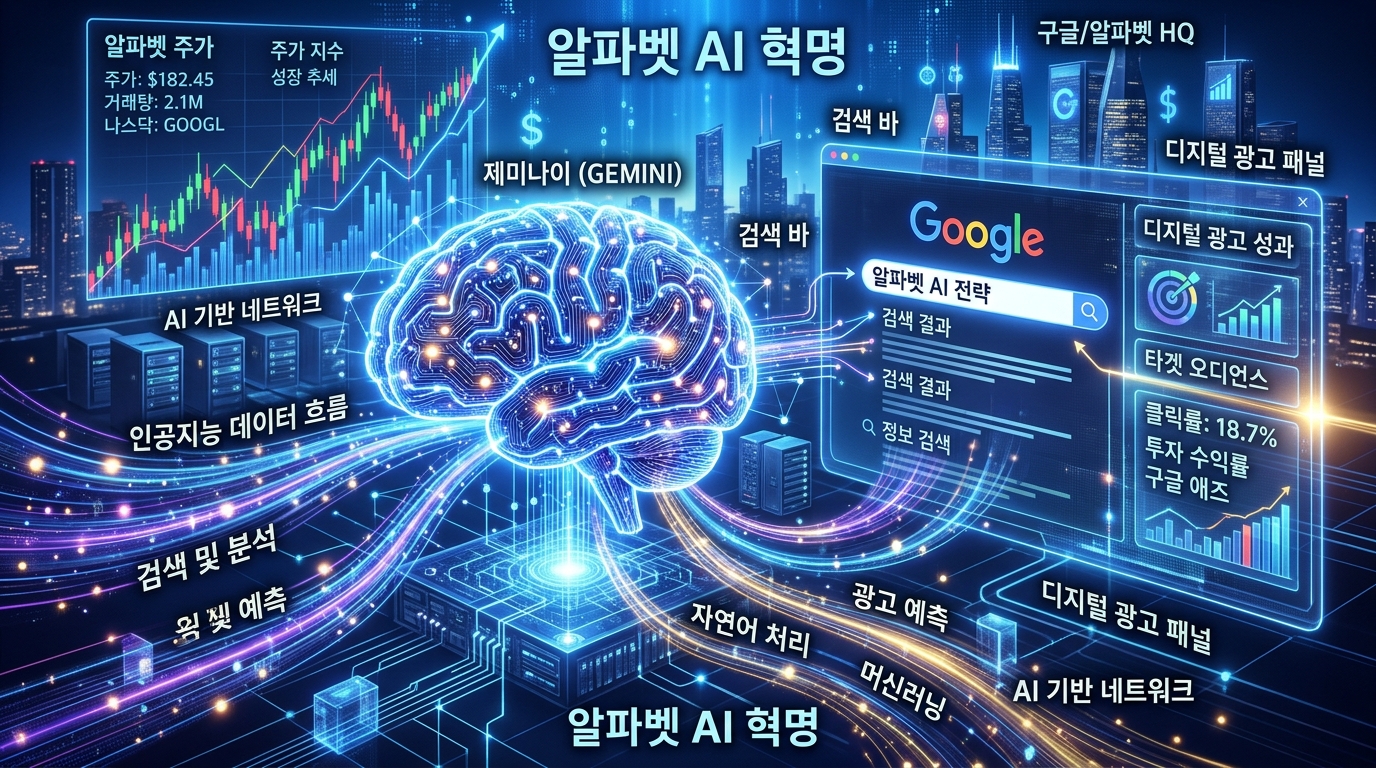
Alphabet is countering the generative AI surge by integrating its next-generation multimodal model suite, 'Gemini 2.0,' across its search services and broader cloud ecosystem.
By expanding the rollout of 'AI Overviews'—which display summarized information at the top of search results—the company is heavily focused on defending against concerns over ad query cannibalization.
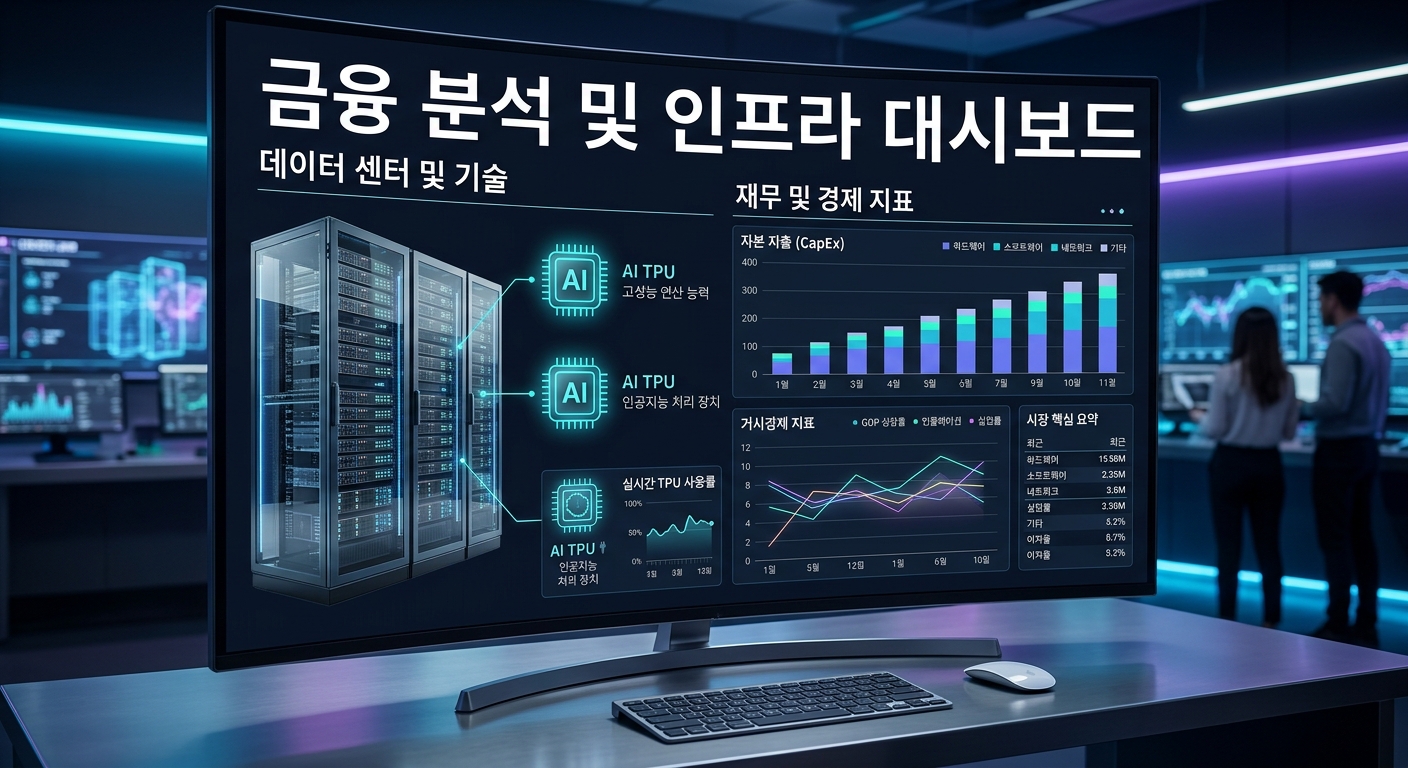
While search advertising revenue continues to demonstrate resilient defense, the burden of expanding capital expenditures (CAPEX) for infrastructure investments is increasingly weighing on free cash flow (FCF).
Concurrently, in the macroeconomic landscape, fluctuations in the 10-year U.S. Treasury yield (US10Y) and the U.S. Dollar Index (DXY) remain key variables determining valuation multiples for Big Tech.
Current Market Overview
Looking at macroeconomic indicators during Korean trading hours on November 23, 2026 (tentative), the Nasdaq composite stands at 22,617.73, and the USD/KRW exchange rate is at 1,343.00 KRW.
In the domestic market, the KOSPI is recorded intraday at 4,731.43, and the KOSDAQ is at 628.60.
Daily Stock's proprietary Fear & Greed Index, reflecting market sentiment, currently reads 9.7 for the Nasdaq, placing it firmly in the 'Extreme Fear' zone.
The Nasdaq's historical Fear & Greed trajectory shows Fear (37.4) one week ago, Fear (28.7) one month ago, and Extreme Fear (5.2) three months ago, underscoring clear psychological contraction driven by heightened volatility and slowing momentum, regardless of headline index levels.
The KOSPI Fear & Greed Index also points to Extreme Fear at 11.7, compared to 15.4 a week ago, 6.9 a month ago, and a Neutral reading of 51.5 three months ago.
Alphabet (GOOGL) stock is marked as 'Unverified today (based on latest verified value)' due to limitations in calculating precise real-time transaction data as of 2026-11-23.
Market attention is concentrated on the tangible impact that the full-scale deployment of the Gemini 2.0 Flash and Pro lineups will have on legacy search query share and cost-per-click (CPC) rates.
Financial Analysis
Alphabet's core earnings engine, the 'Google Search & other' segment, has maintained moderate growth despite the rise of formidable rivals such as OpenAI and Anthropic.
Although concerns surfaced that embedding AI Overviews at the top of search queries would reduce direct website clicks, sponsored ad integrations within high-value commercial queries, such as commerce and travel, have provided an effective defensive buffer.
Conversely, the capital expenditure burden required for AI model training and massive inference workloads is putting pressure on free cash flow across financial statements.
While in-house Tensor Processing Units (TPUs) help lower the cost of inference per token, the rapid scaling of data center clusters has simultaneously driven up quarterly depreciation expenses and capital outlays.
| Business Segment / Key Metric | Key Details & Developments | Structural Impact & Implications |
|---|---|---|
| **Google Search & other** | Expansion of commercial AI queries paired with sponsored links | Defending against search market share erosion; maintaining query volume |
| **Google Cloud (GCP)** | Supplying Gemini 2.0 APIs and accelerating enterprise AI workloads | Driving top-line growth and operating margins by absorbing AI-native demand |
| **Capital Expenditures (CAPEX)** | AI accelerator clusters, data center expansions, TPU infrastructure | Pressuring near-term free cash flow (FCF); heightening scrutiny on return on investment (ROI) |
| **Traffic Acquisition Costs (TAC)** | Partnership payments for default search placement on mobile and browsers | Ongoing legal uncertainty regarding potential modifications to distribution contracts from DOJ antitrust litigation |
Valuation
Alphabet's valuation multiple remains closely tied to shifts in macroeconomic variables, particularly the 10-year U.S. Treasury yield (US10Y).
Within the tech-heavy Nasdaq 100 (NDX), Alphabet has traded at a relatively lower price-to-earnings (P/E) ratio compared to other Big Tech peers, a valuation discount shaped by the dual overhang of AI disruption risks and antitrust proceedings.
In a market environment where the Cboe Volatility Index (VIX) faces upward pressure, strength in the U.S. Dollar Index (DXY) dilutes the translated value of digital advertising revenue generated overseas.
While the Philadelphia Semiconductor Index (SOX) directly reflects the tailwinds benefiting the hardware supply chain, the Communication Services sector—which includes Alphabet—faces multiple compression tied to the uncertain return on investment (ROI) on massive capital outlays.
Expert & Institutional Analysis
Major Wall Street investment banks assess that Gemini 2.0 has successfully mitigated market share erosion in search engines so far.
Leading institutions such as Morgan Stanley and Goldman Sachs maintain the view that even as user behavior shifts toward conversational chat interfaces, displacing Google's vast indexing infrastructure and distribution channels will be difficult in the near term.
However, analyst warnings are increasingly focused on the pace of capital expenditure.
Despite continued top-line expansion in Google Cloud powered by AI demand, institutions repeatedly point out that unit margins in the advertising business—which accounts for the vast majority of operating profit—could be diluted by rising inference costs.
Risk Factors
The most prominent structural risk is the increase in Cost Per Query stemming from the transition to generative AI search.
Because large language model (LLM) inference computations are vastly more expensive than conventional keyword indexing, operating margins could deteriorate if click-through rates (CTR) fail to expand commensurately.
The ongoing antitrust litigation initiated by the U.S. Department of Justice (DOJ) over search monopolization also presents an active overhang.
If mandatory structural remedies alter the Traffic Acquisition Cost (TAC) model that secures default search engine status across Apple and major smartphone OEMs, a gap in Alphabet's mobile query defense cannot be ruled out.
Investment Outlook
Alphabet's medium-to-long-term investment thesis hinges on how effectively the Gemini 2.0 ecosystem extends beyond search defense into enterprise agent services and smart device integration.
The ability to rapidly rein in inference costs using proprietary TPUs and dedicated data center networks will likely serve as a primary inflection point for the stock.
From a macroeconomic perspective, with the broader Nasdaq Fear & Greed Index lingering in Extreme Fear at 9.7, a conservative, staged accumulation strategy is warranted rather than anticipating an immediate rebound in valuation multiples.
A durable re-rating will likely require clearer visibility on the trajectory of interest rate cuts alongside verifiable earnings evidence confirming the payback timeline of the current AI CAPEX cycle.
Investor Checkpoint Q&A
Q1. What is the immediate impact of Gemini 2.0 on the Google Search advertising model?
A1. By providing intuitive summaries for complex queries via AI Overviews, Google is preventing user attrition. For commercial queries, sponsored links placed within and below summaries defend monetization, though the potential for reduced clicks on general informational queries persists.
Q2. Why is the market particularly concerned about Alphabet's AI capital expenditures (CAPEX)?
A2. The rapid escalation in spending on AI data centers and custom chipsets is squeezing quarterly free cash flow (FCF). Market scrutiny has intensified regarding exactly when these invested funds will generate high-margin returns across the search ad and cloud segments.
Q3. How do stock trajectories differ between the Semiconductor Index (SOX) and hyperscalers like Alphabet?
A3. SOX constituents directly benefit from surging hardware revenues driven by hyperscaler CAPEX. In contrast, Alphabet sits on the spending side, simultaneously absorbing elevated cost structures and compressed valuation multiples.
Q4. Why do increases in the 10-year Treasury yield (US10Y) and Dollar Index (DXY) weigh on Alphabet?
A4. Rising long-term yields elevate the discount rate applied to future earnings, compressing multiples for high-growth tech stocks. Furthermore, given Google's global reach, a stronger dollar (higher DXY) creates foreign exchange headwinds that diminish the translated value of overseas revenues.
Q5. With the Nasdaq Fear & Greed Index at 9.7 (Extreme Fear), what technical signals deserve attention?
A5. An extreme contraction in sentiment indicates elevated broad-market volatility and weak risk appetite. Rather than aggressive buying, a more prudent strategy involves waiting for the Volatility Index (VIX) to stabilize lower and watching for renewed institutional capital inflows.