Hello, this is Daily Stock, delivering cool-headed analysis on market macroeconomic indicators and intrinsic corporate value.
Key Summary
Samsung C&T is rapidly giving concrete shape to its eco-friendly new business portfolio spanning overseas solar development, Battery Energy Storage Systems (BESS), Small Modular Reactors (SMR), and clean hydrogen.
At the same time, it is seeking to narrow its holding company discount based on the completion of its existing treasury stock retirement roadmap alongside its 2026–2028 shareholder return policy.
As of November 23, 2026, the KOSPI stands at 4,708.54, while foreign investor supply-demand volatility is intensifying amid a KRW/USD exchange rate of 1,344.20.
According to Daily Stock's proprietary Fear & Greed Index, the KOSPI indicates 'Extreme Fear (10.9)', suggesting a selective approach toward large-cap stocks with stable cash flows and shareholder return safety cushions is necessary.
Current Market Situation
Although the latest closing price for Samsung C&T (028260) is pending update, robust operating cash flow generated across diversified business segments—such as Construction, Trading & Investment, and Bio—continues to support downside protection for the stock.
The monetization model of selling US-focused solar development pipelines has become firmly established, and overseas SMR business expansion through partnerships with NuScale Power and others is entering visible range.
Meanwhile, large-cap KOSPI stocks overall face ongoing supply-demand uncertainty driven by high FX pressure at 1,344.20 KRW/USD and concerns over the Bank of Korea adjusting the pace of its base rate cuts.
The current KOSPI Fear & Greed Index stands at 10.9 (15.4 a week ago, 6.9 a month ago, and 51.5 three months ago), lingering in the Extreme Fear territory and reflecting foreign futures selling as well as FX-linked volatility.
Overseas, the NASDAQ Fear & Greed Index also signals Extreme Fear at 9.7 (37.4 a week ago, 28.7 a month ago, and 5.2 three months ago), illustrating broad global risk-off sentiment.
Financial Analysis
Backed by a virtually debt-free, solid balance sheet, Samsung C&T has sustained large-scale green and bio new business investments over the past three years.
With its debt-to-equity ratio remaining in the mid-60% range and net debt reliance maintained at an exceptionally low level, it has demonstrated outstanding defensive capability even in a prolonged high interest rate environment.
The following table compares the key capabilities of Samsung C&T's major business divisions with the core pillars of its shareholder return policy:
| Segment | Major Business Details & Current Status | Financial & Return Contribution |
|---|---|---|
| **Green New Business** | Sale of US solar & BESS development rights, entry into overseas SMR projects (e.g., Romania) | Diversifying cash generation sources via high-margin EPC and development fees |
| **Construction & Trading** | High-tech plant construction, overseas infrastructure orders, eco-friendly materials trading | Core cash cow underpinning trillions of KRW in annual operating profit |
| **Bio Division** | Earnings consolidation and equity value from Samsung Biologics stake | Securing group-level future growth drivers and lifting asset value |
| **Shareholder Return Policy** | Re-distributing 60–70% of dividend income from affiliates, setting minimum DPS of KRW 2,500 | Sustained defense of value per share combined with cumulative share retirement effects |
On a consolidated holding company basis, bio and high-tech-driven construction order backlogs absorb corporate earnings volatility.
Abundant Free Cash Flow (FCF) provides ample headroom to fund stable dividend resources even after executing investments in new growth businesses.
Valuation
Samsung C&T's market capitalization is still subject to an estimated 50–60% holding company discount (NAV discount) relative to the value of its holdings.
Even when considering only the equity value of core listed subsidiaries such as Samsung Biologics and Samsung Electronics, its current market valuation sits firmly within a markedly undervalued territory.
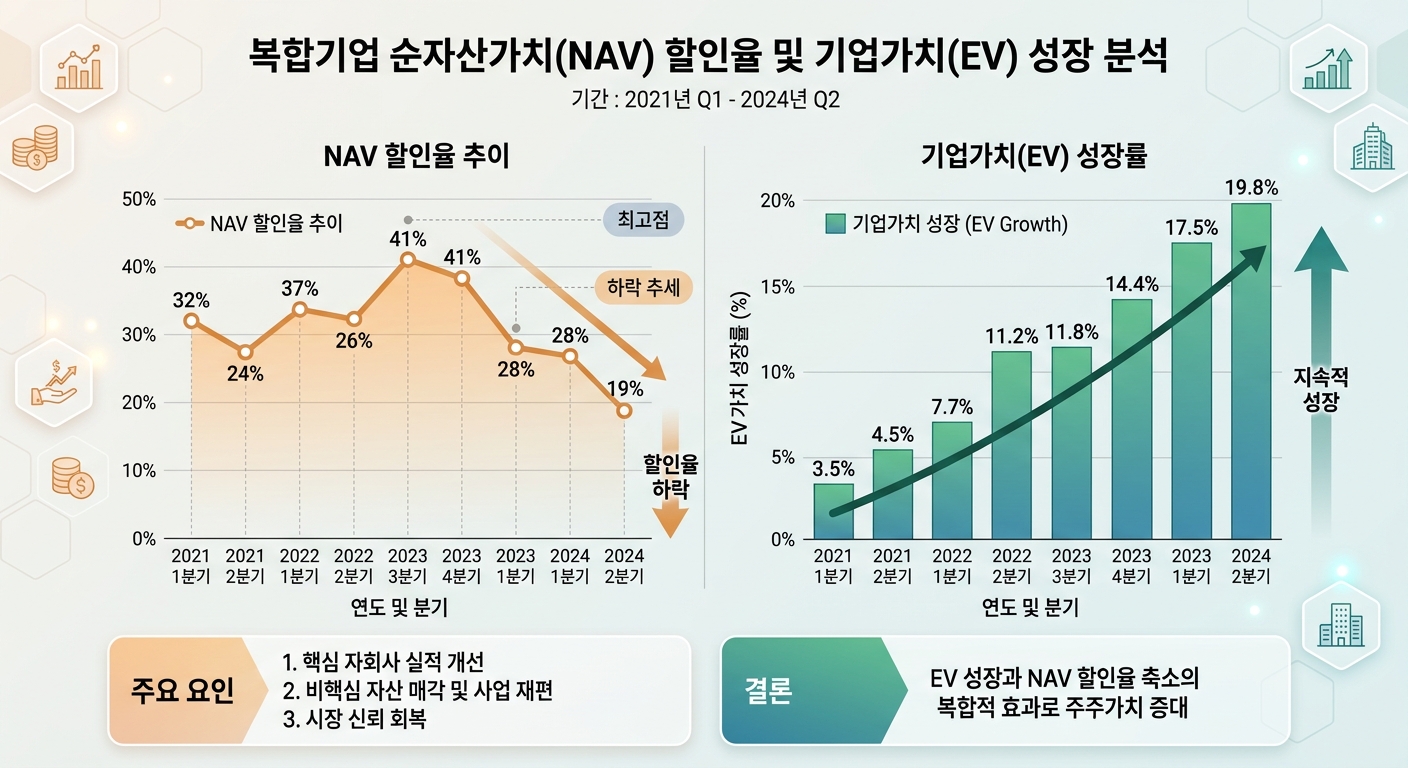
By completing its treasury stock retirement roadmap over three years, the number of circulating shares decreased by more than 13% compared to historical levels, sending Book Value Per Share (BPS) on a structural upward trajectory.
Even under identical asset valuations, the reduction in total shares outstanding makes the PBR (Price-to-Book Ratio) valuation appeal stand out even more conspicuously.
Expert & Institutional Analysis
Securities firms consistently evaluate Samsung C&T as both a key beneficiary of the corporate Value-up Program and a defensive value stock.
The policy of returning 60–70% of dividend income derived from affiliates while raising the minimum dividend per share is cited as a major factor significantly improving governance credibility.
Foreign and institutional investors are watching closely whether the conglomerate discount characteristic of large-cap KOSPI holdings will ease.
Analysts predominantly note that, amid sharp exchange rate fluctuations, its diversified business portfolio functions as a volatility hedge compared to other large-cap peers with high exposure to export manufacturing.
Risk Factors
A global economic slowdown and shrinking trade volumes could negatively affect trading margins and raw materials demand within the Trading & Investment segment.
Delayed recovery in domestic and overseas construction environments and rising procurement costs for raw materials caused by a strong dollar place pressure on project cost ratio management.
If the KRW/USD exchange rate surges further beyond 1,344.20, heavy selling in domestic index futures by foreign investors could accelerate, triggering passive capital outflows from large-cap names.
Delays in the commercialization timelines for overseas SMR and clean hydrogen represent conditional variables that could postpone their reflection in new business valuations.
Investment Takeaway
Samsung C&T is overlaying green growth engines—renewable energy and nuclear power—onto its resilient operational fundamentals.
Continuous treasury share cancellations and a guaranteed dividend floor serve as dependable buffers for shareholder value amid market downside volatility.
However, during periods of heightened macro pressure—such as rising FX rates and elevated fear indices—a phased, paced entry approach remains prudent.
Looking ahead, any re-rating of Samsung C&T's stock price will hinge upon the pace of actual monetization in green projects and continued progress in group governance transparency.
FAQ
Q1. What is the core benchmark of Samsung C&T's recent shareholder return policy?
The company maintains a consistent policy of distributing 60–70% of dividend income received from affiliates as dividend resources, while guaranteeing a minimum floor for dividend per share (DPS).
Q2. Which green new business is becoming tangible the fastest?
The pipeline sale model for US-centered solar and Battery Energy Storage Systems (BESS) is already making meaningful contributions to quarterly financial results.
Q3. How is the SMR (Small Modular Reactor) business being pursued?
Samsung C&T participates in global projects through strategic equity investments in leading technology firms like NuScale Power, paired with EPC execution partnerships.
Q4. What impact does treasury share cancellation have on corporate governance and value per share?
Reducing the number of shares outstanding raises Earnings Per Share (EPS) and Book Value Per Share (BPS), while naturally contributing to the stabilization of major shareholder ownership percentages.
Q5. Is the elevated exchange rate (around 1,344 KRW) favorable for Samsung C&T's earnings?
While it provides positive translation tailwinds for trading transactions and dollar-denominated overseas project orders, it also introduces complex headwinds by triggering foreign passive fund outflows.