Hello, this is Daily Stock, delivering core market context.
Key Takeaways
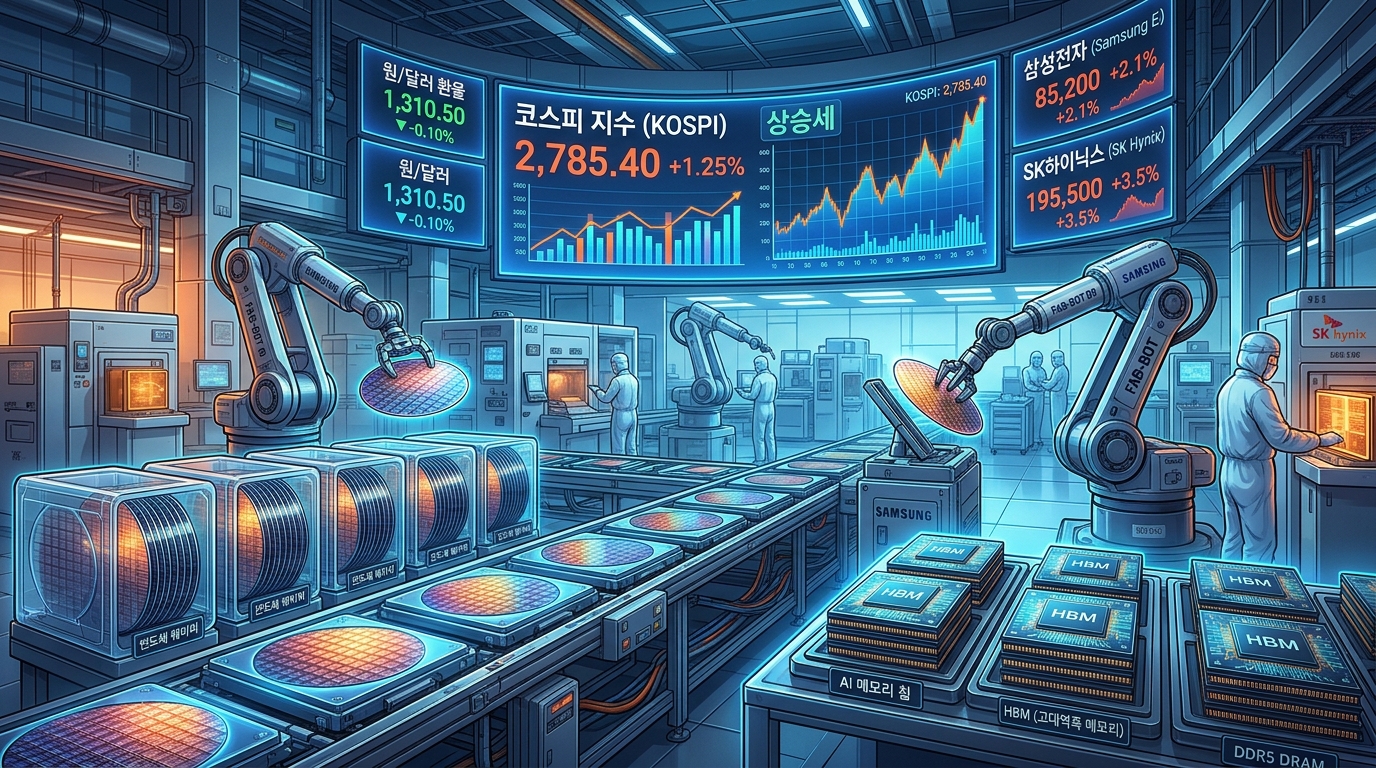
- SK Hynix firmly defends its leadership in supplying HBM3E and next-generation volumes for NVIDIA's next-generation architecture, fleshing out a scenario to achieve record quarterly operating profit in Q4.
- With the USD/KRW exchange rate settling around 1,346.50 KRW, a memory export structure overwhelmingly denominated in US dollars is enhancing margin defense through favorable FX effects.
- Although broad KOSPI market sentiment remains mired in Extreme Fear (11.7), foreign investor futures flows and semiconductor trade statistics support the potential for earnings differentiation centered on large-cap names.
Market Overview
Following the close of the domestic regular equity market on November 21, 2026, the KOSPI index stood at 4,869.96 and the KOSDAQ index at 645.68.
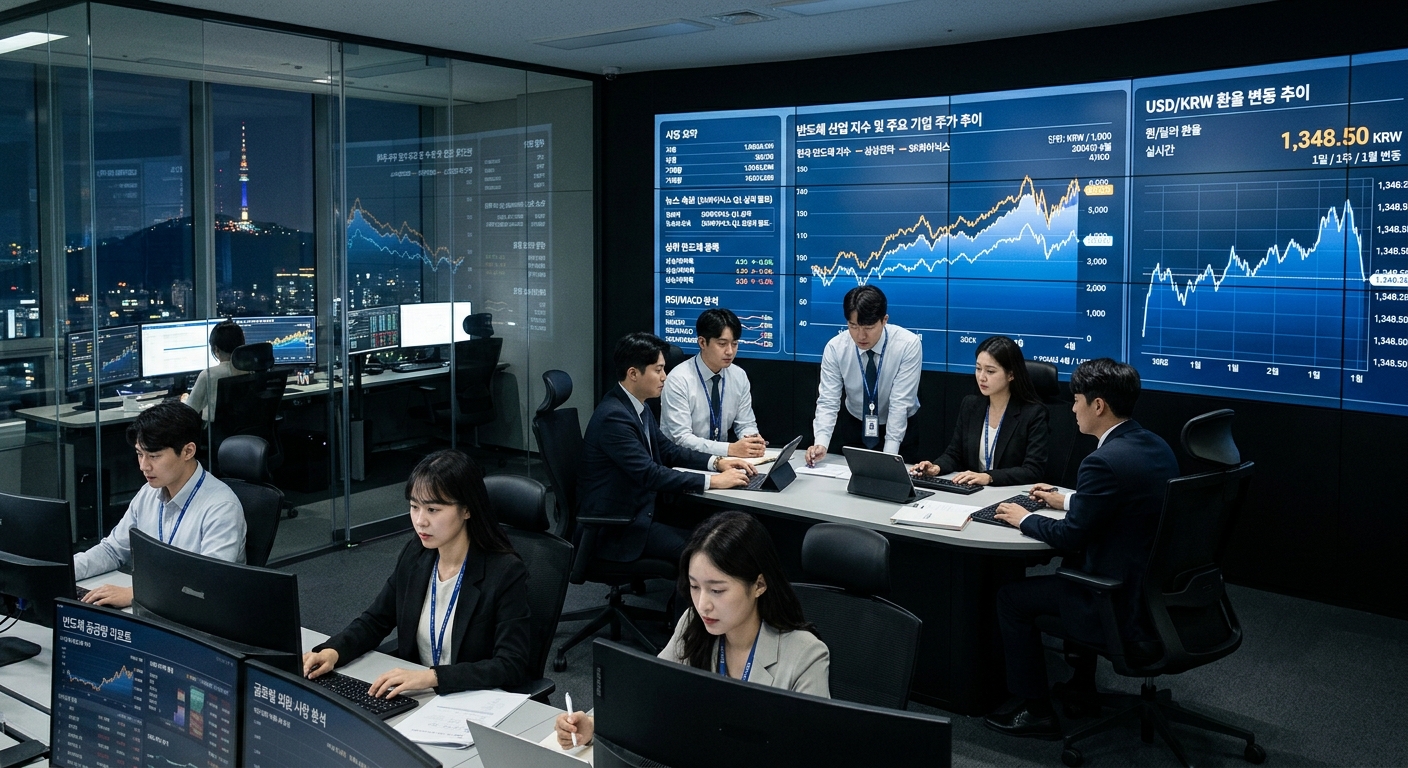
In the foreign exchange market, the USD/KRW exchange rate closed at 1,346.50 KRW, sustaining a level favorable for large-cap exporters.
According to Daily Stock's proprietary Fear & Greed Index analysis, the KOSPI Fear & Greed Index currently sits in Extreme Fear at 11.7, reflecting depressed investor sentiment compared to Extreme Fear (15.4) a week ago, Extreme Fear (6.9) a month ago, and Neutral (51.5) three months ago.
At the same time, the NASDAQ Fear & Greed Index—a global benchmark—also pointed to Extreme Fear at 9.7, indicating a sharp cooling from Fear (37.4) a week ago and Fear (28.7) a month ago.
While SK Hynix's individual intraday price remains unverified for the day (based on the latest confirmed data), the semiconductor sector's earnings contribution across KOSPI 200 large caps maintains an overwhelming presence.
Financial Analysis
Following robust Q3 earnings, SK Hynix is expected to sustain its earnings improvement in Q4 as the shipment mix of high-value-added memory expands.
With stabilizing yields for HBM3E (8-layer and 12-layer) and an accelerated transition to next-generation HBM volumes, both per-unit manufacturing cost reductions and average selling price (ASP) gains are occurring simultaneously.
| Category | Q3 2026 (Confirmed) | Q4 2026 (Consensus) | Notes |
|---|---|---|---|
| **DRAM ASP Change** | Double-digit QoQ growth | Continued QoQ increase | Driven by high-value server products |
| **HBM Product Share** | Core contributor to overall DRAM revenue | Share maximized via next-gen shipments | Backed by customer Long-Term Agreements (LTAs) |
| **Net Cash Flow** | Turned net cash positive with massive FCF | Continued expansion of cash equivalents | Debt reduction & enhanced balance sheet health |
| **Operating Margin (OPM)** | Stabilized high-margin structure | Expected maximization from high-value product mix | Concentrated demand from AI infrastructure |
The substantial cash-equivalent assets accumulated as of the end of Q3 provide the balance sheet capacity to self-fund capital expenditures (CapEx) required for upcoming advanced fab expansions, including the Yongin semiconductor cluster.
Consequently, reliance on external borrowing is reduced, establishing a resilient financial structure with controlled financing costs even during prolonged high interest rates.
Valuation
Within the KOSPI 200, large-cap leaders in semiconductors, autos (e.g., Hyundai Motor), and financial holding companies are forming a stark valuation divide against small- and mid-caps in terms of earnings stability.
Compared to major overseas memory and foundry peer groups (such as TSMC and Micron), domestic flagship memory stocks trade at relatively depressed 12-month forward price-to-earnings (Forward P/E) multiples.
In particular, multi-year Long-Term Agreements (LTAs) signed with big tech customers represent a structural shift that cushions against the sharp cyclical volatility historically seen in the memory industry.
Once downside earnings rigidity is validated, a rerating scenario could unfold as valuation multiples recover from the dampening effect of short-term economic slowdown concerns.
Expert & Institutional Analysis
Major securities firms analyze that surging demand for high-density HBM, fueled by NVIDIA's ramp-up in next-gen AI accelerator production, is driving upward revisions to SK Hynix's Q4 and next-year earnings estimates.
Global investment banks, including Goldman Sachs, also highlight the likelihood of memory supply shortages persisting through 2027–2028, maintaining favorable price targets.
From the perspective of foreign capital flows, with USD/KRW holding at 1,346.50 KRW and alleviating foreign exchange loss concerns, potential arbitrage inflows led by foreign investors in the index futures market are being observed.
Furthermore, the Bank of Korea's policy rate trajectory and preliminary monthly ICT semiconductor export/import data from the Korea Customs Service serve as pivotal indicators for large-cap institutional liquidity.
Risk Factors
The primary variable to monitor is the ongoing debate over the return on investment (ROI) regarding global big tech companies' AI infrastructure CapEx.
If the actual monetization timeline of AI services is delayed, a scenario involving order adjustments for subsequent quarters cannot be ruled out.
A recurrence of sharp volatility in the USD/KRW exchange rate could trigger foreign selling in spot and futures markets, expanding broad index volatility.
Additionally, a broader macroeconomic demand slowdown and potential shifts in the stringency of US export controls on advanced semiconductors remain key external variables requiring regular monitoring.
Investment Perspective
With the KOSPI Fear & Greed Index in Extreme Fear (11.7), an incremental accumulation strategy grounded in earnings visibility is far more viable than chasing short-term momentum.
SK Hynix's leadership in HBM3E and next-generation specifications is expected to act as a crucial defense mechanism for Q4 earnings differentiation.
Investors should continuously track forthcoming semiconductor export data to the US, whether USD/KRW stabilizes around the 1,350 KRW mark, and the execution pace of next-gen server CapEx by big tech.
Disciplined positioning—avoiding emotion-driven trading while cross-examining corporate fundamentals and institutional flow dynamics—remains recommended.
Investor Checkpoint Q&A
Q1. What is the impact of SK Hynix's HBM3E supply share on its Q4 earnings?
Backed by high average selling prices (ASP) and stable yields, high-value-added HBM3E elevates overall DRAM profitability, serving as the main growth driver for potential record Q4 performance.
Q2. How does the USD/KRW exchange rate of 1,346.50 KRW affect large-cap semiconductor flows?
A higher exchange rate lifts the KRW-denominated operating profit of semiconductor firms with predominantly USD-denominated sales; however, excessive spikes can trigger foreign selling to avert currency losses, making range stability essential.
Q3. What does the KOSPI Fear & Greed Index reading of 'Extreme Fear (11.7)' signify?
It indicates that market sentiment is deeply contracted, often serving historically as a volatility gauge to assess whether the market has entered an oversold zone.
Q4. What is driving the valuation divergence between KOSPI 200 large caps and small/mid-caps?
Liquidity is concentrating into large-cap semiconductor stocks with tangible exposure to the global AI cycle, whereas small- and mid-caps face a slower earnings recovery due to sluggish domestic demand and elevated financing costs.
Q5. How is the CapEx burden managed amid the transition to next-generation products?
Thanks to substantial net cash and an improved debt ratio built on strong cumulative Q3 earnings, SK Hynix has secured the balance sheet capacity to fund future advanced fab CapEx without relying on external borrowing.