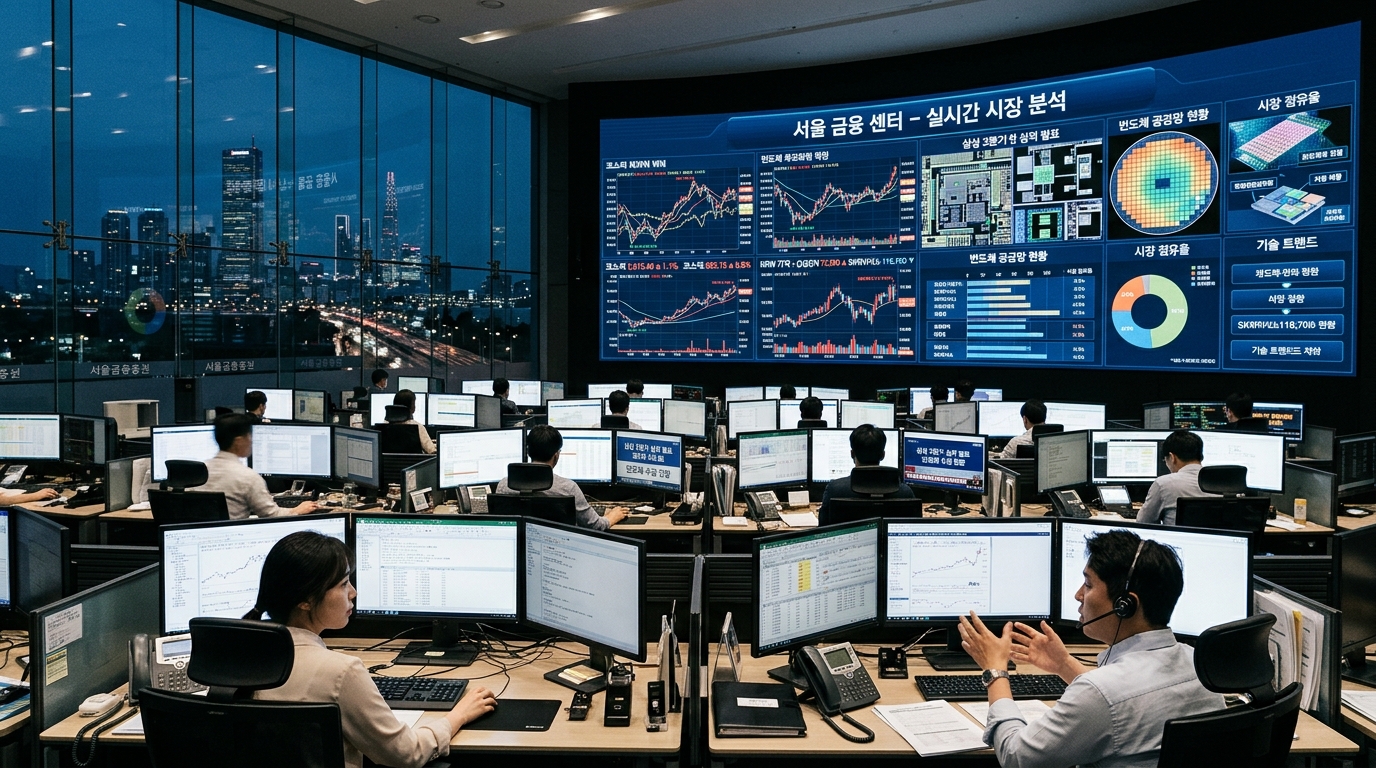
Hello, this is Daily Stock, delivering in-depth insights into market trends and financial inflection points for key companies.
Key Takeaways
Samsung Electronics' resolution to initiate a share buyback and cancellation program totaling KRW 10 trillion—aimed at enhancing shareholder value and stabilizing its share price—is functioning as a significant defensive barrier against a prolonged downward supply-demand trend.
Under the initial execution plan, the company will purchase and fully cancel KRW 3 trillion worth of shares (approx. 50.14 million common shares and 6.91 million preferred shares) on the open market over three months. The sequential utilization plan for the remaining KRW 7 trillion will be determined through subsequent board resolutions.
As of the domestic market close on November 20, 2026, the KOSPI index closed at 4,869.96, and the USD/KRW exchange rate stood at 1,336.20.
According to the Daily Stock Fear & Greed Index, the KOSPI is currently hovering at the Extreme Fear level (10.6). Consequently, the impact of share cancellations by large-cap semiconductor stocks has emerged as a crucial testing ground for securing downside rigidity across the index.
Current Situation Overview
The domestic stock market exhibits a structural feature where index volatility is heavily dictated by foreign net buying and selling trends in top-tier large-cap stocks across semiconductors, automobiles, and financials.
While Samsung Electronics' share price on the day remains at 'current price unconfirmed (based on latest verified value)', market participants assess that a buffer has been established to partially absorb passive foreign selling pressure following the announcement of the KRW 10 trillion buyback resolution.
Historical precedents in 2015 (KRW 11.3 trillion) and 2017 (KRW 9.3 trillion), when large-scale buybacks and cancellations were conducted, demonstrated that short-term price rebounds later converged with earnings turnarounds to drive structural re-ratings.
Similar to past initiatives, the current measure aims to fundamentally reduce total outstanding shares, thereby structurally elevating earnings per share (EPS) and book value per share (BPS).
| Classification | 1st Phase Execution (3 Months) | Remaining KRW 7 Trillion Plan | Comparison with Past 2017 Program |
|---|---|---|---|
| **Buyback & Cancellation Size** | Approx. KRW 3 trillion (fully cancelled) | Approx. KRW 7 trillion (tranche execution) | Total KRW 9.3 trillion (fully cancelled) |
| **Target Shares** | 50.14M common / 6.91M preferred shares | To be decided via individual board resolutions | Tranche acquisition and cancellation of common/preferred shares |
| **Primary Objective** | Enhance shareholder value & reduce float | Diversify returns & boost corporate value | Expand shareholder returns & stabilize share price |
| **Supply/Demand Impact** | Direct on-market purchase inflow vs. ADTV | Expected to serve as a long-term support floor | Established downside rigidity followed by earnings-driven rally |
Financial Analysis
The funding for Samsung Electronics' share buyback is backed by robust net cash assets and operating cash flow, meaning it does not disrupt short-term liquidity or capital expenditure (CAPEX) schedules.
Typically, multi-trillion-won share buybacks and cancellations decrease equity, functioning as a representative financial leverage technique to enhance return on equity (ROE).
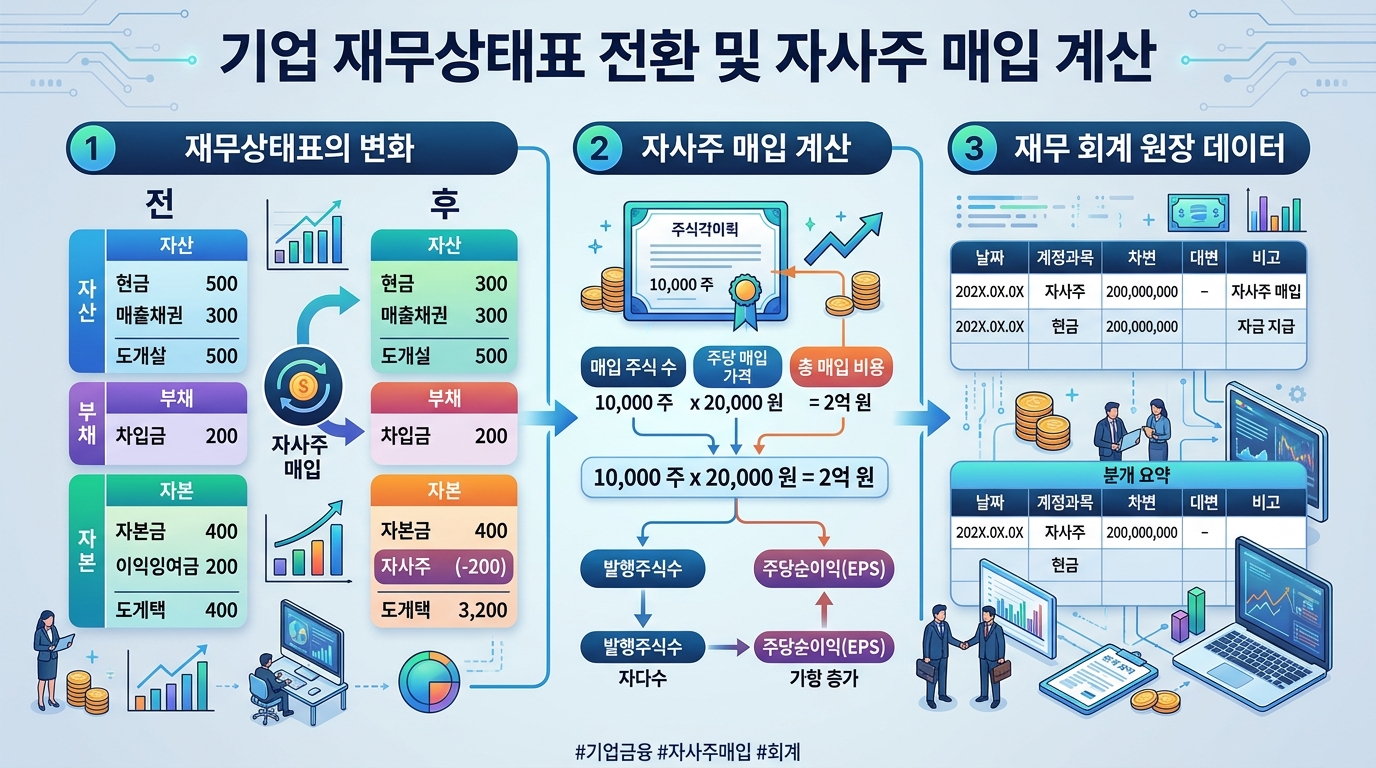
Although concerns are occasionally raised regarding potential contractions in R&D and advanced manufacturing investments due to massive cash outflows, the company's ample cash holdings ensure that capital expenditure execution capabilities remain intact.
Ultimately, the simultaneous reduction in total equity and circulating shares establishes a defensive foundation for core profitability metrics.
Valuation
Historically, periods where Samsung Electronics' price-to-book ratio (PBR) fell below 1.0x or hovered near 0.9x have been interpreted as deep historical troughs from a medium- to long-term perspective.
Compared to major US technology peers, leading KOSPI semiconductor shares continue to face steep valuation discounts, and the price-to-earnings ratio (PER) for KOSPI 200 large caps broadly remains subdued relative to global benchmarks.
Once share cancellations are executed, the cancelled shares are permanently extinguished from the total outstanding count. As a result, BPS rises naturally under identical net profit figures, alleviating PBR pressure.
Beyond nominal book values, the tangible upgrade in per-share intrinsic value is poised to expand price elasticity during future rebound phases.
Expert & Institutional Analysis
Securities firms and financial investment experts largely concur that this KRW 10 trillion shareholder return package forms a robust downside support floor for the stock.
However, a cautious consensus maintains that a structural turnaround in foreign fund inflows requires stabilizing exchange rates, validated competitiveness in high-value-added memory such as HBM, and the resolution of oversupply in legacy semiconductors.
While foreign investors react favorably to the technical supply-demand gap filled by corporate buybacks, they tend to recalibrate exposure only after rigorously assessing foreign exchange movements and forward earnings guidance revisions.
Domestic institutional investors likewise evaluate that daily buyback inflows during the acquisition period will serve as an effective shock absorber against futures-linked arbitrage selling.
Risk Factors
The most prominent external macro risks remain USD/KRW volatility and concerns over a global economic slowdown.
If the exchange rate becomes entrenched near the upper 1,330s or higher, foreign spot-market selling driven by FX loss mitigation could erode the defensive supply-demand cushion provided by the buyback.
The Bank of Korea's benchmark interest rate path and trade balance trends are also critical variables.
Should the recovery in IT set demand face delays or Chinese competitors accelerate their catch-up in legacy nodes, the positive tailwinds of the share cancellation could be diluted by broader earnings headwinds.
Investment Perspective
A KRW 10 trillion share buyback and cancellation represents an unmistakable undervaluation signal and a commitment to share price stabilization from management.
Nonetheless, share cancellations do not serve as an operational catalyst that directly accelerates the memory cycle rebound or raises foundry utilization rates.
Therefore, rather than chasing momentum for quick short-term gains, a measured approach is warranted—tracking the detailed deployment timeline for the remaining KRW 7 trillion after the initial KRW 3 trillion cancellation, monitoring foreign net buying reversals across spot and futures markets, and evaluating improvements in export data.
With a structural supply cushion in place, investors should evaluate the scenario for a valuation normalization rally once competitive strength in next-generation memory is reaffirmed.
Investor Checkpoint Q&A
Q1. How is Samsung Electronics' KRW 10 trillion buyback plan structured?
Out of the KRW 10 trillion total, the initial KRW 3 trillion (approx. 50.14 million common shares and 6.91 million preferred shares) will be purchased on-market over 3 months and fully cancelled. The specific timing and deployment methods for the remaining KRW 7 trillion will be resolved sequentially through future board meetings.
Q2. What is the difference between simply holding treasury shares versus cancelling them?
Simply acquiring and holding treasury shares leaves potential overhang risks, as those shares can later be re-released into the market. Complete cancellation permanently reduces total shares outstanding, thereby permanently boosting EPS and BPS to deliver tangible shareholder value enhancement.
Q3. How does this compare to the impact of the 2017 buyback program?
During the KRW 9.3 trillion buyback in 2017, the stock experienced a strong upward rally powered by the semiconductor supercycle. While the current program establishes firm downside rigidity, a sustained upward trend requires accompanying earnings growth in next-generation semiconductor lines.
Q4. How do FX rates and foreign flows influence the effectiveness of the buyback?
Elevated USD/KRW levels may intensify foreign selling aimed at mitigating FX losses, potentially diluting the buyback's impact. Conversely, if exchange rates stabilize and foreign investors flip to net buyers in index futures, rebound momentum could accelerate alongside the buyback inflows.
Q5. How should investors navigate large caps when the Daily Stock Fear & Greed Index signals 'Extreme Fear'?
The KOSPI Fear & Greed Index reading of 10.6 (Extreme Fear) reflects heavily contracted market sentiment. Under such conditions, it is prudent to observe large caps equipped with corporate safety nets—such as buyback mandates—in phased tranches while maintaining a conservative eye on concrete signs of operational turnaround.