
Here is an in-depth analysis of recent booking metrics and pricing policy shifts for Airbnb (ABNB), a leader in the global travel platform space.
Key Takeaways
Airbnb's (ABNB) stock price has entered a period of heightened volatility as signs of slowing travel demand in core markets such as North America and Europe coincide with a potential deceleration in Average Daily Rate (ADR) growth.
The fourth quarter, arriving after the peak summer season, coincides with a seasonal lull where consumer preference for cost-effectiveness intensifies.
While long-term stay nights and growth in emerging markets remain robust, prolonged macroeconomic high interest rates and diminished real consumer spending power pose challenges to defending average spend per booking.
Amid broader valuation pressures across the Nasdaq, Airbnb's ability to consistently demonstrate high-margin cash generation remains the critical variable for its future stock trajectory.
Current Market Context
As of intraday trading on November 20, 2026 (preliminary), the Nasdaq index stands at 23,879.20 points, with Airbnb's trading activity observed around its latest confirmed quotes.
According to Daily Stock's proprietary Fear & Greed Index, the Nasdaq sentiment currently sits in "Extreme Fear" (18.7), showing a sharp renewed contraction in investor sentiment compared to "Neutral" (40.3) one week ago, "Extreme Fear" (19.5) one month ago, and "Extreme Fear" (7.9) three months ago.
The KOSPI also stands at 4,943.33 points intraday (preliminary), registering "Extreme Fear" (12.1) as a conservative stance spreads across global risk assets.
Across the broader travel sector, the prevailing view is that the post-pandemic "revenge travel" boom has fully transitioned into a normalization phase.
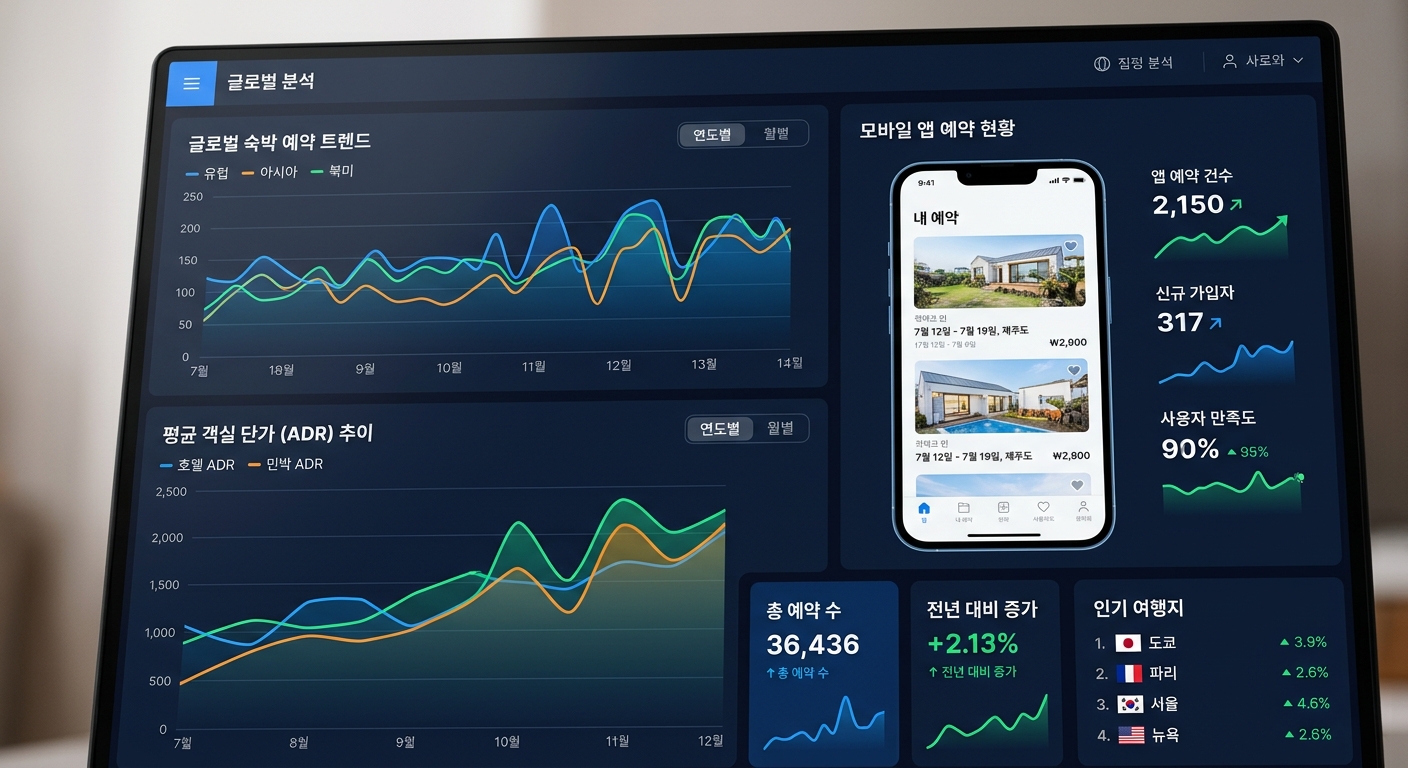
In particular, Q4 booking trends reveal shorter booking lead times and a "trade-down" phenomenon favoring lower-priced accommodations, limiting further upside for Average Daily Rates (ADR).
Financial Analysis
Airbnb continues to demonstrate strong Free Cash Flow (FCF) generation capabilities powered by disciplined marketing execution and stringent cost controls.
The financial metrics summarizing quarterly trends in Nights Booked and average spend are outlined below:
| Metric | Q3 2024 (Actual) | Q4 2024 (Reported) | Q3 2025 (Preliminary) | Notes & YoY Trend |
|---|---|---|---|---|
| **Revenue** | Approx. $3.73B | Approx. $2.68B | Approx. $4.10B | Solid top-line growth around double digits |
| **Adjusted EBITDA Margin** | 52% | Approx. 33% | 50% | Reflects seasonality; maintains high profitability |
| **Gross Booking Value (GBV)** | Approx. $20.1B | Approx. $17.6B | Approx. $22.9B | Up approx. 10–14% YoY |
| **Nights & Experiences Booked** | Approx. 123M | Approx. 119M | Approx. 134M | Driven by emerging markets like Asia & LatAm |
| **Free Cash Flow (FCF)** | Approx. $1.10B | Approx. $450M | Approx. $1.20B | Consistently generating over $4B annually |
Thanks to its asset-light business model with minimal capital expenditure (CAPEX) requirements, Airbnb steadily achieves FCF margins exceeding 30%.
However, mild stagnation in ADR alongside foreign exchange fluctuations (DXY strength) has exerted a modest drag on US dollar-converted revenues from overseas bookings.
Valuation
Airbnb trades at a forward price-to-earnings (Forward P/E) multiple of approximately 25–30x, commanding a premium over traditional hotel chains like Marriott and Hilton (20–22x).
This premium reflects the platform fee model's superior cash flow generation and powerful platform lock-in effects.
Nonetheless, in a macroeconomic environment where the 10-year US Treasury yield (US10Y) remains elevated, discount pressure on high-multiple growth stocks persists.
While mega-cap tech stocks in the Nasdaq 100 sustain their multiples on expectations of AI infrastructure CAPEX returns, consumer-facing platform equities tend to respond more sensitively to multiple contraction risks when real household income slows.
Wall Street & Institutional Analysis
Major Wall Street research firms maintain a favorable view of Airbnb's formidable brand equity and vast host network.
Conversely, they have concurrently issued conservative price target cuts in response to near-term booking deceleration and capped ADR expansion.
Major investment banks, including Morgan Stanley and Goldman Sachs, note that while Airbnb still offers compelling space efficiency compared to mid-to-budget hotels, near-term pressure on spend per guest is inevitable due to constrained consumer disposable income.
At the same time, analysts point out that the rollout of AI-driven personalized search features and the launch of new ancillary offerings (such as the Co-Host Network) could serve as mid-to-long-term revenue diversification catalysts.

Risk Factors
The most direct headwind is the potential retrenchment in Q4 leisure travel spending caused by depleted consumer savings and slowing real household income in the US and Europe.
If travelers reduce trip durations or lower their per-night spending limits, downward pressure on ADR could expand.
A second risk is the tightening of short-term rental regulations across major metropolitan areas worldwide.
If restrictive ordinances like New York City's Local Law 18 spread to other major cities across Europe and North America, core urban supply could become constrained.
A third factor is sensitivity to macroeconomic variables.
A strong US dollar (rising DXY) curbs purchasing power for travelers outside the United States, while sharp spikes in the Volatility Index (VIX) could widen drawdowns for consumer growth equities within risk-asset portfolios.
Investment Takeaway
Backed by a differentiated business model distinct from traditional hospitality providers, Airbnb possesses the balance sheet resilience to defend operating margins even during economic slowdowns.
Its low debt burden and ample liquidity to sustain share repurchases serve as key downside supports.
In the near term, however, investors should consider that softening ADR trends and off-peak Q4 earnings uncertainty may cap share price upside.
Consequently, a prudent strategy involves monitoring the macroeconomic interest rate path alongside subsequent quarterly booking growth rates and management guidance before scaling into positions.
Investor FAQ Checkpoint
Q1. What is the primary reason behind the recent plateau in Airbnb's Average Daily Rate (ADR)?
A1. The pent-up demand surge immediately following the pandemic has normalized, and travelers have increasingly opted for more affordable accommodations ("trading down") in response to inflationary pressures.
Q2. What is Airbnb's competitive advantage over traditional hotel stocks?
A2. Because it does not own physical real estate, Airbnb avoids depreciation charges and heavy capital expenditure (CAPEX), allowing it to maintain a high Free Cash Flow (FCF) conversion margin above 30%.
Q3. How significantly do municipal regulations (e.g., NYC short-term rental rules) impact company-wide earnings?
A3. While municipal crackdowns limit supply in specific local markets, Airbnb's revenue base is globally diversified across urban, suburban, and rural destinations, keeping systemic risks from any single city regulation contained.
Q4. Through what channel does a rise in the 10-year US Treasury yield (US10Y) affect the stock?
A4. A higher long-term discount rate compresses valuation multiples (P/E) applied to high-growth platforms, while concurrently squeezing consumer credit and card borrowing limits, which dampens discretionary travel spending.
Q5. What core metrics should investors scrutinize during the Q4 earnings release?
A5. Year-over-year growth in Nights Booked, YoY percentage changes in ADR, and management's forward Adjusted EBITDA guidance for the upcoming quarter.