Hello, this is Daily Stock.
Executive Summary
As of the close on November 19, 2026, the KOSPI index recorded 5,106.13, and the USD/KRW exchange rate settled at 1,329.70 won.
According to the Daily Stock Fear & Greed Index, the KOSPI is currently in the "Extreme Fear (13.5)" zone. Following "Fear (22.0)" one week ago and "Extreme Fear (8.9)" one month ago, extreme caution continues amid index volatility.
Meanwhile, the Nasdaq Fear & Greed Index currently sits at "Fear (24.6)," cooling down from "Neutral (40.3)" a week ago, reflecting broadly subdued risk appetite.
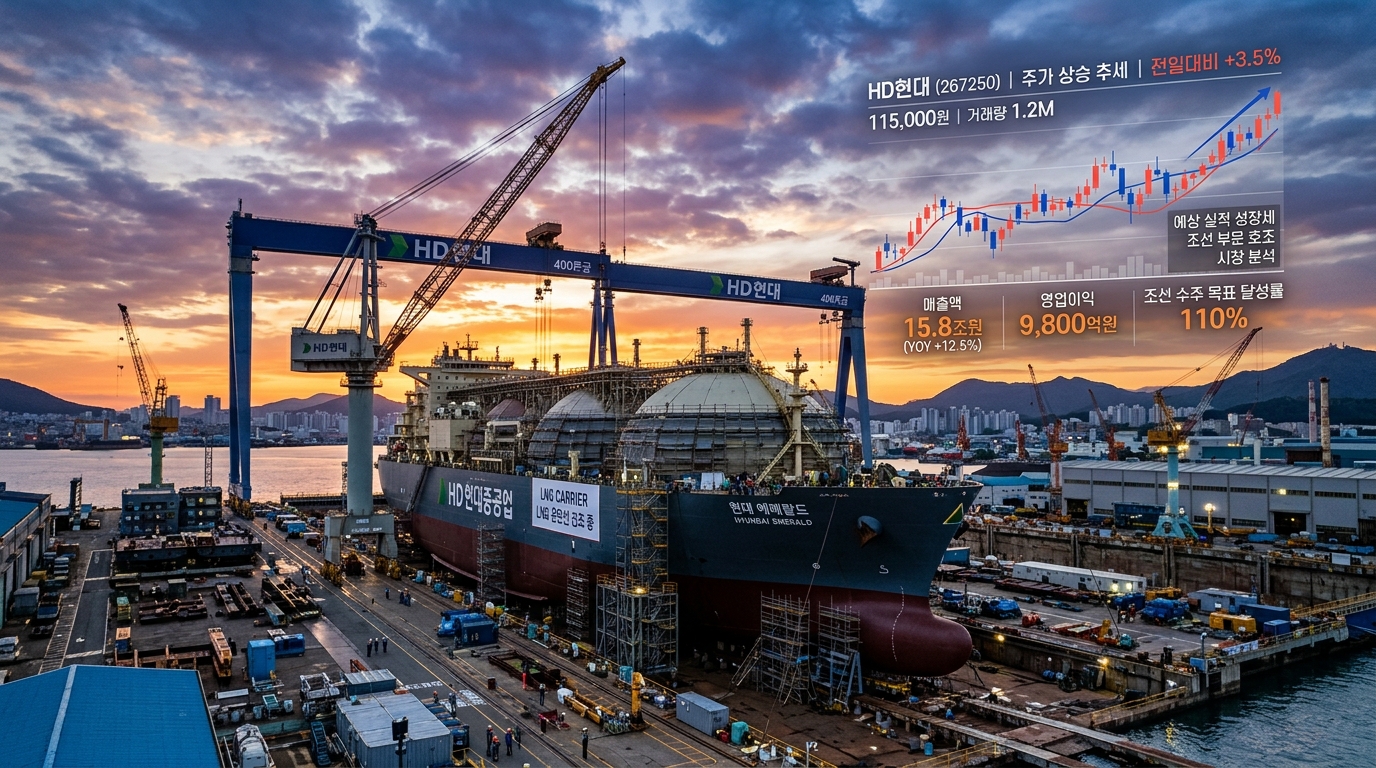
HD Hyundai Heavy Industries is establishing a firm earnings recovery path as the construction and delivery of high-priced liquefied natural gas (LNG) carriers and very large gas carriers (VLGC/VLAC) contracted between 2022 and 2023 accelerate.
Although the day's market price is marked as "unconfirmed as of the close (based on latest verified value)," a structural turnaround fully reflecting higher contract prices is increasingly evident.
Current Market Context
South Korea's shipbuilding industry has secured more than three years of dock backlog running through 2028–2029, driven primarily by the Qatar Phase 2 project and eco-friendly, high-value vessel types.
In particular, HD Hyundai Heavy Industries is on the verge of achieving its annual order target after securing back-to-back orders in early November 2026 from an African shipowner for two LNG carriers (KRW 662.9 billion) and four very large ammonia carriers (VLACs) (KRW 630.1 billion).
Due to the nature of the shipbuilding cycle—where revenue recognition follows a heavy-tail payment structure 2 to 3 years post-order—lower-margin legacy orders have been depleted, and the share of high-priced LNG carriers contracted around $260 million per vessel is rising steeply.
Amid macro uncertainties dampening sentiment for semiconductor and secondary battery names within large-cap KOSPI, the shipbuilding sector stands out for robust earnings visibility backed by confirmed backlogs.
Financial Analysis
HD Hyundai Heavy Industries' annual revenue expanded rapidly from KRW 14.4860 trillion in 2024 to KRW 17.5806 trillion in 2025.
Operating profit also demonstrated a sharp turnaround, surging by triple digits from KRW 705.2 billion in 2024 to KRW 2.0375 trillion in 2025.
For 2026, the company is projected to achieve consolidated annual revenue in the mid-KRW 24 trillion range, with annual operating profit expected to reach between KRW 3.6 trillion and KRW 3.8 trillion.
| Category | FY2024 | FY2025 | FY2026 Estimate (F) | FY2027 Estimate (F) |
|---|---|---|---|---|
| **Revenue (Trillion KRW)** | 14.49 | 17.58 | 24.34 ~ 24.60 | 27.98 |
| **Operating Profit (Trillion KRW)** | 0.71 | 2.04 | 3.63 ~ 3.85 | 4.94 |
| **Operating Profit Margin (OPM)** | 4.9% | 11.6% | 14.9% ~ 15.7% | 17.6% |
| **Net Profit (Trillion KRW)** | 0.62 | 1.42 | 2.82 ~ 2.95 | 3.86 |
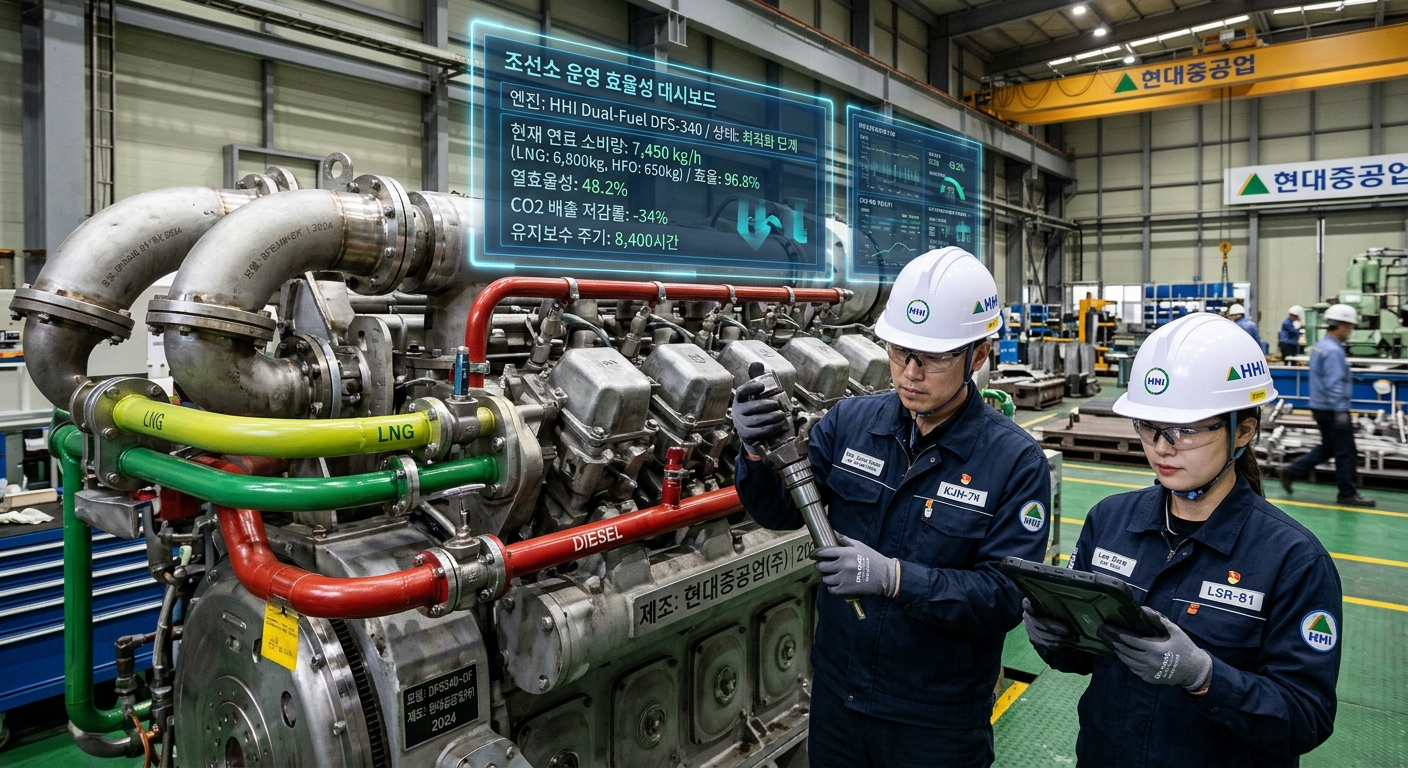
As vessel delivery processes enter their mid-to-late stages, operating margins in the merchant vessel division are stabilizing around 15%. Concurrently, profitability is expanding from proprietary eco-friendly HiMSEN engines and offshore plant projects (such as Trion and RUYA).
Valuation
Despite solid earnings momentum, HD Hyundai Heavy Industries is trading at a 12-month forward price-to-book ratio (PBR) of 3.5x to 4.0x due to foreign exchange volatility and macroeconomic variables.
This reflects a premium for being the world's leading shipyard alongside unmatched competitiveness in the internal production of gas vessel engines.
However, concerns over capacity expansion at Chinese shipbuilders such as Hudong-Zhonghua and moderation in LNG vessel price gains are capping short-term multiple expansion.
Nonetheless, with return on equity (ROE) projected to exceed 20%—well above other manufacturing large-caps in the KOSPI 200—downside valuation support remains robust.
Expert and Institutional Analysis
Market analysts note that although Q3 2026 quarterly profits slowed slightly due to summer vacations, fewer working days, and temporary USD/KRW currency fluctuations, these factors are merely seasonal.
Major domestic equity research centers maintain a "Buy" rating with target prices in the KRW 500,000 to KRW 530,000 range, anticipating that the revenue contribution from higher-priced vessels within the merchant orderbook will rise steadily through the end of 2027.
While institutional and foreign investors engaged in arbitrage profit-taking triggered by index pullbacks, the stance of increasing exposure to shipbuilders with clear earnings momentum remains intact.
Analysts also point out that business diversification into land-based power generation engines—such as supplying generators for North American AI data centers—will serve as a medium- to long-term multiple re-rating catalyst alongside commercial shipbuilding.
Risk Factors
The most direct macroeconomic risk is high volatility in the USD/KRW exchange rate.
If the USD/KRW pair drops sharply below the 1,320 won level, Korean-won-denominated revenues and operating margins on exported vessels could contract.
Additionally, if a slowdown in global trade volumes is prolonged amid Bank of Korea base rate pauses or broader monetary policy shifts, the momentum behind newbuilding price index increases could decelerate.
Quarterly earnings volatility could also stem from one-off provisions related to union wage negotiations and fluctuations in raw material prices, such as thick steel plate distribution costs.
Furthermore, capacity additions and aggressive low-price bidding by Chinese shipyards—expanding beyond tankers and container ships into the LNG carrier segment—warrant continuous monitoring.
Investment Perspective
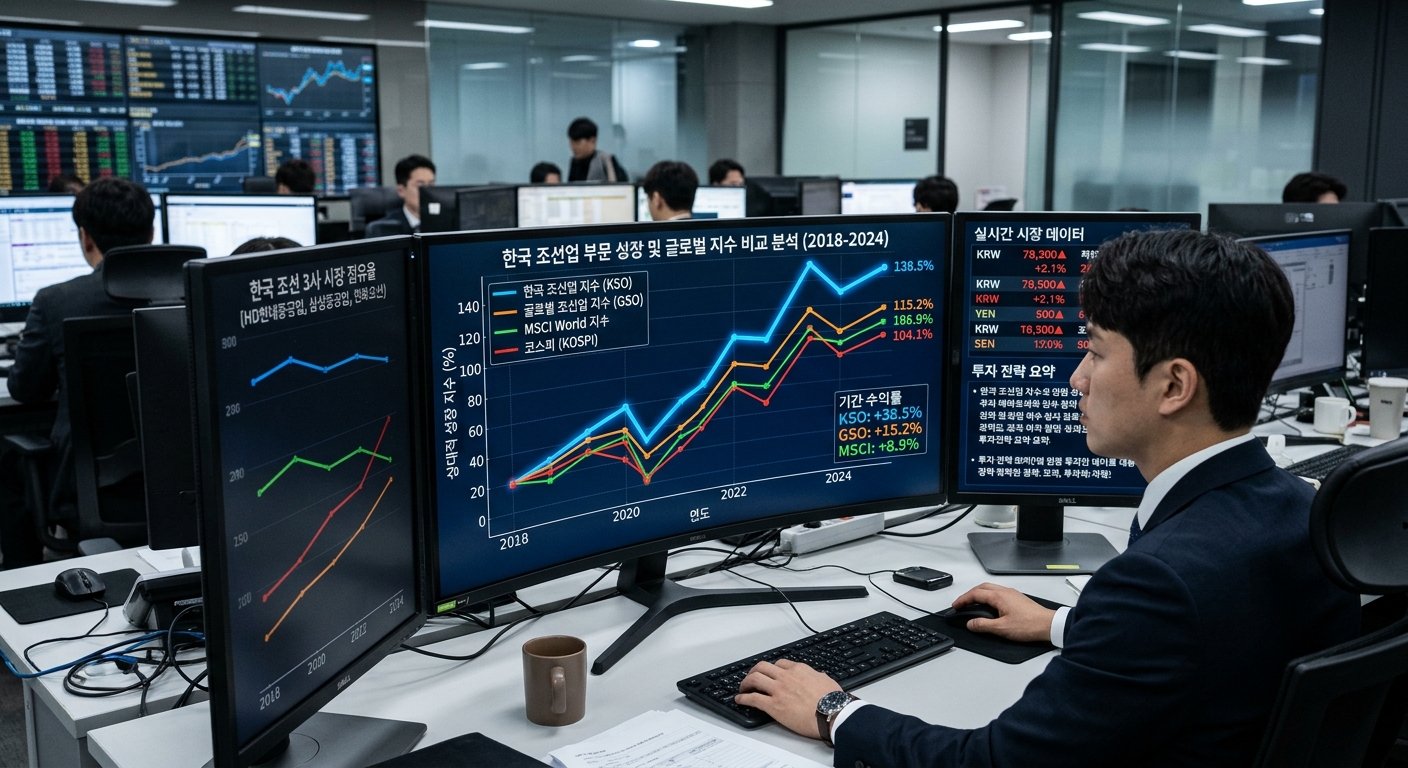
HD Hyundai Heavy Industries is the prominent large-cap shipbuilder best positioned to translate the newbuilding price rally that began in 2022 fully into realized earnings.
Consolidating annual operating profits in the KRW 3 trillion range for 2026 and maximizing high-priced revenue contribution in 2027 signify more than a simple turnaround; they represent a structural supercycle.
With the KOSPI Fear & Greed Index currently lingering in "Extreme Fear" at 13.5, using short-term price pullbacks caused by macro volatility as opportunities for phased accumulation remains a viable approach.
However, this should be paired with prudent allocation management while closely tracking foreign exchange paths and whether newbuilding price indices have peaked.
Daily Stock Q&A
Q1. What is the specific impact of high-priced LNG carrier deliveries on earnings?
A1. In shipbuilding, contract prices set at the order stage are recognized as revenue 2 to 3 years later during vessel construction. As LNG carriers contracted at significantly higher prices in 2022–2023 enter major delivery stages, cost ratios drop markedly, driving operating margins up toward the 15% range.
Q2. Is a USD/KRW exchange rate around 1,329.70 won favorable for shipbuilders?
A2. Because shipbuilders typically receive payment installments in US dollars, a sustained high exchange rate maximizes converted won revenues and margins. However, rapid short-term drops in the currency can introduce foreign exchange losses and adjustments to construction loss provisions, making FX hedging strategies critical.
Q3. Does the entry of Chinese shipyards into the LNG carrier market pose a significant threat to Korean shipbuilders?
A3. While Chinese yards are expanding market share incrementally, South Korean majors maintain an absolute competitive edge in containment system fabrication technology, engine reliability, and on-time delivery track records.
Q4. Why are HiMSEN engine orders for data center generators significant?
A4. They broaden the product scope beyond traditional marine propulsion engines into distributed onshore power generation for applications like North American AI data centers, creating a stable, high-margin cash flow stream less susceptible to maritime shipping cycles.
Q5. How should investors navigate when the KOSPI Fear & Greed Index is in 'Extreme Fear'?
A5. When the broader market is burdened by psychological weakness and volatility, it is advisable to select companies with proven earnings visibility and confirmed backlogs, adopting a phased dollar-cost-averaging approach rather than aggressive lump-sum entries.