Hello, this is Daily Stock.
Executive Summary
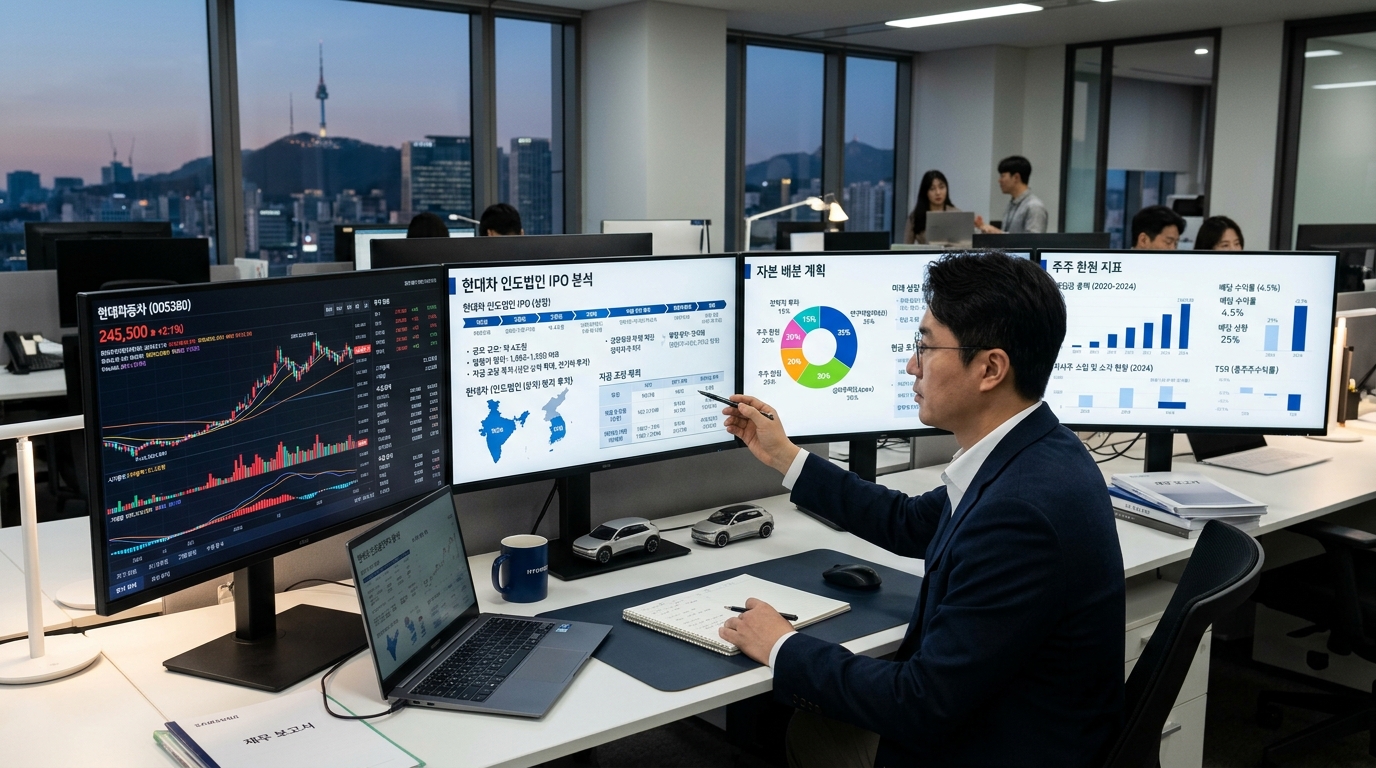
Hyundai Motor has reached a critical turning point in global business revaluation and capital allocation by securing substantial cash inflows through the local stock market listing of its Indian subsidiary, Hyundai Motor India (HMI).
The secured liquidity is seen as key funding not only for next-generation future vehicle R&D, but also for supporting the early establishment of shareholder return initiatives, including achieving a Total Shareholder Return (TSR) of 35% and executing large-scale share buybacks and cancellations.
Even amid economic slowdowns and tariff variables, the introduction of a minimum annual dividend of 10,000 KRW per share and an undervalued multiple are expected to act as a downside buffer among KOSPI large-cap stocks.
Current Market Context
On November 18, 2026, the domestic stock market closed with the KOSPI index at 5,067.44 and the KOSDAQ index at 662.81, while the USD/KRW exchange rate settled at 1,333.30 KRW.
According to Daily Stock's proprietary Fear & Greed Index, the KOSPI is currently in the Extreme Fear (11.6) zone, following Fear (23.7) 1 week ago, Extreme Fear (9.6) 1 month ago, and Neutral (56.6) 3 months ago. Meanwhile, the Nasdaq Fear & Greed Index stands at Fear (25.2).
With the USD/KRW exchange rate fluctuating within the 1,330 KRW box, foreign investors' spot and futures flows reflect selective portfolio rebalancing centered on top KOSPI market-cap leaders across semiconductors, autos, and financials.
Hyundai Motor's share price could not be confirmed on the day (based on the latest verified figure); however, as a large-cap KOSPI exporter, it tends to track closely with FX movements and shifts in the Bank of Korea's base rate trajectory.
Following the listing of its Indian subsidiary—regarded as the largest IPO in Indian stock market history—the net cash proceeds flowing to headquarters are functioning as a cushion against share price volatility by fueling treasury share repurchases and dividend distributions.
Financial Analysis
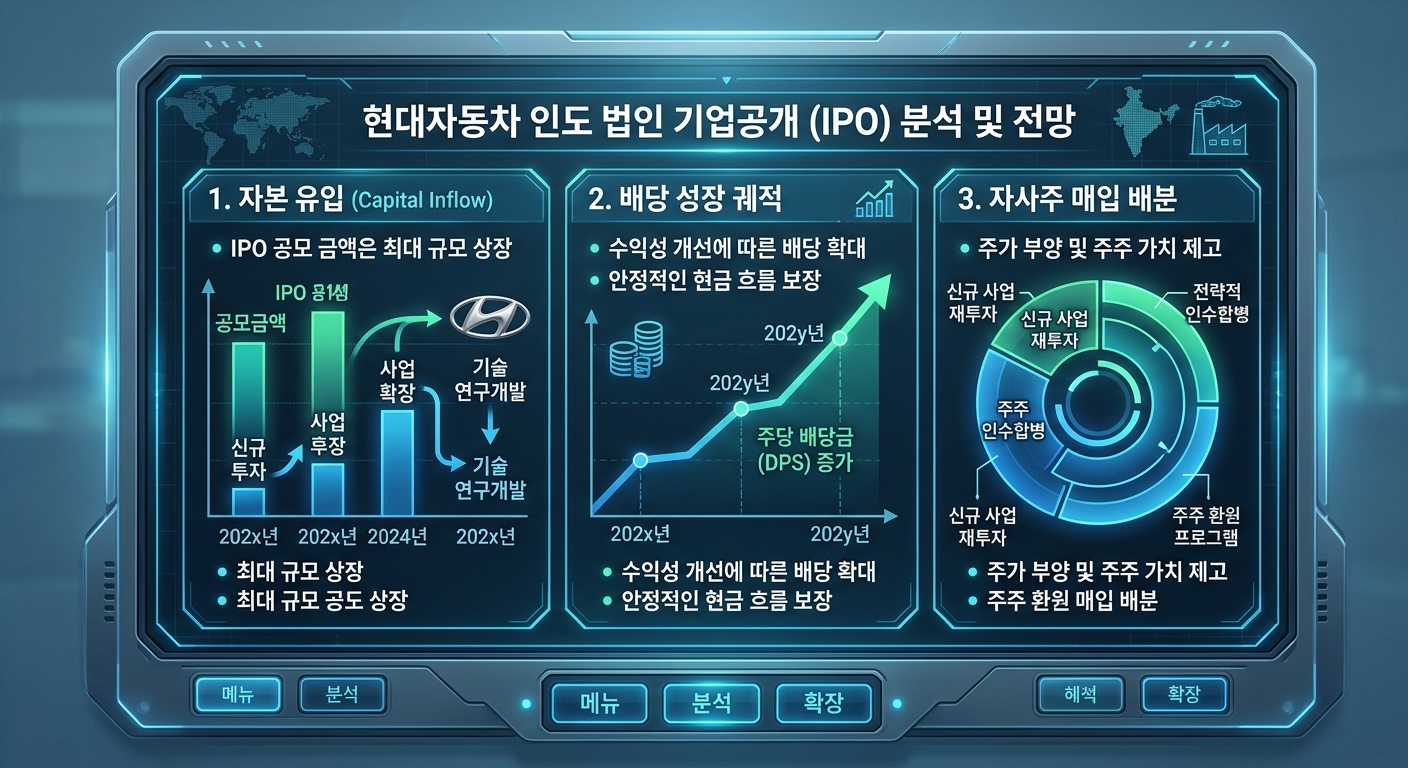
Hyundai Motor is estimated to have secured over 3 trillion KRW in net cash through the secondary offering of HMI shares, net of taxes and ancillary expenses.
This liquidity eases the burden of annual capital expenditures (CAPEX) planned at around 12 trillion KRW, while creating headroom to expand shareholder returns without undermining balance sheet soundness.
Through its Corporate Value-up Plan announced in 2024, the company established a minimum annual dividend of 10,000 KRW per common share and transitioned toward quarterly dividend payouts of 2,500 KRW per share.
In addition, by setting a target to repurchase and cancel 4 trillion KRW worth of treasury shares over three years, the company is bolstering supply-demand dynamics for both common and preferred shares.
| Category | Key Details | Shareholder Value & Financial Impact |
|---|---|---|
| **HMI IPO Impact** | Inflow of over 3T KRW in net cash; established local funding channel | Improved HQ cash flow and secured funds for special shareholder returns |
| **Total Shareholder Return (TSR)** | Targeting at least 35% based on net profit attributable to controlling interests | Maximizing shareholder returns via combined dividends and share cancellations |
| **Cash Dividend Policy** | Guaranteed minimum annual dividend of 10,000 KRW/share (2,500 KRW/quarter) | Stable cash stream even during periods of earnings volatility |
| **Share Buyback/Cancellation Roadmap** | 4T KRW repurchased over 3 years; cancellation of common and preferred shares | Decline in circulating shares drives BPS and EPS growth |
| **Profitability Target** | Achieving a 3-year average ROE of 11–12% | Shedding valuation discounts via improved capital efficiency |
Valuation
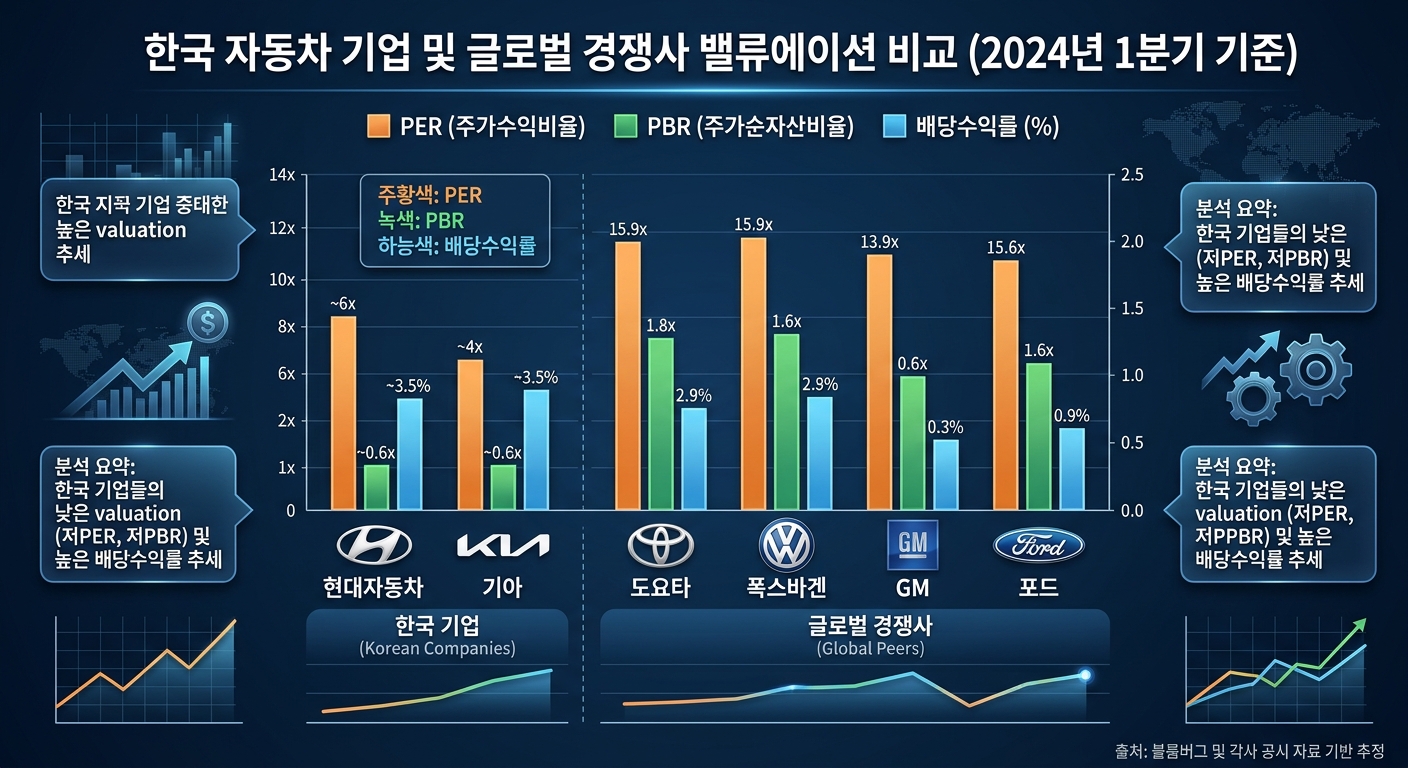
Compared to global automakers, Hyundai Motor trades at a price-to-earnings ratio (PER) of 5–6x and a price-to-book ratio (PBR) of 0.5–0.6x, remaining at a relative discount to international peers.
The fact that its Indian subsidiary listed locally at a premium multiple in the mid-20x PER range has prompted the market to re-evaluate the remaining value of Hyundai Motor's stake.
In particular, the dual buyback and cancellation strategy targeting preferred shares (e.g., 2PB, 3PB)—which trade at substantial discounts to common shares—is a catalyst expanding the upside for overall book value per share (BPS).
With an expected dividend yield hovering around 5% within the KOSPI 200 large-cap manufacturing universe, Hyundai Motor's relative attractiveness as a stable income asset is coming to the fore.
Expert & Institutional Perspectives
Market analysts assess that the substantial liquidity generated from the HMI IPO has served as a powerful catalyst accelerating the timeline for the 35% TSR goal.
Analysts, including Song Sun-jae of Hana Securities, pointed out that if proceeds from the India listing seamlessly feed into treasury share repurchases and special shareholder returns, both supply-demand and valuation could improve in tandem.
However, some institutional analysts note that if geopolitical and trade headwinds materialize—such as global tariff risks or cuts to eco-friendly vehicle incentives—the pace of shareholder return execution may be adjusted flexibly.
From the perspective of foreign investors, resilience in South Korea's auto export data and the potential windfall from a high USD/KRW exchange rate remain primary gauges guiding buy decisions.
Risk Factors
The primary external risk is the potential compression of export margins resulting from protectionist measures and tighter tariff policies from key trading partners, including the United States.
Slowing demand for new vehicles in domestic and advanced markets, along with intensifying market share competition between hybrids and electric vehicles, could drive up promotional incentives.
Furthermore, while maintaining large-scale annual investments exceeding 10 trillion KRW, a sharp macroeconomic deterioration leading to reduced operating profits could risk scaling back the medium-to-long-term volume of share cancellations.
FX sensitivity must also be continuously monitored, as a rapid decline in the USD/KRW exchange rate (won appreciation) would erode translated earnings from overseas vehicle sales.
Investment Perspective
Hyundai Motor presents a hybrid investment profile, capturing direct tailwinds from the high-growth Indian market while demonstrating strong commitment to shareholder returns as a quintessential domestic Value-up stock.
In the near term, supply-demand defenses linked to buyback disclosure dates and quarterly ex-dividend schedules should offer support.
For medium-to-long-term investors, an optimal strategy entails monitoring year-over-year execution toward the 35% TSR and 11–12% ROE targets, alongside tracking shipment growth from new manufacturing capacity in India.
With the KOSPI hovering near psychological lows, the combination of a dependable dividend yield and shrinking floating share count through buyback cancellations is expected to provide a meaningful downward buffer.
Investor Checkpoint Q&A
Q1. How much cash was actually remitted to headquarters from the Indian subsidiary's IPO?
A. Net of taxes, underwriting fees, and related costs from the secondary offering of HMI shares, over 3 trillion KRW in net cash flowed back to Hyundai Motor headquarters.
Q2. How does Hyundai Motor define and calculate its 35% Total Shareholder Return (TSR)?
A. Unlike market conventions centered primarily on stock price appreciation, the company calculates TSR by dividing total cash dividends plus share repurchases/cancellations by net profit attributable to controlling interests, effectively returning 35% or more of net earnings directly to shareholders.
Q3. Will the minimum 10,000 KRW annual dividend per share be maintained if earnings decline?
A. The company has enhanced dividend predictability by committing to a baseline minimum dividend of 10,000 KRW per share (around 2,500 KRW per quarter), irrespective of short-term earnings volatility.
Q4. Could the 4 trillion KRW share buyback plan be delayed by external shocks?
A. Management has noted that timing and scale could be flexibly calibrated should adverse operating conditions intensify, such as punitive tariffs or a broad global recession; tracking macro indicators remains essential.
Q5. Do preferred shareholders benefit equally from shareholder return initiatives?
A. Yes. Taking into account the discount on preferred shares, Hyundai Motor executes buybacks and cancellations across both common and preferred classes, allowing preferred shareholders to benefit from elevated dividend yields and enhanced liquidity.