
Welcome. This is Daily Stock, delivering in-depth analysis of global tech and core Nasdaq market momentum.
Key Takeaways
Apple is driving a new hardware replacement cycle alongside the advancement of its on-device AI, Apple Intelligence.
As of the second half of 2026, upgrade demand from legacy device owners is gaining momentum, demonstrating differentiated shipment resilience even amid a contraction in the broader global smartphone market.
However, margin compression stemming from rising memory semiconductor costs and high-multiple valuation concerns driven by U.S. Treasury yield volatility still warrant close scrutiny.
Rather than focusing on short-term volatility, an incremental dollar-cost-averaging approach centered on an extended upgrade cycle and structural operating leverage in Services revenue is recommended.
Current Market Overview
As of intraday trading on November 18, 2026 (tentative), the Nasdaq Composite recorded 24,328.38 points, entering a consolidation phase following major Big Tech earnings releases.
During the same intraday window (tentative), South Korea's domestic indices stood at 4,968.48 for the KOSPI and 650.06 for the KOSDAQ, while the USD/KRW exchange rate fluctuated around 1,335.50 KRW.
Looking at market sentiment metrics, Daily Stock's proprietary Nasdaq Fear & Greed Index currently sits in the Fear zone at 25.2.
While lower than the previous week's Fear level (37.4), this marks an improvement from Extreme Fear levels seen one month ago (18.2) and three months ago (11.6). For reference, the KOSPI Fear & Greed Index is in Extreme Fear at 10.1, tracing a trajectory from Fear (23.7) a week ago, Extreme Fear (9.6) a month ago, and Neutral (56.6) three months ago.
During the day, Apple (AAPL) shares maintained a resilient trend, trading around the $348 level based on the latest available data.
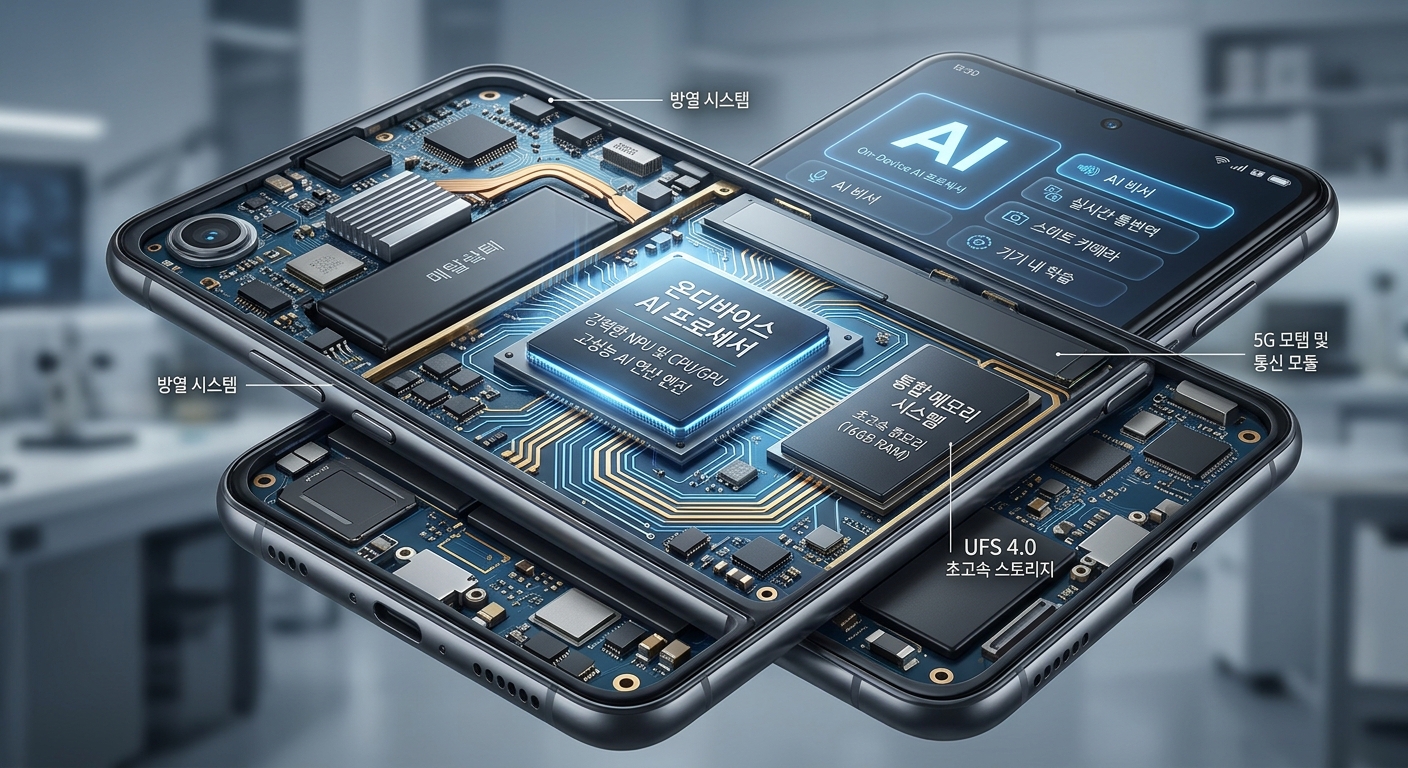
As higher-density DRAM becomes essential to run on-device AI models, device upgrade demand and rising component costs are simultaneously drawing strong market attention.
Financial Analysis
In its recent fiscal Q4 2026 earnings release, Apple reported quarterly revenue of $114.5 billion and earnings per share (EPS) of $2.10.
The iPhone segment, which accounts for roughly half of total net sales, achieved double-digit year-over-year growth, proving the commercial traction of on-device AI integration.
The high-margin Services segment also generated quarterly revenue of $31.6 billion, sustaining a robust gross margin in the mid-70% range.
However, management guided next-quarter gross margin to 45%–46%, reflecting tangible cost headwinds from mobile DRAM and other hardware components.
| Segment / Metric | Q4 2026 Results | YoY Change | Key Highlights & Notes |
|---|---|---|---|
| Total Revenue | $114.5 Billion | +12% | Beat market consensus |
| iPhone Revenue | $57.6 Billion | +18% | Driven by on-device AI upgrade demand |
| Services Revenue | $31.6 Billion | Double-digit growth | Defended gross margin around 76% |
| Total Gross Margin | 47.9% | +0.7%p | Includes ~1%p tariff rebate benefit |
| Diluted EPS | $2.10 | +14% | Record high for the September quarter |
Apple's capital expenditures (CAPEX) remain controlled compared to hyperscaler peers heavily investing in centralized servers.
By prioritizing client-side on-device computing, Apple faces relatively less financial burden from expanding cloud infrastructure maintenance.
Valuation
Apple currently trades at a forward price-to-earnings (Forward P/E) ratio in the low-to-mid 30x range, sitting above its five-year historical average.
This reflects a market premium that prices Apple not merely as a hardware manufacturer, but as an on-device AI platform leader.
However, in an environment where the U.S. 10-year Treasury yield (US10Y) remains elevated, room for further multiple expansion may be constrained.
Even compared to the average valuation of growth stocks within the Nasdaq-100 (NDX), Apple's current multiples require sustained earnings delivery to remain justified.
Relative strength in the U.S. Dollar Index (DXY) and intermittent spikes in the Volatility Index (VIX) also act as discounting factors for global consumer discretionary demand.
From a valuation standpoint, earnings (EPS) growth must act as the primary share price driver rather than multiple expansion.
Expert & Institutional Analysis
Major Wall Street investment firms broadly agree that Apple Intelligence will stimulate an extended hardware upgrade cycle.
Morgan Stanley noted in a report that Apple's shipments could expand by more than 7% over the next 1–2 years, even if the broader global smartphone market softens.
The rationale is that over 1 billion active legacy devices face hardware constraints, particularly insufficient RAM, required to run on-device AI models.
This dynamic fuels optimism that a multi-year replacement cycle will remain robust.
Conversely, conservative institutions such as Morningstar caution against memory chip supply constraints and component price inflation.
They emphasize that growth will likely depend more on higher Average Selling Prices (ASP) than unit shipment volume, making consumer price resistance a key variable to monitor.

Risk Factors
The most direct risk is the actual perceived utility of on-device AI features and potential monetization delays.
If consumer-facing daily utility remains limited, the motivation to upgrade early to premium flagship devices could soften.
A second risk is margin erosion driven by global semiconductor supply chains and rising memory input costs.
Because high-density memory is mandatory to operate performant on-device models, gross margin spreads could face downward pressure.
Lastly, antitrust scrutiny and regulatory pressure surrounding closed AI platform ecosystems pose ongoing headwinds.
Regulatory frameworks like the European Union's Digital Markets Act (DMA) may cause phased rollouts or localized delays for proprietary AI capabilities.
Investment Perspective
At this juncture, the investment thesis for Apple should focus on ecosystem lock-in and replacement cycle momentum rather than quarterly variance.
While hyperscaler peers face debate over the return on investment (ROI) for aggressive AI CAPEX, Apple's client-side approach provides cost defensiveness.
The Nasdaq Fear & Greed Index lingering in the Fear zone at 25.2 indicates that overall market sentiment remains cautious.
Considering broader index volatility and interest rate trajectories, an incremental accumulation strategy during pullbacks is more prudent than aggressive chasing.
Investors should track the Philadelphia Semiconductor Index (SOX) and its value chain to evaluate input cost shifts.
A disciplined portfolio allocation strategy that confirms iPhone replacement data points and gross margin defense in Services remains effective.
Investor Checkpoint Q&A
Q1. What is the core catalyst driving legacy device upgrades via on-device Apple Intelligence?
Running advanced AI voice features and localized client-side processing reliably requires high-capacity unified memory and high-performance NPUs. Legacy models face hardware-level memory constraints that prevent full support, creating a natural catalyst for device replacement.
Q2. How significantly will rising memory prices impact Apple's earnings?
Apple possesses substantial pricing power, allowing it to pass a portion of component cost inflation through to higher average selling prices. In the near term, however, gross margins could experience a 1%–2%p headwind, as reflected in next-quarter guidance.
Q3. How does Apple's AI strategy differ from other Big Tech firms deploying massive data center CAPEX?
While other hyperscalers deploy massive capital expenditure to construct AI data centers, Apple handles processing primarily on the device itself, routing only complex queries to private cloud infrastructure. This reduces capital expenditure burdens and monetizes AI directly through hardware sales.
Q4. How sensitive is Apple's share price to fluctuations in the U.S. 10-year Treasury yield?
Because Apple trades at an elevated forward P/E above 30x, higher bond yields raise the discount rate on future cash flows, creating downward valuation pressure. Consequently, periods of reduced rate-cut expectations or elevated Treasury issuance tend to amplify equity volatility.
Q5. Which core indicators should investors track most closely?
Key metrics include whether quarterly iPhone shipments and Average Selling Prices (ASP) expand concurrently, and whether Services gross margins stay in the mid-70% range. Additionally, management's product gross margin guidance serves as a critical operational barometer.