Hello, this is Daily Stock.
Key Summary
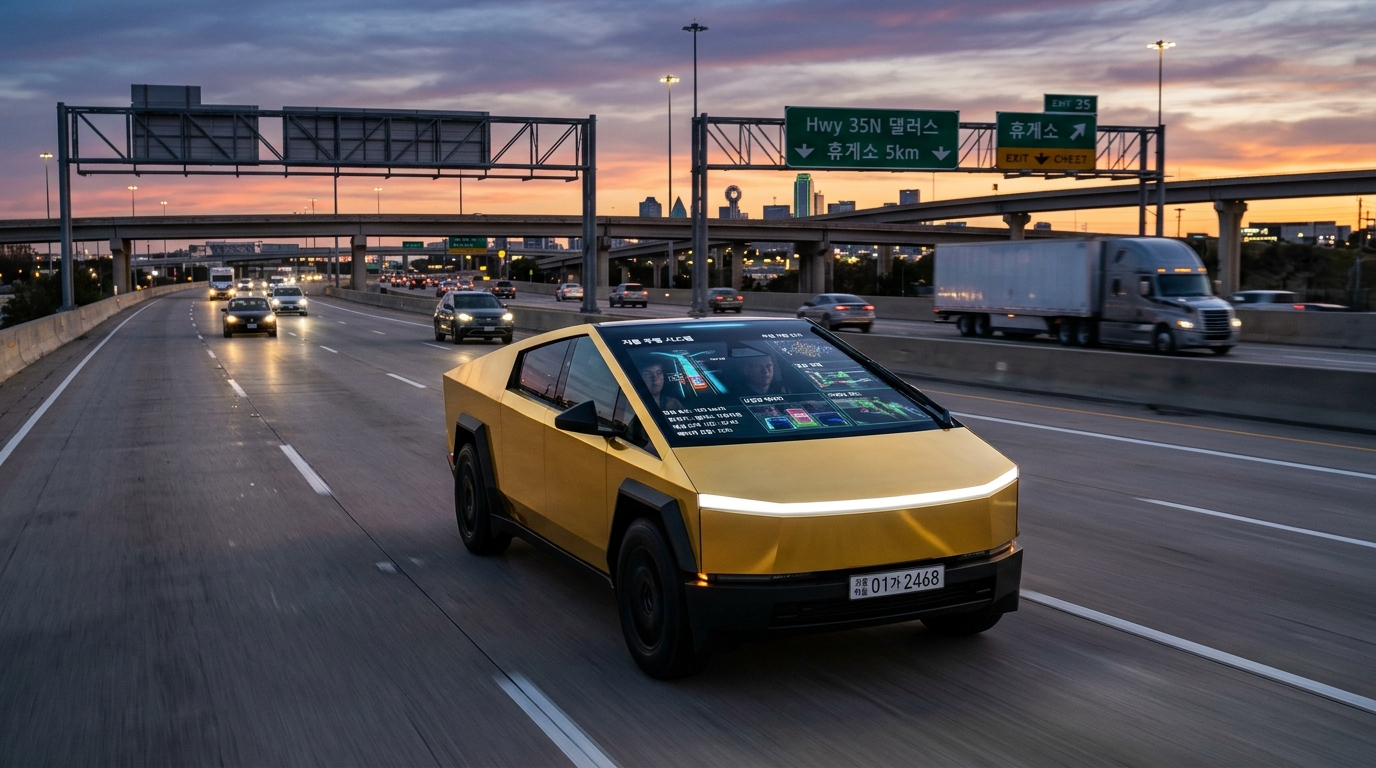
Tesla's (TSLA) commercialization of the dedicated driverless autonomous vehicle, "Cybercab," along with the rollout of the end-to-end neural network-based FSD v13, represents a defining watershed moment in evaluating its structural transition from a pure automaker to an AI robotics platform company.
The practical commercial deployment of the two-seater platform Cybercab—which completely eliminates the steering wheel and pedals—hinges on obtaining Federal Motor Vehicle Safety Standards (FMVSS) exemption approval from the National Highway Traffic Safety Administration (NHTSA) and driverless commercial operating permits from individual state governments.
While accelerating AI capital expenditures (CAPEX) centered around the Cortex supercomputing cluster at Giga Texas and the FSD v13 architecture are establishing a technological inflection point, high sensitivity between the 10-year U.S. Treasury yield (US10Y) and valuation multiples continues to drive stock price volatility.
Current Situation Overview
As of intraday trading on November 16, 2026 (preliminary), the global macroeconomic backdrop shows the Nasdaq index standing at 25,136.27 points, while the USD/KRW exchange rate fluctuates around 1,337.00 won.
According to Daily Stock's proprietary Fear & Greed Index, the Nasdaq market registered 38.6 (Fear). Although this marks a slight recovery from the Fear level of 24.4 logged one week prior, cautious sentiment remains dominant compared to the Neutral reading of 45.6 one month ago.
Tesla has rapidly scaled up Model Y-based robotaxi operating mileage across regulatory-friendly operational hubs such as Austin, Dallas, and Houston, Texas, while progressively fleshing out its plan to sell the Cybercab to private consumers.
To expand Cybercab operations nationwide, obtaining approval not only from individual states but also securing regulatory framework revisions from NHTSA—which must move beyond the limits of legacy automotive crash and steering safety standards—is cited as a critical bottleneck.
On the software front, the rollout of the FSD v13 series, featuring native neural networks optimized for HW4 (AI4), 36Hz high-resolution video input, and a 50% reduction in photon-to-control latency, attempts to advance the system into Unsupervised FSD operating without human driver intervention.
| Category | Key Status & Technical Specs | Notes & Core Impact |
|---|---|---|
| **Platform Hardware** | 2-seater dedicated Cybercab (No steering wheel or pedals) | Produced at Giga Texas; targeted starting price around $29,990 |
| **Software Evolution** | FSD v13 (AI4 optimized, 5x training compute via Cortex) | Unified parking, reverse, and unparking; significantly improved latency |
| **Operating Permitting** | Texas limited operational hubs vs. Pending California CPUC approval | NHTSA FMVSS safety standards exemption procedure is crucial |
| **Autonomous Subscription Model** | $299/month integrated autonomous driving subscription (subject to revision) | Incorporates remote teleoperation monitoring and driverless liability costs |
| **Market Sentiment Metrics** | Nasdaq Fear & Greed at 38.6 (Fear); expanding VIX and yield sensitivity | Scrutiny over Big Tech CAPEX returns amid macro uncertainty |
Financial Analysis
Tesla's recent financial health is being reshaped at the intersection of traditional automotive delivery margins and substantial capital expenditures (CAPEX) aimed at building out its AI ecosystem.
Tesla's annual capital expenditures have remained elevated between $15 billion and $20 billion, driven by the construction of the Cortex AI cluster and the expansion of dedicated driverless vehicle production lines, exerting near-term downward pressure on free cash flow (FCF).
Conversely, with the paid FSD subscription take rate rising steeply alongside new vehicle deliveries in North America and an expanding active FSD user base, software and service margins—alongside high profitability from the energy storage segment (Megapack)—are serving as a resilient buffer.
While falling automotive manufacturing costs and manufacturing innovations at Giga Texas contribute to lowering per-unit production costs, financial results appear to be absorbing elevated R&D spending rather than demonstrating explosive operating margin expansion prior to full-scale driverless autonomous commercialization.
Valuation
Currently, Tesla's price-to-earnings (P/E) ratio trades in an ultra-high multiple territory exceeding 300x, reflecting significant front-loading of its value as an AI and robotics tech platform rather than as a pure-play automotive manufacturer.
With intraday quotes pending confirmation (based on latest validated metrics), Tesla's valuation maintains a considerable premium over Nasdaq 100 components and the S&P 500 large-cap growth stock average (P/E around 30x).
This high-multiple framework is characterized by extreme sensitivity to fluctuations in the 10-year U.S. Treasury yield (US10Y) and the U.S. Dollar Index (DXY).
Whenever bond yields face upward pressure, the discount rate on future cash flows increases, exerting immediate multiple contraction pressure. This dynamic often moves in tandem with valuation adjustments across AI accelerator supply chain equities within the Philadelphia Semiconductor Index (SOX).
Expert & Institutional Analysis
Major Wall Street investment banks continue to exhibit a distinct divergence in views regarding Tesla's robotaxi commercialization roadmap.
The bullish camp, led by Morgan Stanley, evaluates Tesla's proprietary vision-only approach and the massive volume of real-world driving video data collected from millions of production vehicles globally as providing a decisive unit-cost advantage over competitors.
From their perspective, this grants Tesla superior scalability and cost competitiveness over Waymo's approach, which relies on LiDAR and high-definition (HD) mapping, paving the way for substantial expansion in software margins.
In contrast, conservative institutions emphasize that Waymo is already operating hundreds of millions of commercial, paid autonomous ride-hailing miles under full regulatory approval in cities such as San Francisco and Phoenix.
They caution that the path to securing legal driverless autonomous driving (Level 4) licensing for Tesla's Cybercab remains uncertain, warning that failure to overcome regulatory hurdles could impair hardware asset utilization and returns on invested capital.
Risk Factors
The most fundamental risk lies in federal- and state-level permitting delays and rigorous safety verification procedures for autonomous driving.
Because vehicles completely lacking steering wheels and pedals cannot operate under existing automotive safety standards, regulatory revisions or special exemption grants by the NHTSA are mandatory; however, regulatory agencies maintain a cautious stance.
A second challenge is the time lag in realizing returns on heavy AI computing infrastructure CAPEX.
Astronomical capital outlays are being directed toward cloud and data center infrastructure. Should the nationwide rollout of paid driverless robotaxi services face extended delays, the mounting burden of depreciation expenses could weigh on profit margins.
Lastly, on the macroeconomic front, uncertainty surrounding the Federal Reserve's monetary policy path and potential rebounds in the US10Y Treasury yield remain structural risks capable of compressing multiples across Nasdaq growth equities.
Investment Perspective Summary
An investment strategy regarding Tesla requires looking beyond near-term vehicle delivery figures to meticulously monitor neural network performance advancements across the FSD v13 to v14 pipeline, as well as the feasibility of the Cybercab regulatory timeline.
A key observation point is whether autonomous mileage and safety statistical data accumulated in regulatory-flexible regions like Texas will serve as sufficient empirical justification for regulatory approval.
With the Nasdaq currently hovering at a Fear index level of 38.6, investors should exercise caution against assuming rapid multiple expansion. Instead, maintaining an incremental dollar-cost-averaging approach that factors in interest rate volatility and regulatory newsflow appears to be a prudent strategy.
Investor Checkpoint Q&A
Q1. What regulatory hurdles must the Cybercab clear to operate on public roads without a steering wheel and pedals?
At the federal level, it requires a Federal Motor Vehicle Safety Standards (FMVSS) exemption approval from the NHTSA. At the state level, it must secure Autonomous Vehicle Deployment Permits from state transit authorities, such as the California DMV and the CPUC.
Q2. How does FSD v13 differ technologically from the prior v12 architecture?
FSD v13 is optimized for AI4 (HW4) hardware, boosting camera input frequency to 36Hz. It expands training compute fivefold using the Cortex supercomputing cluster and unifies all driving tasks—including parking, reverse maneuvering, and unparking—into a single end-to-end neural network.
Q3. When can Tesla realistically expect a financial return on its massive AI CAPEX outlays?
Financial returns are expected to phase in gradually once paid driverless robotaxi networks receive regulatory clearance and reach commercial operation, alongside an acceleration in software licensing and high-margin autonomous driving subscription revenues.
Q4. How does a rise in the 10-year U.S. Treasury yield (US10Y) impact Tesla's stock price?
Because a substantial portion of Tesla's corporate valuation is derived from distant future cash flows in AI and autonomy, rising bond yields raise the applied discount rate, exerting downward pressure on its valuation multiple.
Q5. What are the key differences in technology and business models between Tesla and Waymo?
Waymo utilizes a safety-oriented sensor fusion approach anchored by LiDAR and HD mapping. In contrast, Tesla adopts a vision-only model driven by cameras and end-to-end AI, aiming for an advantage in mass manufacturing scalability and unit-cost reduction.