This is Daily Stock, delivering in-depth analysis of global tech and the Nasdaq market.
Key Summary
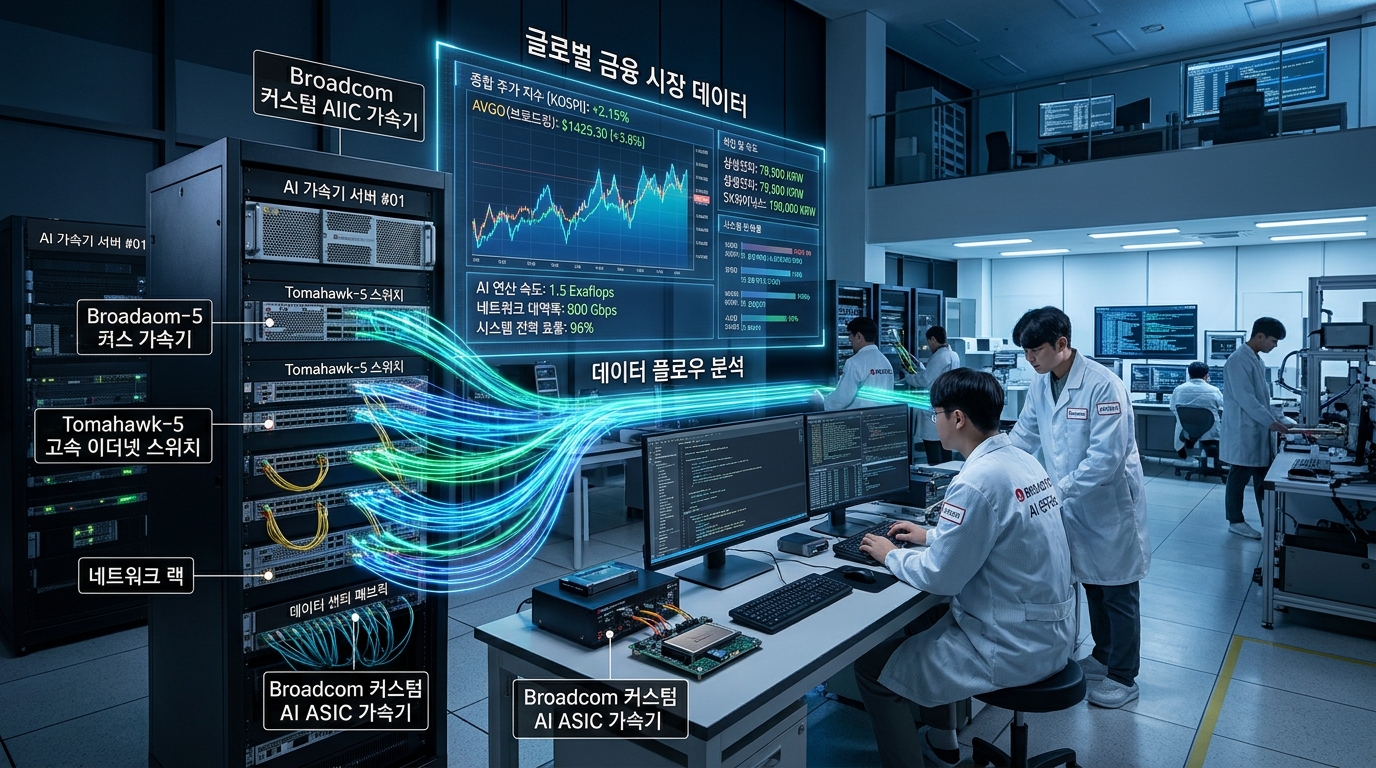
Broadcom (AVGO) is rapidly expanding its AI semiconductor order backlog, propelled by expanding demand for custom accelerators (Custom ASICs) across major Big Tech firms.
Led by its long-term Google TPU partnership, adoption of proprietary chips by global hyperscalers such as Meta and ByteDance continues to drive structural earnings growth.
Conversely, an increasing share of custom chips brings concerns over gross margin dilution due to a higher proportion of advanced packaging and HBM costs.
In response, high-margin Ethernet switches like the Tomahawk 5 and 6, coupled with the cash-generating power of VMware software, serve as countervailing forces defending downside profitability.
Current Market Context
As Big Tech companies deploy astronomical AI capital expenditures (CAPEX), they are accelerating custom ASIC development to reduce total cost of ownership (TCO) and diversify supply chains.
Leveraging peerless IP and ultra-submicron process design capabilities, Broadcom occupies a dominant position in the global custom accelerator market.
In the macro environment, fluctuations in the 10-year US Treasury yield (US10Y) and the trajectory of the Dollar Index (DXY) are heightening valuation sensitivity across high-multiple tech stocks.
Within both the Philadelphia Semiconductor Index (SOX) and the Nasdaq 100 Index, differentiation is noticeable between pure hardware manufacturers and companies generating steady free cash flow (FCF).
As of today, major market benchmarks stand at KOSPI 5290.53, KOSDAQ 699.66, Nasdaq 25136.27, and the USD/KRW exchange rate at 1,340.00 KRW.
According to Daily Stock's proprietary Fear & Greed Index, the KOSPI is currently in the Extreme Fear territory (19.3, compared to 15.9 a week ago, 6.6 a month ago, and 54.8 Neutral three months ago).
The Nasdaq Fear & Greed Index indicates Fear at 38.6 (compared to 24.4 Fear a week ago, 45.6 Neutral a month ago, and 24.5 Fear three months ago), reflecting market sentiment sensitive to Volatility Index (VIX) trends.
| Category | Key Figure / Status | Period Change and Context |
|---|---|---|
| **KOSPI / KOSDAQ** | 5290.53 / 699.66 | Low volatility regime and weakened investor sentiment in domestic markets |
| **Nasdaq Composite Index** | 25136.27 | Reflects megacap tech earnings and AI CAPEX momentum |
| **USD/KRW Exchange Rate** | 1340.00 KRW | Linked to DXY and global FX conditions |
| **Nasdaq Fear & Greed Index** | 38.6 (Fear) | Rebounded from a week ago (24.4), but cautious sentiment persists |
| **KOSPI Fear & Greed Index** | 19.3 (Extreme Fear) | Recovering from a month ago (6.6), yet remains severely depressed |
| **Broadcom (AVGO) Share Price** | Unconfirmed intraday (based on latest check) | Reflects prior trading day's close due to weekend market closure |
Financial Analysis
Within Broadcom's Semiconductor Solutions segment, AI semiconductor revenue posted triple-digit year-over-year growth, driven by rising shipments of custom ASICs and high-bandwidth networking silicon.
The company's total AI order backlog significantly exceeds $70 billion, providing multi-year visibility.
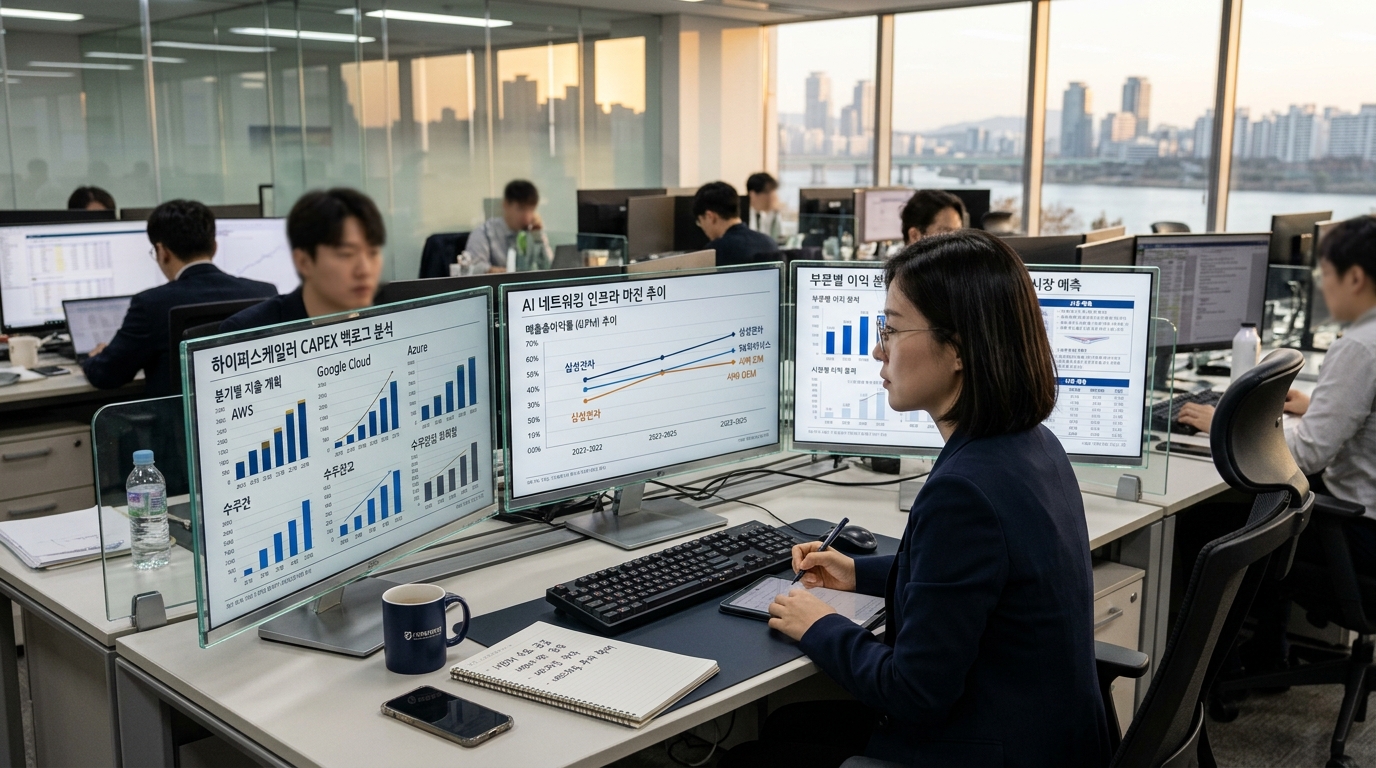
However, gross margin trajectory stemming from product mix shifts remains under close market scrutiny.
Because the ASIC manufacturing process factors in external foundry, advanced packaging (CoWoS), and HBM procurement costs as cost of sales, gross margin has moderated slightly to the mid-70% range compared to historical levels.
Nonetheless, Tomahawk 5 and 6 Ethernet switch chipsets, which lead the migration toward 800GbE and 1.6TbE, continue to achieve commanding profit margins.
Combined with the stabilization of VMware's subscription-based model in the Infrastructure Software segment, non-GAAP operating margin remains resilient at approximately 66%.
Valuation
Broadcom commands a hybrid valuation premium combining the traits of a traditional foundry-reliant fabless firm and an enterprise software provider.
Compared to pure-play AI accelerator suppliers, it holds the distinct advantage of pre-empting hyperscalers' internal chip migration, thereby hedging against customer churn risk.
Should the 10-year US Treasury yield (US10Y) face renewed upward pressure, multiple compression risk on forward P/E across the Nasdaq could resurface.
Even so, robust free cash flow (FCF) generation exceeding $10 billion per quarter remains a core pillar supporting valuation downside during macro tightening phases.
Relative to the Philadelphia Semiconductor Index (SOX), Broadcom exhibits comparative stability by buffering cyclical slowdowns in legacy commodity chips with high-growth AI networking and software margins.
Currently, the market is pricing multiples with greater emphasis on custom ASIC backlog conversion velocity and long-term margin trajectory rather than immediate quarterly print numbers.
Expert & Institutional Analysis
Major Wall Street investment banks point to Broadcom as the prime beneficiary of hyperscalers in-housing AI accelerators.
Analysts note that as more Big Tech players pursue internal chip design (XPUs), their reliance on Broadcom's custom packaging expertise and silicon interconnect IP intensifies.
Institutional investors largely view gross margin dilution from a larger AI ASIC share as a near-term optical illusion.
The prevailing logic is that as long as non-GAAP operating margin is held above 66%, the explosive growth in absolute operating profit and cash inflow serves as the underlying fundamental driver.
Conversely, some caution that high AI revenue concentration among a small cohort of Big Tech clients could exacerbate earnings volatility if the CAPEX cycle decelerates.
Growing scrutiny over Big Tech's return on investment (ROI) on capital expenditures, which could potentially delay custom chip ordering cycles, is also cited as a key monitorable.
Risk Factors
The most fundamental risk is the potential moderation of CAPEX pacing if Big Tech customers experience delays in recovering AI infrastructure investments.
If the ultimate monetization rate of generative AI services fails to keep pace with infrastructure build-out costs, follow-on chip orders from hyperscalers could be delayed.
Supply chain bottlenecks and capacity constraints in foundry advanced packaging also present operational hurdles for near-term delivery.
TSMC's 2nm capacity allocation and advanced packaging contention could directly impact delivery timelines to end customers.
Geopolitical trade regulations and tighter controls over global optical transceivers and component supply chains could also squeeze networking margins.
Additionally, if an appreciating Dollar Index (DXY) coincides with rising long-term yields, the valuation discount applied to Nasdaq growth equities could widen again.
Investment Perspective
Broadcom has established an unassailable moat as the indispensable partner for Big Tech pursuing proprietary silicon amid the universal GPU monopoly.
Near-term gross margin pressure is likely a transitional byproduct of product mix dynamics, effectively cushioned by high-value networking silicon and VMware synergies.
However, a conditional approach is prudent given macro interest rate conditions and potential turning points in the semiconductor CAPEX cycle.
Investors should maintain a strategy centered on monitoring backlog conversion rates into actual revenue and the ongoing defense of quarterly operating profit margins.
Investor Checkpoint Q&A
Q1. What are custom ASIC AI chips, and what is Broadcom's role?
They are application-specific integrated circuits designed by hyperscalers optimized for their dedicated workloads. Broadcom acts as a key collaborative partner handling architectural integration, IP provisioning, ultra-deep submicron tape-outs, and advanced packaging production.
Q2. Why are concerns over gross margin dilution raised when AI ASIC revenue is growing?
Because ASIC production incurs high-cost HBM memories and outsourced advanced packaging costs, which are accounted for as cost of goods sold. This mechanically lowers gross margin percentage figures relative to pure software or licensing businesses.
Q3. Why is Ethernet networking equipment viewed as a critical pillar for margin defense?
Interconnecting large-scale AI clusters requires ultra-low latency, ultra-high bandwidth Ethernet switches like the Tomahawk family. These chipsets and optical components have exceptionally high barriers to entry, generating some of the highest margins in the industry.
Q4. How does the VMware acquisition contribute to Broadcom's AI fundamentals?
Through its virtualized cloud software subscription model, VMware provides immense, predictable cash flow every quarter. This serves as a vital buffer absorbing the cyclical volatility of semiconductor hardware and supporting aggressive AI R&D investments.
Q5. What core metrics must investors watch in upcoming earnings reports?
Key indicators include whether AI semiconductor revenue guidance continues to be revised upward, whether the company maintains the 66% non-GAAP operating margin threshold, and the overall trajectory of Big Tech hyperscalers' forward AI CAPEX commitments.