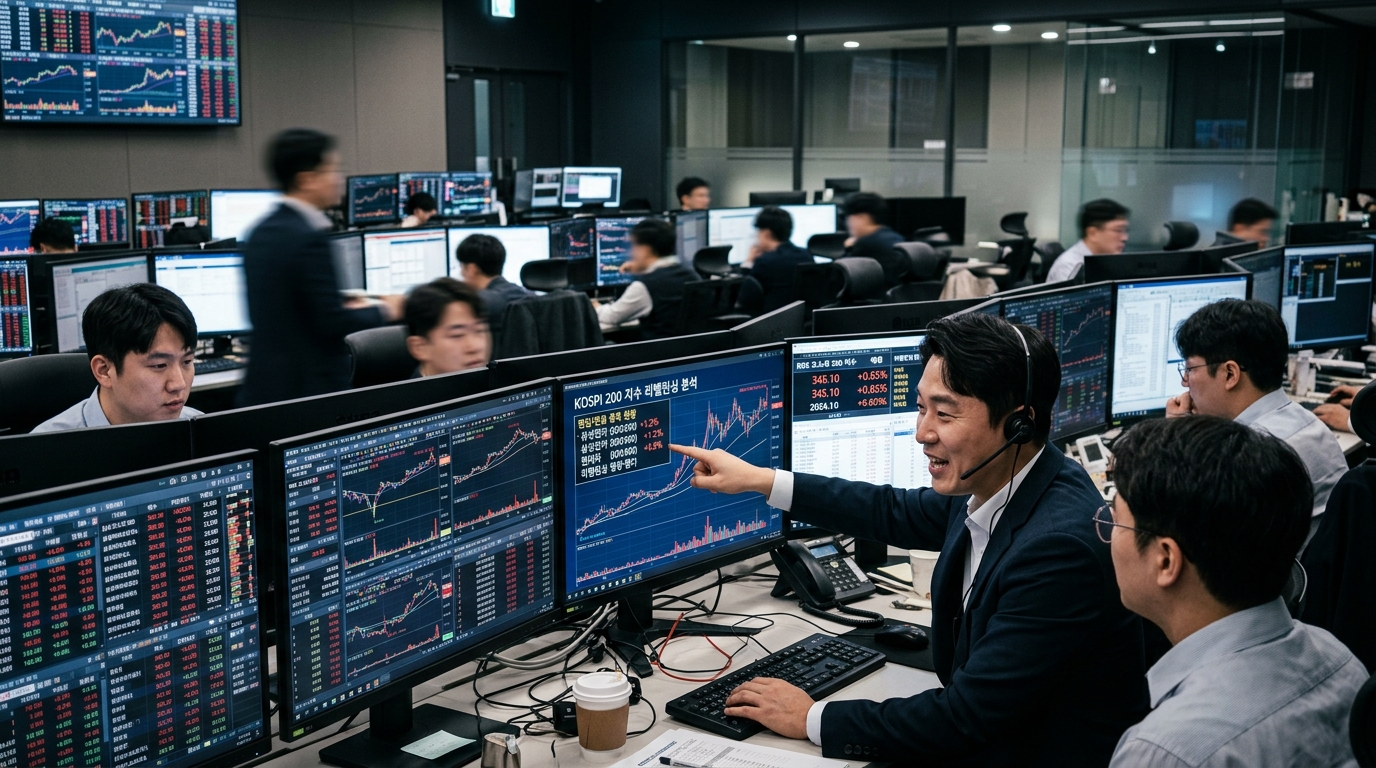
Hello, this is Daily Stock, cutting through market turbulence to deliver data-driven supply-demand insights.
Executive Summary
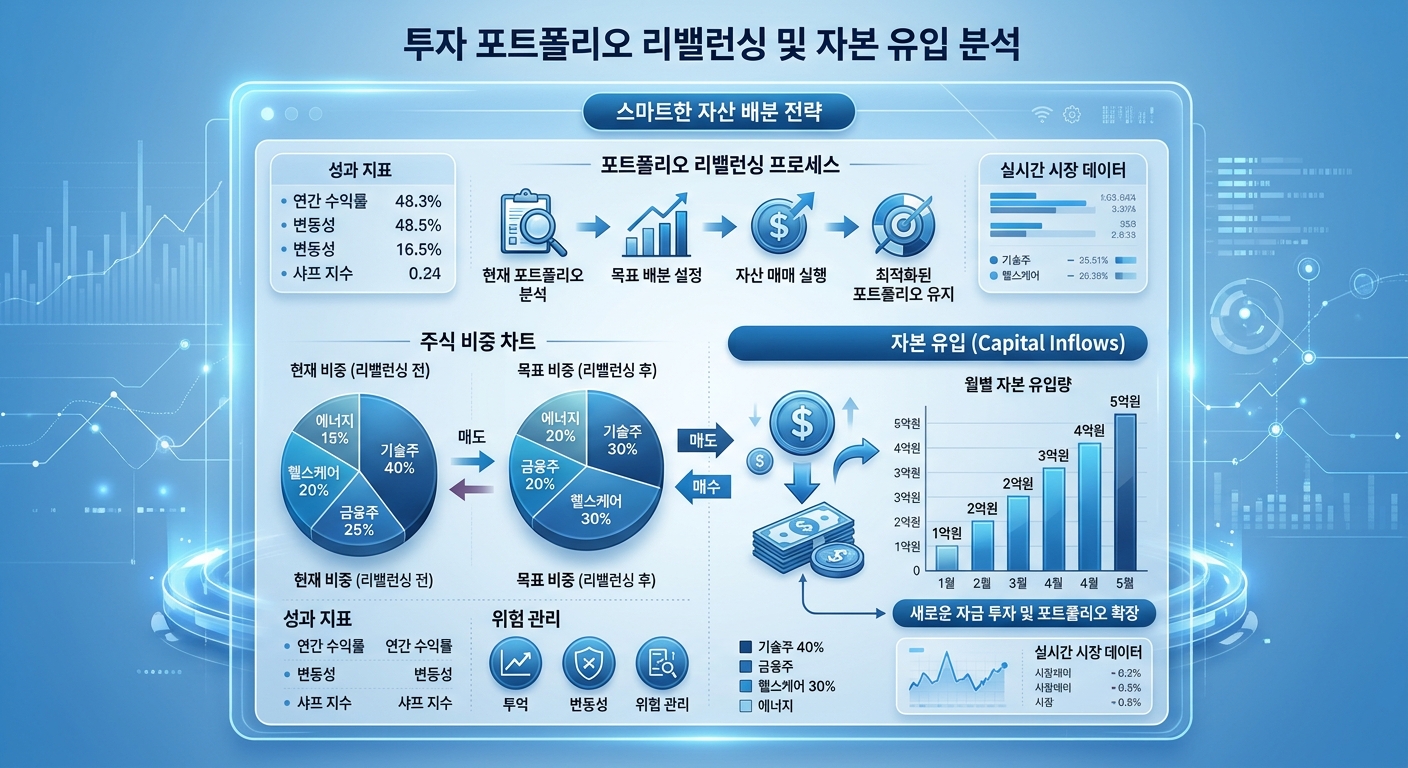
Ahead of the simultaneous expiration date for futures and options on the second Thursday of December, the supply-demand equation for the KOSPI 200 periodic rebalancing has entered an active execution window.
Mechanical buying and selling orders from index-tracking passive funds and index capital serve as the primary catalyst dictating liquidity and short-term price momentum across affected constituents.
As of November 15, 2026, the KOSPI stands at 5,290.53, the KOSDAQ at 699.66, and the USD/KRW exchange rate is hovering at 1,340.00.
According to Daily Stock's proprietary Fear & Greed Index, the KOSPI currently sits in Extreme Fear (19.3). While this marks a modest rebound compared to one week ago (15.9) and one month ago (6.6), heightened vigilance dominates the trading landscape.
A disciplined rebalancing strategy is essential—one that anticipates pre-inclusion positioning while accounting for profit-taking patterns on the actual inclusion date.
Current Market Context
The Korea Exchange (KRX) conducts its periodic review by evaluating daily average market capitalization and trading value criteria to replace representatives across industry groups.
Large-cap growth names or companies undergoing corporate governance restructuring that saw substantial market cap growth over the review period (May to October) emerge as strong candidates for inclusion, whereas underperforming names face exclusion.
As of November 15, 2026, the NASDAQ stands at 25,136.27 in the Fear zone (38.6), reflecting persistent global risk aversion.
With the USD/KRW exchange rate locked in a narrow range around 1,340.00, foreign investors are directing arbitrage and non-arbitrage programs linking KOSPI 200 futures with cash baskets.
Within the KOSPI 200—dominated by legacy heavyweight sectors such as semiconductors, automotive, and financials—the weighting calculations and free-float ratio adjustments for newly added names will govern the net liquidity impact.
| Classification | Target Group / Metrics | November Periodic Review & Flow Factors |
|---|---|---|
| **KOSPI Benchmark Status** | 5,290.53 (Fear & Greed: 19.3, Extreme Fear) | Monitor whether index-tracking passive inflows concentrate despite muted investor sentiment |
| **Expected Inclusions** | Mid/Large caps meeting cumulative market cap top 85% requirement | Early passive buying front-running possible once liquidity and turnover criteria are validated |
| **Expected Exclusions** | Names falling outside top 110% by market cap within their sector | Passive exit outflows inevitable as constituents fail to meet retention thresholds |
| **Macro Flow Backdrop** | USD/KRW 1,340.00 / KOSDAQ 699.66 | Foreign cash-futures arbitrage volatility persists alongside FX-linked selling pressure |
Financial Analysis
A common financial attribute among prospective KOSPI 200 constituents is sustained operational cash flow improvement paired with resilient topline revenue growth.
Companies that experienced structural deterioration in core profitability through the first half and cumulative third-quarter earnings have slid in market cap rankings, exposing them to exclusion risk.
Industrial and manufacturing candidates vying for inclusion have demonstrated solid earnings visibility, underpinned by stable balance sheets with debt ratios around 100% and expanding order backlogs.
Conversely, legacy or marginal firms whose interest coverage ratios have slipped below 1 due to raw material price volatility or domestic demand slumps face shrinking market capitalization and thin volume, marking them for exclusion.
While passive funds adhere strictly to quantitative parameters such as market cap and free-float ratios rather than qualitative financial reviews, pre-emptive market inflows remain deeply tied to fundamental earnings health.
Valuation
While mega-cap constituents in the KOSPI 200 continue to trade at relative discounts compared to their global peers, newly included mid-to-small-cap candidates often carry a short-term multiple premium.
The overall 12-month forward price-to-earnings (P/E) ratio for the Korean market remains below historical averages, yet anticipated additions tend to trade at a 10% to 20% premium relative to their respective sector averages.
Comparing price-to-book (P/B) ratios across KOSPI 200 large caps versus KOSDAQ 150 or small-to-mid caps, large-cap valuations are increasingly being re-rated on the back of shareholder return incentives such as treasury share cancellations.
However, liquidity driven solely by the rebalancing catalyst tends to dissipate rapidly after the implementation date. Investors must beware of value traps among candidates with stretched multiples.
Relative to key overseas benchmarks such as the S&P 500 and NASDAQ, the Korean equity market maintains a broader discount due to its cyclical sensitivity to global trade and export dynamics.
Expert & Institutional Insights
Equity passive strategy analysts emphasize that the optimal alpha generation window for index inclusion historically peaks right before the official review announcement.
Historical periodic review data shows that candidate stocks consistently generate excess returns against the broader market over the one to two months preceding the decision.
However, on the actual effective date (closing price on the futures and options expiration date), mechanical inflows from index funds are often met with substantial profit-taking from early momentum players.
Institutional investors place significant focus on additional rebalancing requirements triggered by free-float ratio changes during broader portfolio basket adjustments.
Institutional consensus highlights that existing large caps undergoing free-float adjustments—via block trades or controlling shareholder stake sales—can experience supply-demand distortions on par with newly included names.
Risk Factors
The primary near-term risk is the sell-on-news dynamic that routinely unfolds once official confirmation is released.
Furthermore, because constituent inclusion brings stocks into the eligible universe for short selling, richly valued additions carry the risk of surging loan balances and targeted short interest.
From a macroeconomic perspective, the Bank of Korea's policy rate trajectory alongside concerns over a global economic slowdown could pressure the fundamentals of key export-driven large caps.
Should monthly export growth figures from the Ministry of Trade, Industry and Energy indicate deceleration in semiconductors and industrial manufactured goods, downside pressure on the broader benchmark could intensify.
If the USD/KRW exchange rate surges past the 1,340.00 mark, synchronized net foreign selling across KOSPI cash and futures could easily overwhelm the positive rebalancing effect.
Strategic Takeaways
Navigating the KOSPI 200 periodic rebalancing requires a framework anchored in quantitative review criteria rather than speculative rumors.
Prior to the confirmation announcement, the most effective approach is to target high-probability candidates that combine sound operational fundamentals with reasonable valuation profiles.
In the interval between announcement and the effective date, scaling out into incoming strength is prudent, particularly by benchmarking the projected passive intake against average daily trading volume.
For names facing exclusion, avoid premature bottom-fishing; wait for mechanical index-selling pressure to clear and volume to normalize before re-evaluating.
With the Daily Stock Fear & Greed Index signaling Extreme Fear (19.3), disciplined phased execution and conservative cash management should take clear priority over aggressive, leveraged momentum chasing.
Investment Checklist
- [ ] Have you verified whether the candidate meets KRX's evaluation timeline, daily average market cap, and trading turnover requirements?
- [ ] Have you calculated the ratio of anticipated passive inflows relative to 20-day average daily volume to gauge flow impact?
- [ ] Have you cross-checked whether high-valuation additions face an elevated risk of sudden spikes in short selling or stock loan balances?
- [ ] Have you assessed foreign institutional positioning in KOSPI 200 cash/futures and monitored futures basis around the USD/KRW 1,340.00 level?
- [ ] Do you have a staged exit plan to manage mechanical closing-auction execution versus profit-taking outflows on the rebalancing date?