
Hello, this is Daily Stock.
Key Summary
Yuhan Corporation's third-generation non-small cell lung cancer (NSCLC) treatment, Leclaza (ingredient name: lazertinib), is making a solid entry into the U.S. and global markets through its global partner, Johnson & Johnson (J&J), following approval by the U.S. Food and Drug Administration (FDA).
Yuhan's cumulative milestones—driven by upfront payments, regulatory approvals, and commercialization launches across various regions—have surpassed $300 million (approximately KRW 420 billion), with remaining milestones collectible in the future amounting to approximately $650 million.
With the KOSPI index at 5,290.53 and lingering in the Extreme Fear stage (19.3) amid foreign investor capital flows and foreign exchange volatility, whether high-margin biopharma royalty cash flows can succeed traditional large-cap export sectors like semiconductors and automobiles has emerged as a key focal point for the market.
Current Status Overview
Leclaza continues to expand prescriptions following its FDA first-line approval in combination with J&J’s targeted oncology drug, Rybrevant (ingredient name: amivantamab).
According to partner disclosures, cumulative global sales of the Leclaza-Rybrevant combination therapy exceeded $866 million as of Q3 2026, putting it on the verge of entering the global blockbuster threshold of $1 billion in annual sales.
The introduction of a subcutaneous (SC) formulation that reduces administration time and its inclusion as a Preferred Category 1 first-line therapy in the National Comprehensive Cancer Network (NCCN) guidelines serve as primary catalysts supporting local prescription momentum.
As of today, Yuhan Corporation's intraday share price status is 'Unconfirmed for today (based on most recent confirmed value)'. However, the base of prescriptions is widening as health insurance listings and reimbursement expansions are sequentially reflected across major global markets (the U.S., Japan, China, and Europe).
The current domestic macro environment shows the USD/KRW exchange rate hovering around 1,339.00 KRW, closely tracking foreign investors' spot and futures trading trends.
In a market where volatility across large-cap exporters is elevated due to uncertainty over the Bank of Korea's medium-term base rate trajectory and global slowdown concerns, dollar-denominated drug royalties and milestone inflows are evaluated as differentiated earnings buffers for Yuhan Corporation.
| Classification | Key Progress Status | Milestone and Performance Scale |
|---|---|---|
| **U.S. Commercialization (FDA)** | First-line approval & prescription expansion; sequential rollout of SC formulation | $60 million received |
| **Cumulative Global Milestones** | Commercialization achieved in U.S., Japan, China, Europe | Cumulative milestones top $300M (approx. $650M remaining) |
| **Global Combination Sales Trend** | Cumulative sales exceeded $866M as of Q3 2026 | Expected to solidify as an annual $1B blockbuster |
| **Running Royalties** | Running royalties linked to global net sales | Increasing net trend in quarterly royalty income |
Financial Analysis
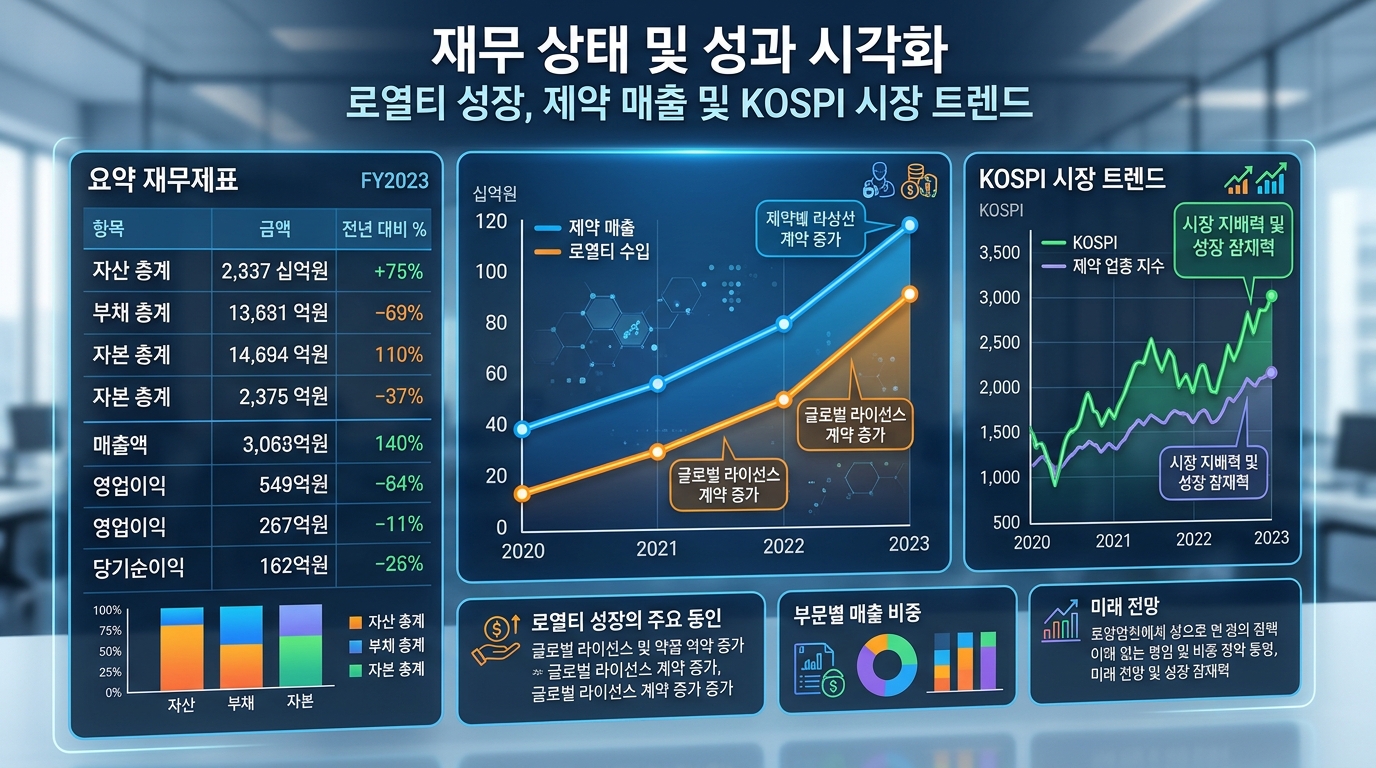
Prior to the launch of Leclaza, Yuhan Corporation faced structural limitations, with operating profit margins lingering in the mid-single digits relative to top-line scale due to a revenue mix centered on its legacy product portfolio.
However, with the full-scale realization of global commercialization milestones and sales-linked royalties from Leclaza, qualitative improvements in consolidated operating profit are becoming evident.
After surpassing KRW 2 trillion in annual revenue in 2024, the company generated over KRW 2.2 trillion in revenue and surpassed KRW 100 billion in operating profit in 2025.
In the first half of 2026, cumulative consolidated revenue reached KRW 1.1662 trillion with an operating profit of KRW 75.7 billion, demonstrating concurrent upward trends in top-line scale and profitability.
In quarters where high-margin licensing income is recognized, the operating margin tends to expand substantially.
However, short-term earnings volatility is observed as milestone inflows are distributed across quarters depending on reimbursement listing timelines in overseas markets.
The generated cash flow is reinvested into research and development (R&D) for the company’s internal pipeline (including allergy treatments and MASH therapies), reinforcing a virtuous R&D cycle.
Valuation
Yuhan Corporation's valuation multiple premium over traditional pharmaceutical companies is determined by the discount rate applied to its new drug value and royalty cash flows.
Unlike cyclical semiconductor or automotive names in the KOSPI 200 large-cap space that fluctuate around 8–12x P/E multiples depending on the global economic cycle, large-cap biopharma stocks with successfully commercialized drugs are assigned higher valuation multiples reflecting growth potential.
While pipeline diversity remains more limited compared to global big pharma, superior progression-free survival (PFS) data compared to Tagrisso in the first-line NSCLC market supports the potential for medium- to long-term market share gains.
Out of the total $950 million contract, the remaining $650 million in milestones to be sequentially collected across future sales tiers—on top of the $300 million already received—acts as a meaningful net present value (NPV) safety margin.
Nevertheless, in an environment where the KOSPI Fear & Greed Index remains in the Extreme Fear territory (19.3), valuations pricing in expectations ahead of visible earnings could experience periodic corrections.
Expert and Institutional Analysis
Securities firms and major institutional analyses point to the actual pace of Leclaza’s U.S. prescriptions and confirmation of final overall survival (OS) data for the combination therapy as primary inflection points.
The Category 1 listing in the U.S. NCCN guidelines acts as a robust regulatory and clinical catalyst driving physician adoption.
Institutional research is paying closer attention to the quarterly inflow scale of recurring net sales royalties (estimated at approximately 10–15%) driven by prescription expansion, rather than short-term, one-off commercialization milestones.
Additionally, the clinical adoption of the subcutaneous (SC) formulation in the U.S. market significantly improves administration convenience compared to intravenous (IV) infusion, which is expected to gradually strengthen its competitive edge against standard-of-care therapies.
On the other hand, Pharmacy Benefit Manager (PBM) formulary negotiations with major U.S. insurers and price rebate pressures remain variables requiring continuous monitoring, as they directly impact net sales in the U.S.
Risk Factors
The most direct risk is intensifying market share competition with the incumbent rival drug, Tagrisso (osimertinib).
If physician prescription switching progresses at a slower pace than anticipated against an entrenched first-line standard of care, it could lead to decelerating royalty growth.
Exchange rate volatility also poses a persistent risk.
With the USD/KRW rate demonstrating elevated volatility around 1,339.00 KRW, fluctuations in the dollar directly impact the KRW-translated value of overseas royalty earnings.
Furthermore, the Bank of Korea's monetary policy path and concerns over a global economic slowdown could fuel foreign capital outflows from the domestic equity market, pressuring broad market multiples.
In addition, if milestone receipts are deferred to subsequent quarters due to administrative procedures or pricing negotiations with regional health authorities, quarterly earnings could miss market consensus, leading to volatility.
Investment Perspective
Yuhan Corporation is a flagship case proving that a domestic novel drug can overcome the U.S. FDA commercialization hurdle and enter the ranks of global blockbusters.
While quarterly earnings fluctuations are inevitable in the short term depending on the timing of regional commercialization milestones, the company is securing stable operating cash flows over the medium to long term as a royalty structure based on global net sales takes root.
In a risk-off sentiment environment where the KOSPI Fear & Greed Index sits at 19.3 (Extreme Fear) and the NASDAQ is at 38.6 (Fear), growth narratives for large-cap biopharmas must also be validated by hard financial figures.
Therefore, a prudent approach is recommended—closely tracking quarterly U.S. prescription data trends, the speed of transition to the SC formulation, and clinical progress across follow-on pipeline assets.
Q&A with Daily Stock
Q1. What is the fundamental significance of Leclaza's U.S. FDA approval?
It marks the first time a domestically developed Korean targeted oncology therapeutic has received official commercial approval as a first-line therapy in the United States, the world's largest pharmaceutical market. This establishes a benchmark case where a Korean pharma company's open innovation R&D model translates into global commercialization and substantial cash flow generation.
Q2. What is the scale of remaining Leclaza milestones that Yuhan Corporation can collect in the future?
Out of the total $950 million contract value, cumulative receipts have exceeded $300 million. Approximately $650 million in remaining milestones can be collected in stages based on achieving country-by-country sales targets.
Q3. Besides milestones, what is the structure and percentage of royalties received by Yuhan Corporation?
It is estimated that Yuhan receives tiered running royalties of approximately 10% to 15% on Leclaza's portion of global combination therapy net sales on a quarterly basis. Unlike one-off milestones, this provides a continuous revenue stream as long as prescriptions remain active.
Q4. Why is the recent development and approval of the subcutaneous (SC) formulation drawing attention?
While traditional IV combination therapy requires extended hospital administration and carries the risk of infusion-related reactions, the subcutaneous formulation dramatically cuts administration time. This improves convenience for both patients and healthcare providers, significantly bolstering prescription competitiveness locally.
Q5. Which external variables should investors monitor closely in the current macroeconomic environment?
Investors need to closely watch the trajectory of the USD/KRW exchange rate around the 1,339.00 KRW level, foreign capital flows, the Bank of Korea's benchmark rate policy, and how broader KOSPI market sentiment (Fear & Greed Index at 19.3) impacts multiple preservation across large-cap biopharma equities.