Hello, this is a specialized editor from Daily Stock.
Key Summary
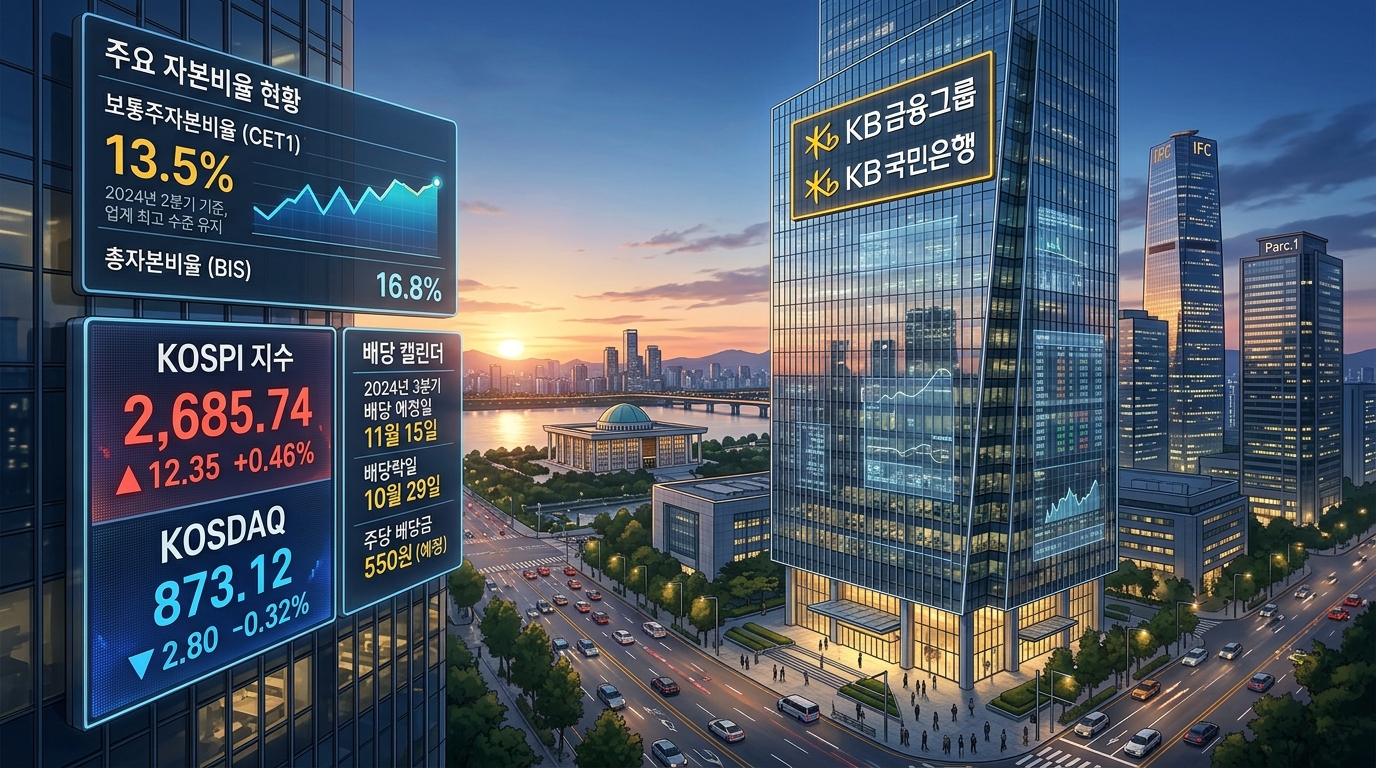
KB Financial Group has established a clear capital management framework dedicated to returning all surplus capital exceeding a Common Equity Tier 1 (CET1) ratio of 13.5% to shareholders.
As of the end of the third quarter, its CET1 ratio reached 13.80%, demonstrating ample capital buffers that comfortably surpass regulatory guidelines.
As of November 11, 2026, the KOSPI closed at 5,375.36, the KOSDAQ at 705.10, and the KRW/USD exchange rate at 1,334.30 won.
Daily Stock's proprietary Fear & Greed Index shows the KOSPI currently in Fear (23.7), compared to Fear (28) one week ago, Extreme Fear (9) one month ago, and Fear (34.8) three months ago. Meanwhile, the NASDAQ Fear & Greed Index registers Fear (33.4), compared to Fear (34.2) one week ago, Neutral (43.5) one month ago, and Fear (30.5) three months ago, indicating that risk-averse sentiment continues to dominate broad markets.
In the short term, price adjustments around the year-end ex-dividend date remain possible; however, over the medium to long term, share cancellations and an upward trend in dividend per share (DPS) are highly likely to establish downside support.
Current Market Situation
In the domestic stock market, while large-cap semiconductor and automotive names continue to experience earnings divergence, the financial sector plays a defensive role as a central pillar of the Value-up Program.
While the KOSPI hovers around the 5,375.36 level, the KRW/USD exchange rate fluctuates near 1,334.30 won, directly impacting the inflow pace of foreign spot and futures capital.
Although the day's closing price for KB Financial Group (105560) was not confirmed as of the latest check, the stock maintains a top-tier valuation premium among major financial holding companies backed by the recent Value-up momentum and solid capital ratios.
During its Q3 conference call, management reaffirmed its shareholder return principle based on surplus capital above 13.5%, underscoring its firm commitment to executing year-end dividends alongside share buybacks and cancellations.

Financial Analysis
KB Financial Group's cumulative net profit through Q3 2026 demonstrated record-high earnings resilience, driven by diversification into non-interest income and solid net interest income.
Return on Equity (ROE) reached 13.89%, substantially exceeding the mid-to-long-term target of 10% and proving robust capital profitability.
| Key Financial Metrics | Cumulative Q3 2026 / Recent Releases | Notes |
|---|---|---|
| Common Equity Tier 1 (CET1) Ratio | 13.80% | +30 bps above the baseline (13.5%) |
| Return on Equity (ROE) | 13.89% | +1.11%p YoY |
| Q3 Cash Dividend Per Share (DPS) | KRW 1,167 per share | Total KRW 404.9 billion approved |
| Risk-Weighted Assets (RWA) Change | -0.5% QoQ | Controlled high-risk assets & portfolio rebalancing |
| KRW/USD Exchange Rate (2026-11-11) | KRW 1,334.30 | Volatility driver for FX-exposed RWA |
Defending the CET1 ratio at 13.80% while reducing Risk-Weighted Assets (RWA)—the denominator of the capital ratio—by 0.5% QoQ highlights the efficiency of its capital allocation.
Furthermore, combining roughly KRW 180 billion in funding reserved for year-end dividends with executed share buybacks and cancellations, the total shareholder return payout ratio for full-year 2026 is widely projected to surpass 50%.
Valuation
Historically trapped in a chronic undervaluation range with a PBR of 0.4x to 0.5x, KB Financial is now attempting to push into the 0.7x to 0.8x PBR range on the back of aggressive capital return initiatives.
Maintaining a higher CET1 ratio than key competitors such as Shinhan Financial Group and Hana Financial Group, it commands the most resilient valuation premium in the domestic banking sector.
Considering that major Japanese financial groups (e.g., Mitsubishi UFJ) trade around 0.8x to 1.0x PBR, further re-rating room remains if the sustainability of the CET1 13.5% surplus return framework is continually validated.
However, given its stronger dividend-stock profile compared to high-growth KOSPI tech names, short-term volatility stemming from post-dividend selling pressure around the ex-dividend date must be taken into account.
Expert & Institutional Analysis
Securities analysts favorably view the fact that KB Financial's shareholder return framework has evolved from vague qualitative pledges into formulaic, quantifiable "predictability."
Coupled with disciplined RWA management and resilient margin defense, institutions also point positively to the potential implementation of an advanced IR structure that pre-announces shareholder return scale when presenting annual earnings guidance early in the year.
Despite concerns over FX translation losses within the range-bound KRW/USD level of 1,334.30 won, foreign investors are paying close attention to stable dividend yields and EPS growth spurred by treasury share cancellations.
On the other hand, institutional reports maintain a degree of caution, noting that if the Bank of Korea's base rate-cutting cycle accelerates, downward pressure on Net Interest Margins (NIM) could intensify.

Risk Factors
The most direct macroeconomic risk involves deterioration in borrower credit quality and increased provisioning burdens due to a domestic economic slowdown.
Should the Bank of Korea's monetary easing cycle gain full momentum, asset yields could decline, likely decelerating interest income growth.
A sharp spike in the KRW/USD exchange rate would expand foreign currency-denominated RWA in won terms, widening the denominator and dragging down the CET1 ratio.
Additionally, immediately following the year-end ex-dividend date, short-term selling by institutional and foreign investors seeking only dividend capture could trigger downside price volatility that exceeds the dividend payout itself.
Investment Perspective
An approach to KB Financial Group should focus less on capturing a single quarterly dividend and more on the sustained execution of its Value-up roadmap—specifically returning all surplus capital above a 13.5% CET1 ratio.
While the stock could experience short-term pressure around the ex-dividend date, ex-dividend price drops are likely to be gradually recouped through resumed share repurchases and equalized quarterly dividend policies.
Therefore, short-term traders should weigh the risk-reward between taking profits right before the ex-dividend date versus buying in tranches at post-dividend lows.
For long-term dividend-growth investors, utilizing temporary price pullbacks after the ex-dividend date as an opportunity for dividend reinvestment can be an effective contrarian strategy.
Investor Checkpoint Q&A
Q1. What exactly is the capital return framework based on exceeding a 13.5% CET1 ratio?
A1. It is a shareholder return policy designed to return all surplus capital above 13.5%—a target set by considering regulatory requirements and management buffers—back to shareholders via share buybacks, cancellations, or additional dividends.
Q2. What was KB Financial Group's CET1 ratio at the end of Q3 2026?
A2. It reached 13.80% at the end of Q3, exceeding the 13.5% baseline by 30 bps and maintaining the strongest capital adequacy among Korea's top four financial holding groups.
Q3. Why does stock price volatility increase around the year-end ex-dividend date?
A3. Because the right to receive the dividend expires on that date, the stock price theoretically adjusts downward by the dividend amount, while short-term capital that entered solely for dividend capture often exits simultaneously, heightening selling pressure.
Q4. How does an increasing KRW/USD exchange rate (won depreciation) affect KB Financial's shareholder returns?
A4. When the KRW/USD rate rises, the won-denominated value of foreign currency loans increases, enlarging Risk-Weighted Assets (RWA). This lowers the CET1 ratio and can constrain the surplus capital available for shareholder returns.
Q5. Can current shareholder return levels be maintained during a rate-cut cycle?
A5. Even if interest income faces pressure from NIM contraction, the formulaic return policy will likely remain intact as long as non-interest income expansion and active RWA management successfully defend the CET1 ratio above 13.5%.