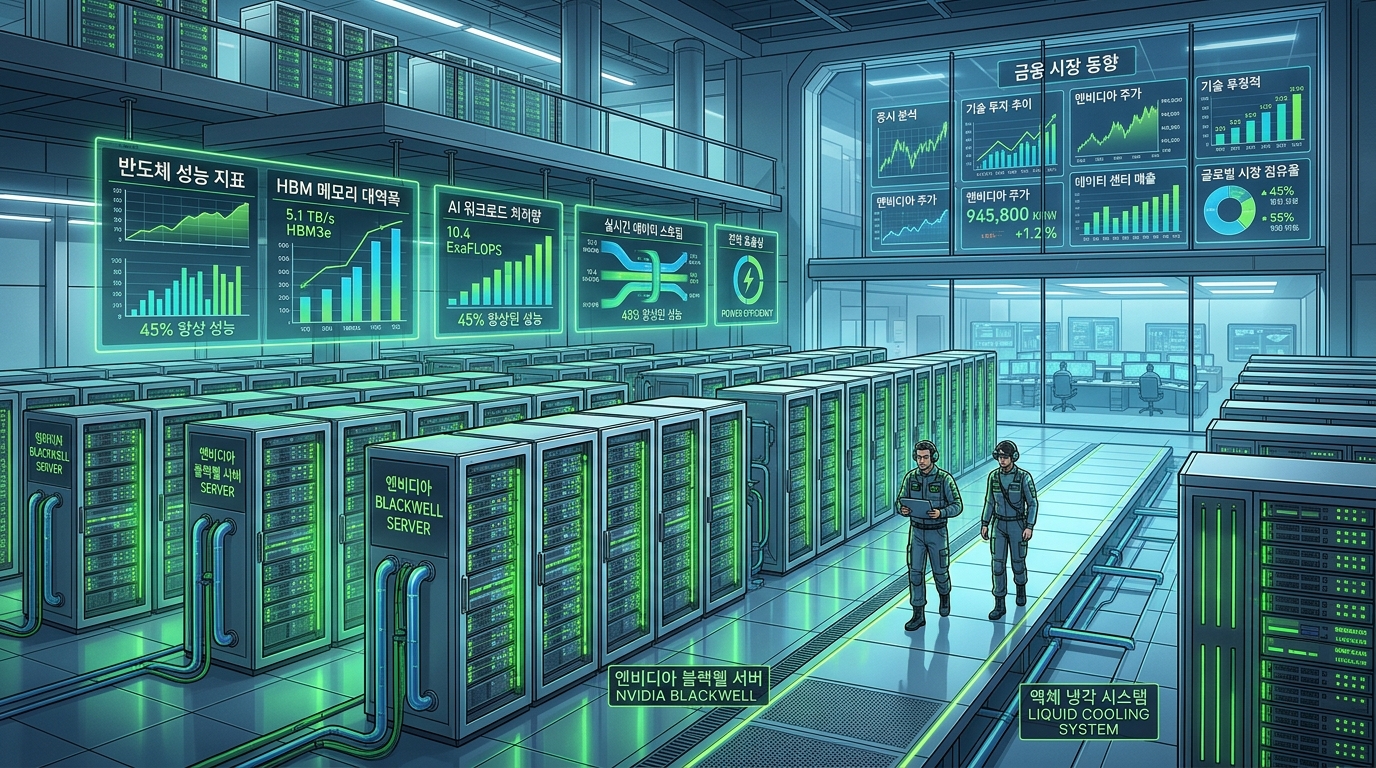
Welcome to Daily Stock, where we highlight key contexts in global financial markets and Nasdaq tech trends using objective metrics.
Executive Summary
As shipments of server systems based on Nvidia's next-generation AI accelerator platform, the Blackwell B200 and GB200 NVL72, accelerate in earnest, the market's focus is intensely zeroing in on upcoming Q3 earnings and forward guidance.
While major hyperscalers (Big Tech) maintain their capital expenditure (CAPEX) expansion stance, the pace of resolving advanced packaging bottlenecks and the integration of liquid cooling solutions have emerged as key drivers of operational leverage.
However, volatility in the US 10-year Treasury yield (US10Y), the relative strength of the Philadelphia Semiconductor Index (SOX), and demands to verify hyperscalers' return on investment (ROI) from AI spending could act as factors capping valuation upside.
Market Overview
As of intraday trading on November 11, 2026 (preliminary), the Nasdaq Composite Index stood at 25,065.88 points, with the USD/KRW exchange rate hovering around 1,343.00 KRW.
At the same time, the KOSPI Index recorded 5,215.98 and the KOSDAQ Index reached 667.38, highlighting clear decoupling and sector-specific divergence between domestic and overseas equity markets.
Looking at Daily Stock's proprietary sentiment indicators, the Nasdaq Fear & Greed Index currently sits at 33.5 (Fear). This reflects a gradual recovery compared to 23.5 (Fear) one week ago, 43.5 (Neutral) one month ago, and 29.9 (Fear) three months ago, though cautious sentiment remains dominant.
The KOSPI Fear & Greed Index registered 17.6 (Extreme Fear), shrinking further compared to 28 (Fear) the previous week.
While intraday quotes for Nvidia (NVDA) remain unconfirmed (based on the latest confirmed levels), market interest is heavily tilted toward earnings sensitivity across regular and extended trading hours.
AI CAPEX allocations for the 2026 fiscal year among the four major hyperscalers—Microsoft, Alphabet, Amazon, and Meta—confirmed in recent Big Tech earnings, continue to demonstrate solid year-over-year growth.
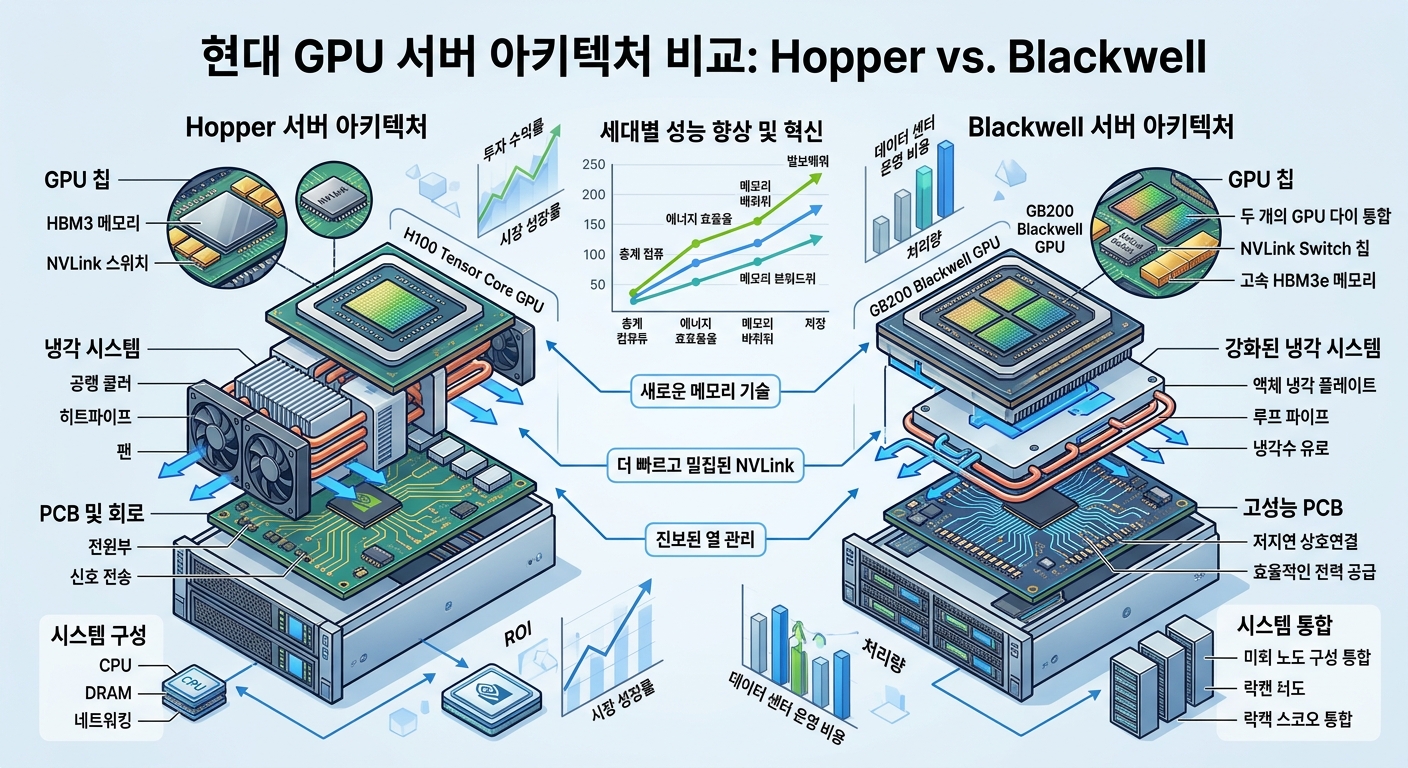
In particular, as computational demand surges not only for training large language models (LLMs) but also for the inference phase, the generational transition from the legacy Hopper (H100, H200) architecture to Blackwell (B200, GB200) is establishing itself as the core growth engine for data center shipments.
| Key Metric | Current Value (As of Intraday 2026-11-11) | Weekly Trend and Market Interpretation |
|---|---|---|
| Nasdaq Composite Index | 25,065.88 | Volatility persists amid caution over mega-cap tech earnings |
| USD/KRW Exchange Rate | 1,343.00 KRW | Interlocked with the stabilization of the US Dollar Index (DXY) |
| Nasdaq Fear & Greed Index | 33.5 (Fear) | Rebounded from 1 week ago (23.5), but cautious stance remains |
| KOSPI Fear & Greed Index | 17.6 (Extreme Fear) | Localized contraction driven by weakened risk appetite |
Financial Analysis
Nvidia's Data Center business unit serves as the company's primary growth engine, accounting for over 85% of total revenue.
According to market consensus, the critical focal point for this Q3 earnings report is whether initial delivery revenues from Blackwell B200 systems have fully begun reflecting in the financial statements.
With TSMC expanding its advanced packaging (CoWoS) capacity and supply chain conditions for components improving, server rack shipment volumes are expanding incrementally.
Regarding gross margins, while they remained in the mid-to-high 70% range during the mature phase of the Hopper generation, they are projected to land in the low-to-mid 70% range in the early phases of Blackwell mass production due to the installation of complex rack-level liquid cooling systems and initial yield tuning costs.
Operating cash flow (OCF) is anticipated to remain robust, buoyed by upfront customer deposits and long-term supply agreements.
However, upfront R&D expenditures for the upcoming B300 and Rubin architectures are also rising, meaning SG&A cost controls will ultimately determine the bottom-line operating margin figures.
Valuation
Nvidia's 12-month forward price-to-earnings (Forward P/E) ratio continues to fluctuate within its five-year historical range.
The rationale behind its premium relative to the Nasdaq 100 average forward P/E lies in its turnkey solution competitiveness, which integrates the proprietary CUDA software ecosystem with high-performance hardware and networking (NVLink, Quantum InfiniBand).
However, compared to the broader Philadelphia Semiconductor Index (SOX), valuation sensitivity to macroeconomic indicators has steadily intensified due to the concentration of capital in pure AI hardware plays.
In particular, a rebound in the US 10-year Treasury yield (US10Y) could raise the discount rate, placing renewed downward pressure on growth stock multiples.
Relative strength in the US Dollar Index (DXY) and localized spikes in the Cboe Volatility Index (VIX) are directly linked to the purchasing power of international hyperscalers and hedging demand from global investment funds, warranting rigorous monitoring.
Expert & Institutional Analysis
Major Wall Street investment banks view the acceleration of Blackwell B200 server shipments favorably, noting that supply chain bottlenecks are easing through the second half of 2026.
Goldman Sachs and Morgan Stanley highlight that contrary to concerns over a near-term slowdown in hyperscaler CAPEX, demand for deploying inference-oriented computing clusters is expanding across general enterprise segments.
Conversely, some research institutions caution that the internal ASIC adoption rate among key clients (Google TPU, Amazon Trainium, Meta MTIA, etc.) requires close observation.
If Big Tech firms expand proprietary chip deployment for specific workloads to lower total cost of ownership (TCO), analysts cannot rule out a long-term scenario where Nvidia's absolute hardware dominance experiences mild dilution.
Risk Factors
First is the risk of delayed AI monetization (ROI) visibility among major cloud service providers. If end-user enterprise and consumer monetization fails to meet expectations while hyperscalers continue unprecedented CAPEX cycles, subsequent infrastructure buildouts could face deferral.
Second is the deployment bottleneck surrounding power availability and liquid cooling infrastructure for high-density data centers. High-end rack configurations like the B200-based NVL72 consume substantially higher power per rack, meaning grid connection approvals and the component supply cadence for cooling systems could constrain actual deployment schedules.
Third are geopolitical regulatory headwinds and uncertainty surrounding macroeconomic interest rate trajectories. Tightening US semiconductor export restrictions targeting China, alongside prolonged high US 10-year Treasury yields, present exogenous pressures that could weigh on Nasdaq growth stock valuations.
Investment Perspective
Nvidia's Q3 earnings and forward guidance represent a benchmark for the direction of the broader Nasdaq tech space and the global AI value chain, extending well beyond a single company's financial performance.
In the short term, Blackwell B200 server delivery volumes and early gross margin resilience will likely dictate primary price direction.
Over the medium to long term, a comprehensive approach involves tracking adjustments to hyperscaler CAPEX guidance, the coexistence dynamic with custom internal silicon, and the expanding revenue contribution of networking segments (the NVLink ecosystem).
With the Nasdaq Fear & Greed Index currently in Fear territory at 33.5, strategic flexibility—focusing on granular data presented during the earnings conference call rather than making aggressive directional wagers amid post-earnings volatility—appears warranted.
FAQ
Q1. Why are Blackwell B200 server shipments so critical in Q3 earnings?
With shipments of the Hopper generation (H100, H200) maturing, the full-scale rollout of Blackwell (B200, GB200) serves as the primary growth catalyst for the Data Center segment and the linchpin for meeting market expectations.
Q2. How is the adoption of liquid cooling connected to financial results?
High-performance rack systems such as the B200 NVL72 feature thermal design power (TDP) levels that exceed air-cooling capabilities, making the supply stability of liquid cooling solutions and power distribution equipment integral to finished unit delivery timelines.
Q3. What should investors watch regarding gross margins this quarter?
Initial Blackwell ramp-up costs and complex rack-level shipments may cause gross margins to contract slightly from peak Hopper levels; the critical question is whether margins stage a steady recovery as production yields mature.
Q4. How do changes in the US 10-year Treasury yield (US10Y) and the DXY impact Nvidia's stock price?
A rising Treasury yield increases the discount rate applied to future cash flows, compressing valuations for high-P/E tech stocks, while a stronger dollar (higher DXY) exerts mixed pressures on international cloud providers' CAPEX capacity and Nvidia's overseas revenue conversions.
Q5. Does hyperscalers' internal ASIC development pose an immediate threat to Nvidia?
While major Big Tech firms design proprietary chips, market consensus suggests that Nvidia's CUDA ecosystem, expansive developer community, and high-speed networking lead make near-term displacement of primary training and inference clusters improbable.