Hello, this is Daily Stock, delivering steadfast value amidst volatile market tides.
Executive Summary
NAVER is accelerating a paradigm shift in its search experience by fully integrating its large language model (LLM), "HyperCLOVA X," into its core portal Search Platform.
The convergence of generative AI search, personalized feeds (Home Feed), and its high-efficiency ad solution "ADVoost" has established a structure that defends both user dwell time and ad pricing across display and search formats.
In the cloud segment, the company is transforming from a basic hosting provider into a B2B infrastructure and solutions supplier by combining its Sovereign AI capabilities with global partnerships, such as with NVIDIA.
In the near term, expenses tied to graphic processing unit (GPU) infrastructure buildout and rising depreciation costs are weighing on operating margins. However, whether NAVER enters a medium- to long-term monetization phase through the accumulation of paid B2B references will be a critical inflection point for valuation re-rating.
---
Market Overview
On November 10, 2026, the domestic stock market closed with the KOSPI at 5,239.13 and the KOSDAQ at 667.61, amid supply-demand rotation centered on large-cap IT hardware and financial shares.
While the USD/KRW exchange rate traded in a tight range around 1,337.00 KRW, foreign investor flows remained bifurcated—profit-taking in index futures versus selective spot buying of large caps—capping further upside.
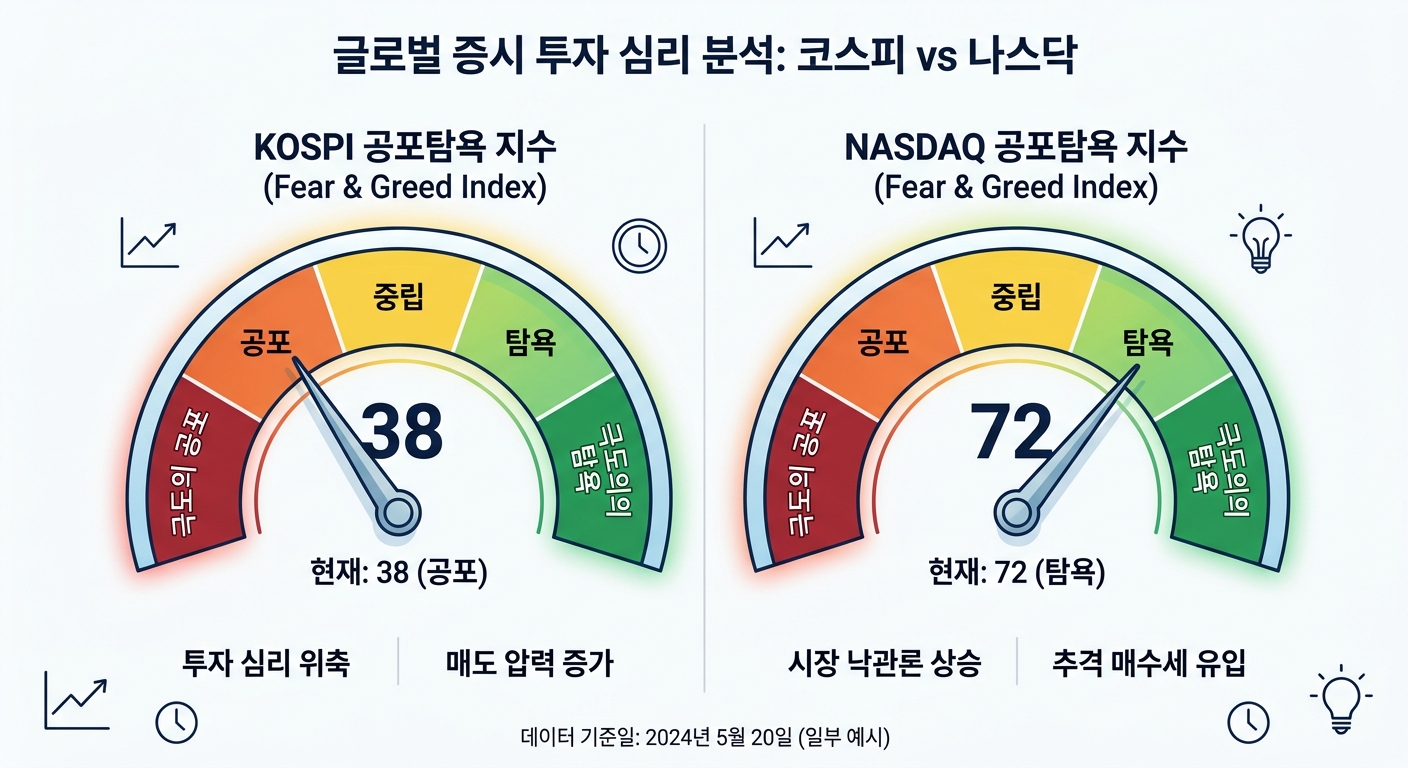
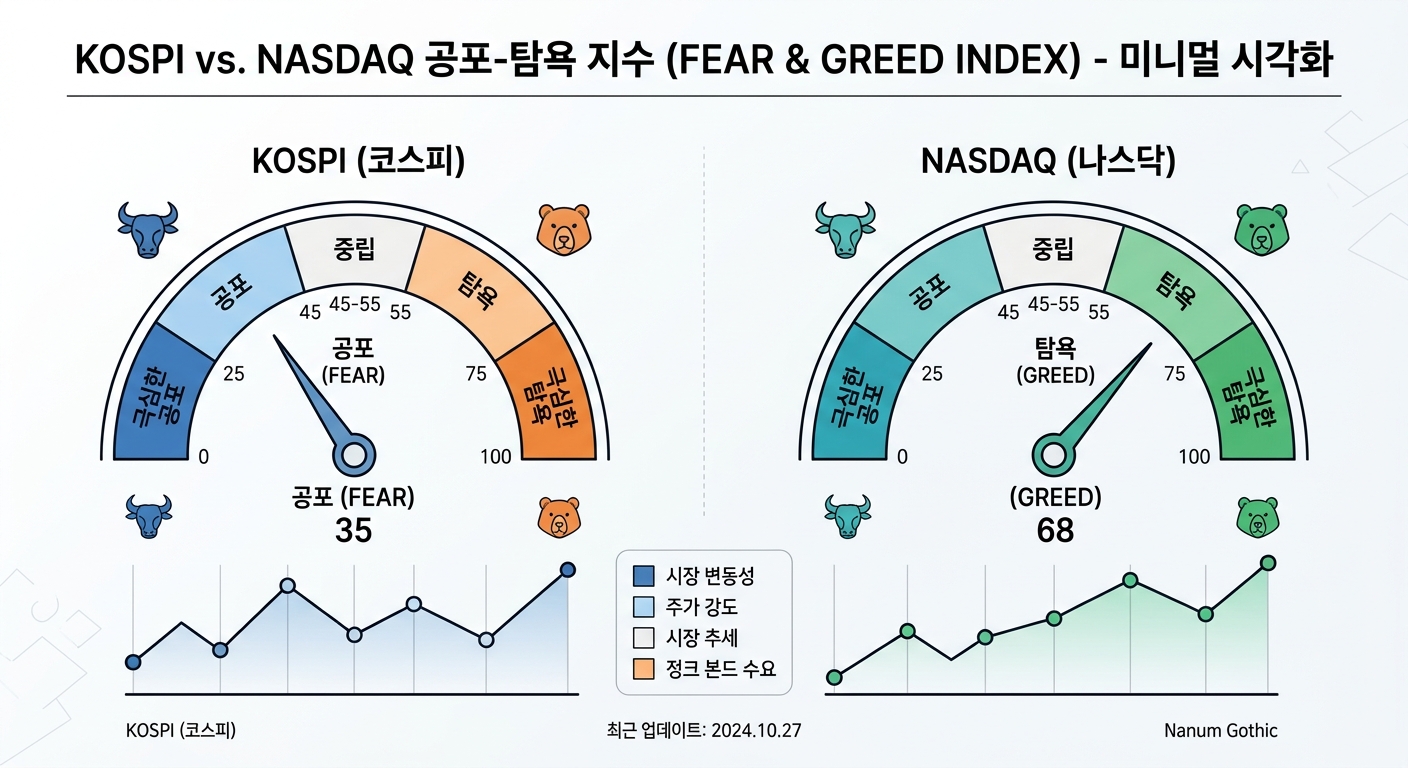
According to Daily Stock's proprietary Fear & Greed Index, the KOSPI currently sits at 16.1 ("Extreme Fear").
It was 19.5 ("Extreme Fear") a week ago, 12.4 ("Extreme Fear") a month ago, and 21.7 ("Fear") three months ago, indicating a prolonged period of extreme sentiment contraction.
The Nasdaq market also stands at 31.7 ("Fear") compared to 23.5 ("Fear") a week ago, 43.5 ("Neutral") a month ago, and 29.9 ("Fear") three months ago, reflecting ongoing elevated volatility across tech names.
NAVER's (035420) share price on the day was "Unconfirmed for the session (recently tracked around the 170,000–190,000 KRW range)."
Affected by macro uncertainties and earnings adjustments due to AI capex recognition, the stock has been consolidating near technical support at the lower bound of its annual trading range.
---
Financial Analysis
NAVER's top-line revenue continues to settle stably in the KRW 3 trillion per quarter range, supported by a recovery in search advertising and growth across its commerce and cloud divisions.
However, operating expenses have risen due to large-scale GPU server deployments for AI infrastructure expansion, depreciation from the operational launch of its "GAK Sejong" data center, and marketing/content partnership outlays.
Quarterly operating profit margins have temporarily adjusted to the mid-to-high 10% range. Nevertheless, the debt ratio remains below 40%, preserving a solid financial buffer underpinned by a net cash position.
As next-generation growth drivers such as B2B cloud and GPUaaS (GPU as a Service) see a meaningful ramp-up in utilization, the pace of fixed-cost absorption is gradually accelerating.
| Metric (Unit: KRW Trillion / %) | 2024 (Actual) | 2025 (Estimate) | Q3 2026 (Prelim/Est.) |
|---|---|---|---|
| **Consolidated Revenue** | 10.57 | 11.85 | 3.48 – 3.53 |
| **Consolidated Operating Profit** | 1.98 | 2.15 | 0.45 – 0.49 |
| **Operating Profit Margin (OPM)** | 18.7% | 18.1% | 13.0% – 14.0% |
| **Debt-to-Equity Ratio** | 38.2% | 37.5% | 36.8% (Sound) |
| **Cloud / New Business Share** | 5.3% | 6.2% | Approx. 7.5% |
---
Valuation
Compared to global big tech peers (Alphabet, Microsoft, etc.) trading at 25–30x forward P/E on priced-in generative AI monetization expectations, NAVER's 12-month forward P/E has compressed to the 16–18x level.
This deep valuation discount reflects capital concentration within KOSPI 200 large caps toward export manufacturing sectors such as semiconductors, defense, and shipbuilding, which has sidelined the domestic internet platform sector.
On a P/B basis, NAVER trades at 1.1–1.3x, sitting near the lower end of its historical valuation band.
This is widely viewed as a structurally undervalued territory where a re-rating could materialize once heavy second-half capital expenditures (CAPEX) convert into expanding B2B order backlogs.
---
Institutional & Analyst Perspectives
Major domestic and global brokerages view the soft Q3 results caused by cost surges as an "anticipated investment phase."
Quarterly depreciation peaked due to fewer working days around the Chuseok holiday and expanded GPU procurement, but consensus suggests that cost pressures will ease beginning in Q4.
On the institutional flows front, foreign investors have calibrated the pace of their cash equity purchases amidst exchange rate consolidation near 1,337 KRW, while long-term pension funds have provided downside support via bargain hunting.
Analysts point to progress in Brookfield and NVIDIA partnerships regarding the phase 1 rollout of its 200MW AI Factory, alongside tangible Sovereign AI export contracts in the Middle East and Asia, as potential catalysts for a share price turnaround.
---
Risk Factors
The principal risk is the potential delay in monetization relative to large-scale AI infrastructure outlays.
With GPU replacement cycles shortening, if the pace of onboarding enterprise clients lags behind the growth rate of depreciation, margins could face an extended period of compression.
Additionally, a delayed monetary easing cycle by the Bank of Korea and muted domestic economic consumption represent macroeconomic headwinds that could restrict display advertising and SmartStore gross merchandise value (GMV) growth.
Mounting costs to defend Korean-language search market share against direct inroads from global tech giants such as Google and OpenAI also require close tracking.
---
Investment Outlook
At this juncture, approaching NAVER with a medium-term investment horizon aimed at capturing the fruits of its structural transition appears more prudent than focusing on short-term quarterly earnings volatility.
Historically, periods where the Fear & Greed Index lingers in 'Extreme Fear' (16.1) and investor sentiment is muted have offered favorable setups for staged accumulation strategies.
Downside rigidity is well-established for this platform bellwether, which has been largely bypassed during the export-heavy KOSPI advance.
Consequently, a phased accumulation strategy monitoring the confirmation of a Q3 cost peak-out, definitive contract disclosures for the B2B AI Factory, and foreign passive inflows accompanying FX stabilization could be a sensible approach.
---
Daily Stock Q&A
Q1. Will NAVER's transition to generative AI search cannibalize existing search advertising revenue?
On the contrary, combining generative AI summary search with personalized feeds has created synergies that boost click-through rates and pricing for targeted advertising products like ADVoost. Increased user dwell time is also improving conversion rates across linked shopping and local service ecosystems.
Q2. Are B2B cloud and 'Sovereign AI' generating tangible revenue?
Yes. Starting with overseas wins such as the digital twin platform project for Saudi Arabia's Ministry of Municipal and Rural Affairs and Housing, NAVER has steadily secured hybrid cloud contracts in domestic and international financial and public sectors. The AI Factory business, co-developed with NVIDIA for sovereign states and security-conscious enterprise clients, is expected to drive full-scale top-line expansion moving forward.
Q3. What was the main reason Q3 operating profit fell short of market consensus?
It was primarily driven by a temporary concentration of depreciation from GPU infrastructure expansion to support AI advancements, deployment costs for offline payment terminals, and seasonal marketing expenses. Because revenue continues to show double-digit expansion, profitability is expected to recover once cost surges normalize starting in Q4.
Q4. The KOSPI Fear & Greed Index is at 16.1 ('Extreme Fear'). Is it an appropriate time to enter?
Because extreme index sentiment implies elevated market-wide volatility, systematic dollar-cost averaging is generally preferred over lump-sum allocation. When pessimism reaches extremes, contrarian accumulation of leading platform companies at trough valuation multiples has historically been viable.
Q5. What are the key catalysts to monitor for a stock rebound?
Key triggers include the formalization of global tenant agreements for the 200MW phase 1 AI Factory around year-end, the finalization of the financing structure with Brookfield, and tangible progress updates regarding the NVIDIA partnership.