
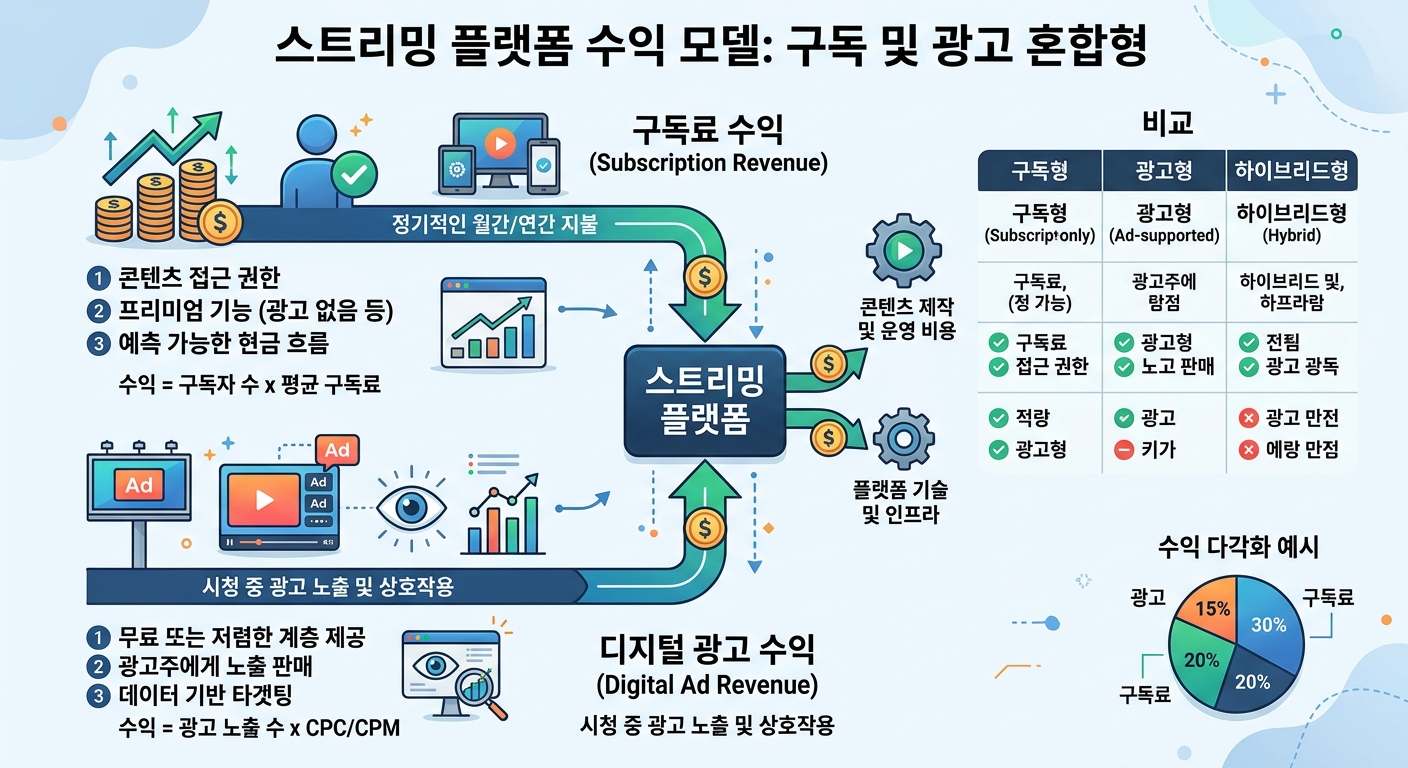
Netflix (NFLX), the pioneer of the global streaming industry, is fundamentally transforming its financial model by moving beyond a pure subscription model to establish a dual monetization engine powered by both advertising and subscription fees.
Key Takeaways
Netflix has built an independent ecosystem of 250 million ad-tier viewers, funneling over 60% of all new global subscribers into its ad-supported tier (Standard with Ads).
Despite concerns over headline price dilution from lower-priced tiers, Average Revenue per Membership (ARM) continues to demonstrate solid gains, bolstered by high-value programmatic advertising slots.
While full-year 2026 advertising revenue guidance was trimmed slightly to $2.7 billion due to integration delays with its proprietary ad-tech partners, rapid year-over-year growth exceeding 80% remains intact.
Amid a macro backdrop where the 10-year US Treasury yield (US10Y) hovers near 5.0%, Netflix’s robust free cash flow (FCF) generation serves as a critical buffer defending valuation downfalls.
With the broader Nasdaq market currently in "Fear" territory, selective multiple re-ratings are emerging for mega-cap tech platforms backed by high earnings visibility.
Current Market Context
As of intraday trading on November 2, 2026 (preliminary), the Nasdaq Composite stands at 25,437.00 points, with the USD/KRW exchange rate trading at 1,335.00 KRW.
According to DailyStock's proprietary Fear & Greed Index, the Nasdaq reading sits at "Fear (26.2)." While this reflects a rebound from last week’s "Extreme Fear (16.7)," it still highlights cautious investor sentiment compared to one month ago (30.3) and three months ago (37.1).
In South Korea, the KOSPI is at 5,730.74 and the KOSDAQ is at 724.38, with the KOSPI Fear & Greed Index also registering "Fear (21.1)."
Netflix demonstrated stable top-line growth in its latest quarterly earnings release, guiding for full-year revenue of $51.1 billion (an increase of approximately 13% YoY).
However, the stock has experienced a temporary pause amid short-term noise, including a recent restructuring of approximately 1,000 employees and a delayed rollout schedule for its proprietary ad-tech integrations.
| Indicator | Value (Nov 2, 2026, Intraday Prelim.) | Notes |
|---|---|---|
| **Nasdaq Composite** | 25,437.00 | Reflects mega-cap tech earnings and macro volatility |
| **USD/KRW Exchange Rate** | 1,335.00 KRW | Linked to the global currency environment |
| **Nasdaq Fear & Greed Index** | 26.2 (Fear) | Rebounded from 16.7 (Extreme Fear) a week ago |
| **KOSPI Fear & Greed Index** | 21.1 (Fear) | Risk-off sentiment prevailing |
| **NFLX 2026 Projected Revenue** | $51.1 billion (Guidance) | Target of approx. 13% YoY growth |
| **NFLX 2026 Projected Ad Revenue** | $2.7 billion | Adjusted from $3.0 billion due to ad-tech rollout delays |
Financial Analysis
Netflix posted an operating margin of 34.6% in the third quarter, demonstrating substantial operating leverage compared to 28.2% in the prior-year period.
The primary drivers of revenue growth included subscription price hikes in mature markets (US and Europe), advertising revenue expansion, and net subscriber additions in emerging regions.
The company has successfully transitioned away from subscriber volume growth toward qualitative metrics, prioritizing engagement (time spent on platform) and Average Revenue per Membership (ARM).
The deployment of the "Netflix Ads Suite," its proprietary ad platform, is reducing external intermediary take-rates and strengthening margin structures.
By keeping content amortization and production CAPEX under disciplined control while delivering net income exceeding $3 billion per quarter, the stability of Netflix’s cash flow profile is increasingly prominent.
Valuation
Netflix's same-day share price remains unconfirmed (trading around the $68–$72 range based on recent verified data, split-adjusted), with valuation pressure easing considerably from prior peak cycles.
Its 12-month forward price-to-earnings (Forward P/E) ratio currently fluctuates between 25x and 28x, cooling down from historic peaks above 40x.
With the 10-year US Treasury yield (US10Y) holding above 5.0%, elevated yields continue to compress valuation multiples across growth equities.
Nevertheless, Netflix continues to defend earnings per share (EPS) growth through substantial long-term debt retirements and sustained share repurchases.
Although it trades at a premium relative to the broader S&P 500 growth universe, strong free cash flow conversion rates support and justify this valuation multiple.
Expert and Institutional Analysis
Major Wall Street institutions praise Netflix for breaking through the growth ceilings of traditional, mature streaming models via its dual revenue engine (subscriptions + advertising).
Programmatic integrations with The Trade Desk (TTD) and Yahoo DSP are expected to broaden the advertiser base into the small-and-medium-sized business (SMB) segment.
Morgan Stanley noted that "the ad-supported tier is contributing far more to incremental subscriber acquisition and churn mitigation than it is cannibalizing higher-priced subscribers."
Conversely, some cautious market observers point out that the revision of annual ad revenue guidance from $3.0 billion down to $2.7 billion illustrates that partner platform integrations and ecosystem maturation take time.
Additionally, analysts highlight the need to monitor the relative strength of the US Dollar Index (DXY) and foreign exchange volatility in emerging markets, which can negatively impact converted global ARM.

Risk Factors
The first risk is delays in ad-tech deployment. If integrations with third-party data lag during the global rollout of its in-house ad platform, advertising CPM defense could face near-term pressure.
The second risk involves macroeconomic instability and elevated Treasury yields (US10Y). Sustained 5%-level rates increase economic slowdown concerns, potentially leading major enterprise brands to scale back overall digital marketing budgets.
The third risk centers on content fatigue and live-event broadcasting challenges. Expanding into live sports and entertainment (e.g., WWE) brings infrastructure traffic cost pressures and production inflation.
Lastly, tightening global privacy frameworks and regulatory mandates present ongoing variables for ad-targeting efficiency.
Investment Perspective
Among mega-cap tech peers, Netflix holds a differentiated profile as it avoids getting caught in excessive AI infrastructure CAPEX cycles, preserving its core cash-cow engine.
During periods of technical volatility across the Nasdaq 100 and Philadelphia Semiconductor Index (SOX), reliable subscription-based cash flows position Netflix as a defensive growth asset.
While higher ad-tier penetration might appear to dilute headline ARM in the short run, cumulative viewing hours expand ad inventory, optimizing long-term Total ARM.
Investors should closely track the progress of full ad-tech platform internalization and rollout schedules for the ad tier across 15 additional countries.
With the Nasdaq Fear & Greed Index lingering at 26.2 in a corrective phase, staggered entry strategies into companies with high cash visibility and profitability remain a prudent consideration.
Frequently Asked Questions
Q1. Does an increase in ad-tier subscribers lower Netflix’s Average Revenue per Membership (ARM)?
While the base monthly subscription fee is lower, programmatic ad CPMs generated during viewing hours add up, allowing Total ARM to approach or even surpass that of the ad-free Standard tier.
Q2. Why was 2026 ad revenue guidance lowered from $3.0 billion to $2.7 billion?
The revision was not caused by weak advertiser demand, but rather by integration schedules with partners like The Trade Desk and the technical rollout of its proprietary ad suite taking several months longer than initially projected.
Q3. How does the 10-year US Treasury yield (US10Y) affect Netflix’s stock?
Yields hovering around 5% raise the discount rate applied to future cash flows, putting downward pressure on growth stock multiples. However, Netflix's strong free cash flow generation enables balance-sheet discipline, providing higher interest-rate resilience compared to unprofitable streaming peers.
Q4. Why did Netflix stop reporting quarterly subscriber numbers?
Management determined that metrics such as engagement (total time spent), operating margins, free cash flow, and combined ad/subscription revenue represent a more accurate picture of enterprise value than simple subscriber headcount.
Q5. How will the global rollout of the ad-supported tier planned for 2027 impact performance?
Expanding beyond the current 12 key markets into 15 additional regions (including the Netherlands, Switzerland, Poland, and Southeast Asia) will substantially enlarge the global advertising inventory base, serving as a catalyst for accelerated advertising revenue growth from 2027 onward.