Hello, this is Daily Stock, delivering financial context and market perspectives.
Executive Summary
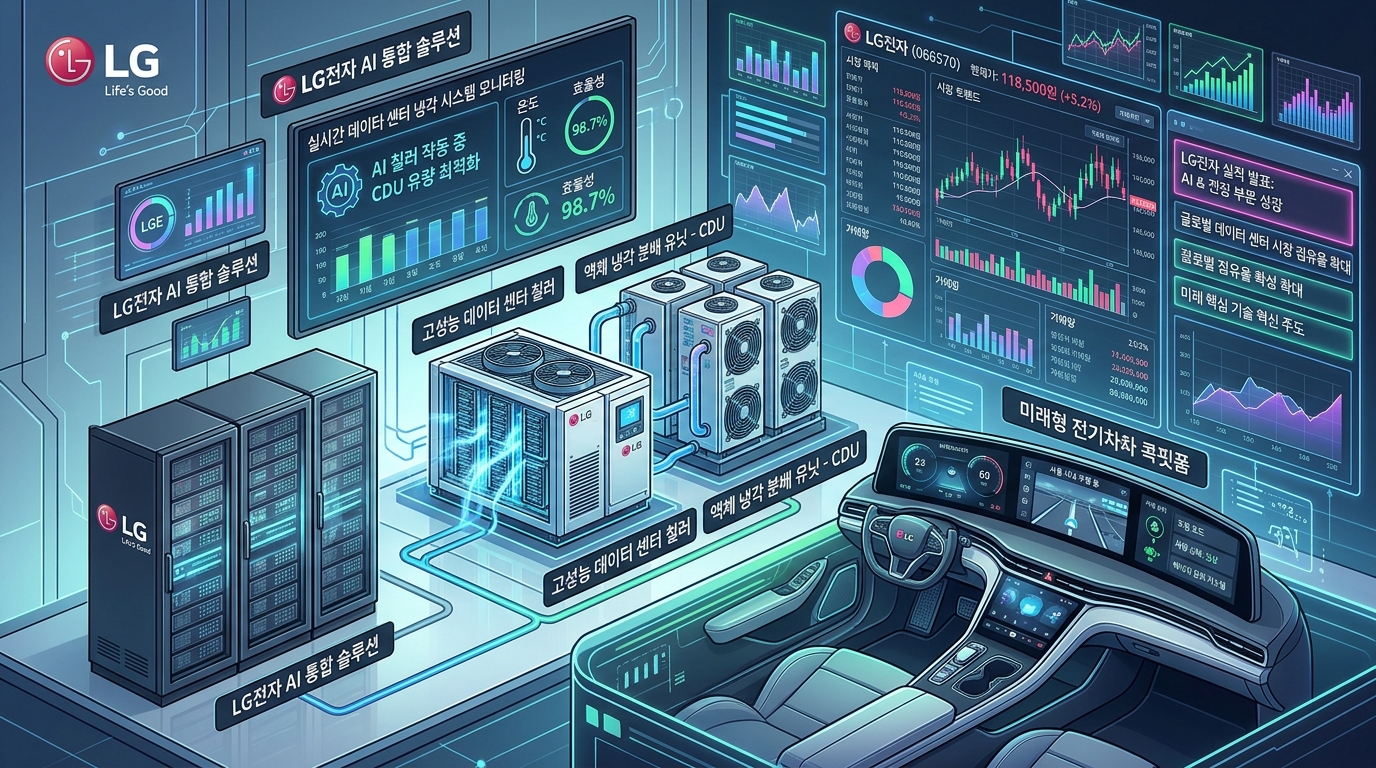
LG Electronics is accelerating its strategic pivot from a traditional B2C home appliance manufacturer toward a high-value B2B enterprise centered on AI data center cooling solutions and vehicle component solutions (VS).
Expanding order backlogs for AI thermal management technologies, including industrial chillers and coolant distribution units (CDUs), have emerged as powerful new earnings drivers.
Having demonstrated robust profitability by surpassing 4 trillion won in cumulative operating profit through the third quarter, the key catalyst for valuation re-rating hinges on whether the company can decisively break away from its chronic "strong first half, weak second half" seasonal earnings pattern.
Amid ongoing FX market fluctuations and broader macroeconomic uncertainty, investors must closely track the pace at which the mid- to long-term order pipeline converts into recognized revenue.
Market Snapshot
The domestic equity market continues to exhibit volatility, with the KOSPI at 5,859.08 and the KOSDAQ at 734.36, while the USD/KRW exchange rate fluctuates around 1,343.90 won.
According to Daily Stock's proprietary Fear & Greed Index, the KOSPI currently sits in the "Fear" territory (28.6)—a modest rebound from the "Extreme Fear" reading (6.9) seen a week earlier, yet reflecting lingering investor caution.
The Nasdaq Fear & Greed Index also remains in "Fear" (26.2), signaling persistent global risk aversion.
While intraday price quotes for LG Electronics were not updated at the time of writing (based on latest confirmed figures), institutional and foreign cash and futures flows driven by the strong dollar continue to dictate trading volatility across large-cap IT hardware.
Within the KOSPI 200 large-cap space, passive flows show a selective reallocation toward companies carrying higher B2B portfolio exposure over traditional consumer electronics.
| Category | Key Metrics & Data | Details & Notes |
|---|---|---|
| **KOSPI / Nasdaq Index** | 5,859.08 pt / 25,437.00 pt | Closing figures as of 2026-11-02 |
| **USD/KRW Exchange Rate** | 1,343.90 won | Core driver of foreign institutional flow volatility |
| **KOSPI Sentiment Index** | Fear (28.6) | Recovered from 6.9 (Extreme Fear) a week ago |
| **Q3 Consolidated Results** | Rev: KRW 23.8241T / OP: KRW 781.9B | Up 8.9% and 13.5% YoY, respectively |
| **Cumulative 9M Results** | Rev: KRW 71.3778T / OP: KRW 4.0347T | First time cumulative 9M OP surpassed KRW 4T |
| **AI Data Center Cooling Orders** | Cumulative backlog exceeds KRW 3T | Rapid rise from KRW 600B in 1H |
| **VS Division Q3 Performance** | Rev: KRW 2.8261T / OP: KRW 190.3B | All-time record Q3 performance |
Financial Analysis
LG Electronics reported final Q3 consolidated revenue of 23.8241 trillion won and operating profit of 781.9 billion won, advancing 8.9% and 13.5% year-over-year, respectively.
Most notably, cumulative operating profit for the first nine months reached 4.0347 trillion won, marking an all-time record for the company.
Breaking down performance across divisions, the Vehicle Component Solutions (VS) Company solidified its structural turnaround with Q3 revenue of 2.8261 trillion won and an operating profit of 190.3 billion won.
A higher sales mix of high-margin in-vehicle infotainment (IVI) systems and the steady execution of an order backlog hovering around 100 trillion won supported solid profitability.
The Eco Solutions (ES) Company, responsible for heating, ventilation, and air conditioning (HVAC), posted Q3 revenue of 2.1736 trillion won and an operating profit of 87.2 billion won.
While near-term margins were temporarily compressed due to a 220 billion won capital expenditure for a new production facility in Virginia, top-line expansion remains intact.
The Home Appliance & Air Solution (HS) Company delivered Q3 revenue of 7.0444 trillion won and an operating profit of 259.2 billion won, fulfilling its role as a steady cash cow bolstered by appliance subscription models.
The Media & Entertainment (MS) Company returned to profitability with an operating profit of 146.7 billion won, driven by premium OLED TV sales and the continued expansion of the webOS platform ecosystem.
Valuation Assessment
Historically, LG Electronics has traded at a persistent discount relative to global hardware peers due to the seasonal tendency of consumer electronics earnings to peak in the first half and contract in the second.
Heavier promotional spending for year-end retail events like Black Friday, alongside rising logistics costs, typically eroded second-half margins, confining the stock's valuation to a PBR range of 0.7x to 0.9x.
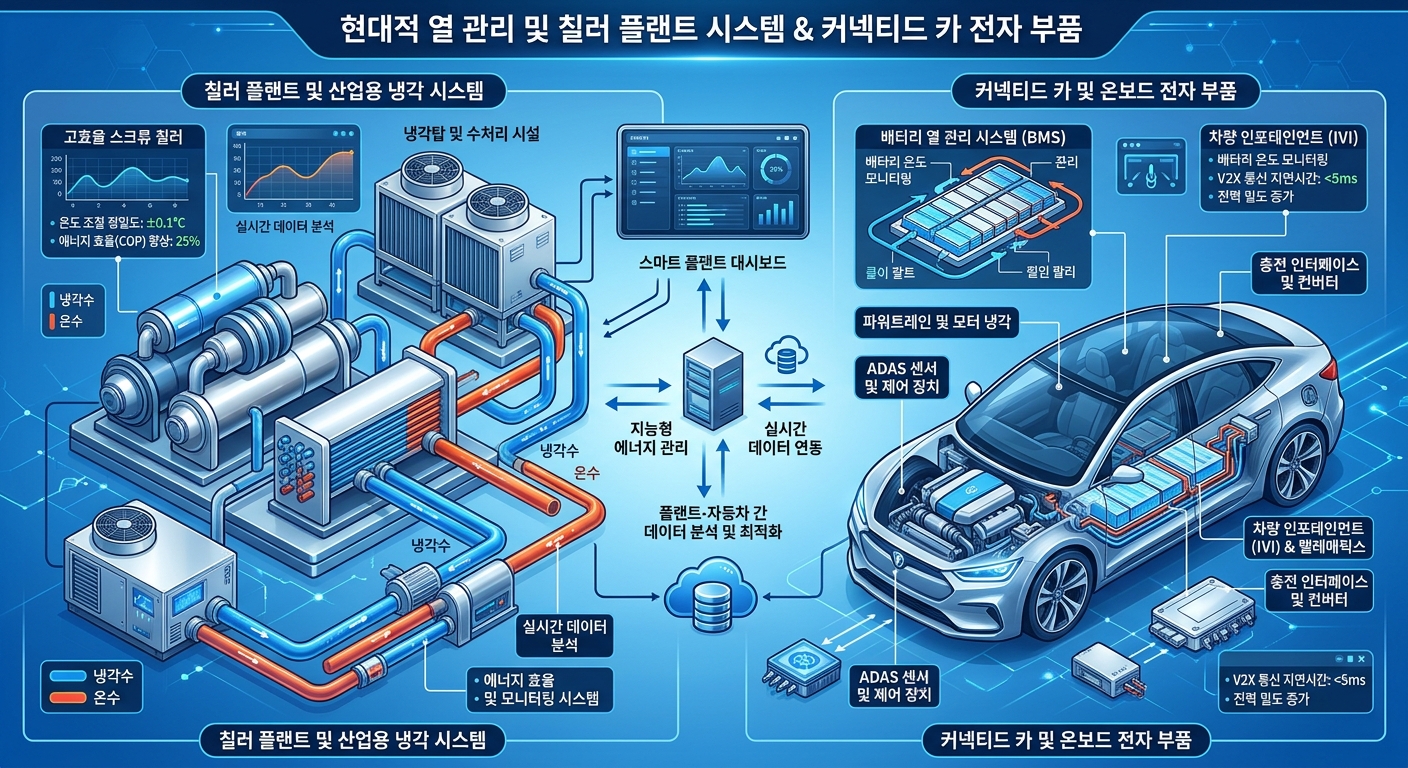
However, industrial chillers and liquid cooling systems designed for AI data centers involve long-term B2B contract structures with lead times between 7 and 9 months, yielding reliable high-margin revenues.
This operational transition provides fundamental justification for multiple re-rating, moving the company from a consumer product assembler to a mission-critical infrastructure provider.
Considering that specialized peers such as Vertiv and global HVAC leaders command premium P/E multiples on the back of AI thermal demand, LG Electronics' rising B2B exposure should help lift its valuation floor.
Coupled with double-digit top-line growth and stable operating margins in the VS division, downside price protection is expected to strengthen.
Expert & Institutional Commentary
Market analysts emphasize that LG Electronics' portfolio diversification strategy is increasingly visible in hard operational metrics.
The company receives high marks for establishing an end-to-end "Chip-to-Chiller" ecosystem in the AI thermal management space, spanning industrial chillers down to CDUs.
Inclusion as a cooling and power partner within the NVIDIA Partner Network (NPN) has significantly reinforced LG's credibility when bidding on hyperscale data center projects worldwide.
Institutional investors are focusing on whether the B2B units (HVAC and VS) can effectively offset the traditional Q4 seasonal rise in consumer marketing outlays on a standalone basis.
From the standpoint of Korea's major exporters, analysts view the current exchange rate regime—with the USD/KRW holding in the 1,340-won range—as supportive of export margins for automotive electronics and chillers.
Nevertheless, higher procurement costs for imported raw materials and elevated maritime shipping rates could partially dilute these benefits, making net margin preservation a central focal point.
Risk Factors
The most immediate threat stems from sluggish consumer demand in the core B2C businesses (home appliances and TVs), caused by the global economic slowdown and cautious consumer sentiment.
Although appliance subscriptions and B2B segments are growing rapidly, the HS and MS divisions still constitute the vast majority of consolidated revenues.
Heightened volatility in container shipping and air freight rates, alongside cost inflation for raw materials such as memory components and display panels, could compress Q4 operating margins.
In addition, delayed capital expenditure (CAPEX) schedules by enterprise clients depending on monetary policy trajectories from the Bank of Korea and the US Federal Reserve remain a key variable.
In automotive components, the broader slowdown in EV adoption (the "EV chasm") across major automakers could lead to selective deferrals of project execution.
Finally, foreign exchange volatility and related translation gains or losses require close monitoring on the non-operating finance cost side.
Investment Perspective
LG Electronics is transitioning away from the cyclical vulnerability inherent in standalone appliance retail, actively pursuing quality growth underpinned by B2B contracts and software platform models.
Data center thermal management and automotive electronics are powered by clear industry secular tailwinds, systematically upgrading the company's structural fundamentals.
However, because the fourth quarter typically involves inventory clearance and concentrated promotional expenses, near-term quarterly profit momentum could moderate.
With broad domestic market sentiment remaining in "Fear" territory, a phased strategy that monitors the quarter-by-quarter conversion of B2B order backlogs into confirmed sales appears more prudent than aggressive short-term positioning.
Daily Stock Q&A
Q1. Why are AI data center cooling solutions (chillers) gaining so much attention?
Because the immense heat generated by high-density AI accelerators cannot be managed by conventional air cooling alone, making large-capacity chillers and direct-to-chip liquid cooling essential infrastructure.
Q2. What was the primary driver behind achieving KRW 4 trillion in cumulative operating profit through Q3?
It was the combined result of resilient cash generation from core appliances, record-high quarterly profitability in the automotive VS division, and an operating turnaround in the premium TV and webOS business.
Q3. Is the operating profitability of the VS division structurally sustainable?
Yes. Supported by a healthy order backlog hovering around 100 trillion won centered on high-margin infotainment (IVI) and e-powertrain platforms, the business has achieved structural profitability.
Q4. Can the chronic "strong first half, weak second half" seasonal earnings pattern break this year?
While promotional spending in Q4 remains unavoidable, the growing revenue share from long-term B2B contracts in HVAC and automotive components is expected to provide stronger margin defense than in past cycles.
Q5. How does the USD/KRW exchange rate remaining in the 1,340-won range affect export performance?
While favorable for the profitability of dollar-invoiced exports in chillers and automotive electronics, it also raises the cost of overseas component procurement and global freight charges, creating offsetting dynamics.