
As concrete outlines of the tax reform plan aimed at improving the fundamental structure of the domestic capital market and encouraging expanded dividends emerge, market participants are paying close attention.
Key Takeaways
The dividend income separate taxation system is structured to provide tiered separate taxation benefits instead of global financial income taxation for shareholders of high-dividend companies that meet specific criteria.
By lowering the effective tax rate for controlling shareholders and high-net-worth individuals, the policy aims to incentivize expanded cash dividends rather than the accumulation of retained earnings.
Pure and operating holding companies are considered prime beneficiaries of the tax reform due to their substantial capacity to raise payout ratios and high controlling-shareholder ownership stakes.
Foreign and institutional capital flows, tied to the KRW/USD exchange rate around the 1,335.80 level, are selectively moving into undervalued holding companies offering attractive dividend yields.
In a defensive environment where the KOSPI Fear & Greed Index stands at 21.1 (Fear), the role of large-cap holding company portfolios with high dividend visibility serves as an important market buffer.
Market Context
As of the close on November 1, 2026, the domestic stock market continued to experience volatile trading, with the KOSPI closing at 5,730.74 and the KOSDAQ at 724.38.
While the US Nasdaq fluctuated near the 25,437.00 mark, the KRW/USD exchange rate stood at 1,335.80, driving foreign supply and demand volatility.
According to the proprietary Daily Stock Fear & Greed Index, the KOSPI currently sits in Fear territory at 21.1, showing a modest improvement from Extreme Fear (6.9) a week ago, but still reflecting subdued investor sentiment compared to Neutral (40.1) a month ago.
The Nasdaq Fear & Greed Index also signals caution across risk assets, standing at Fear (26.2), compared to Extreme Fear (16.7) a week ago, Fear (30.3) a month ago, and Fear (37.1) three months ago.
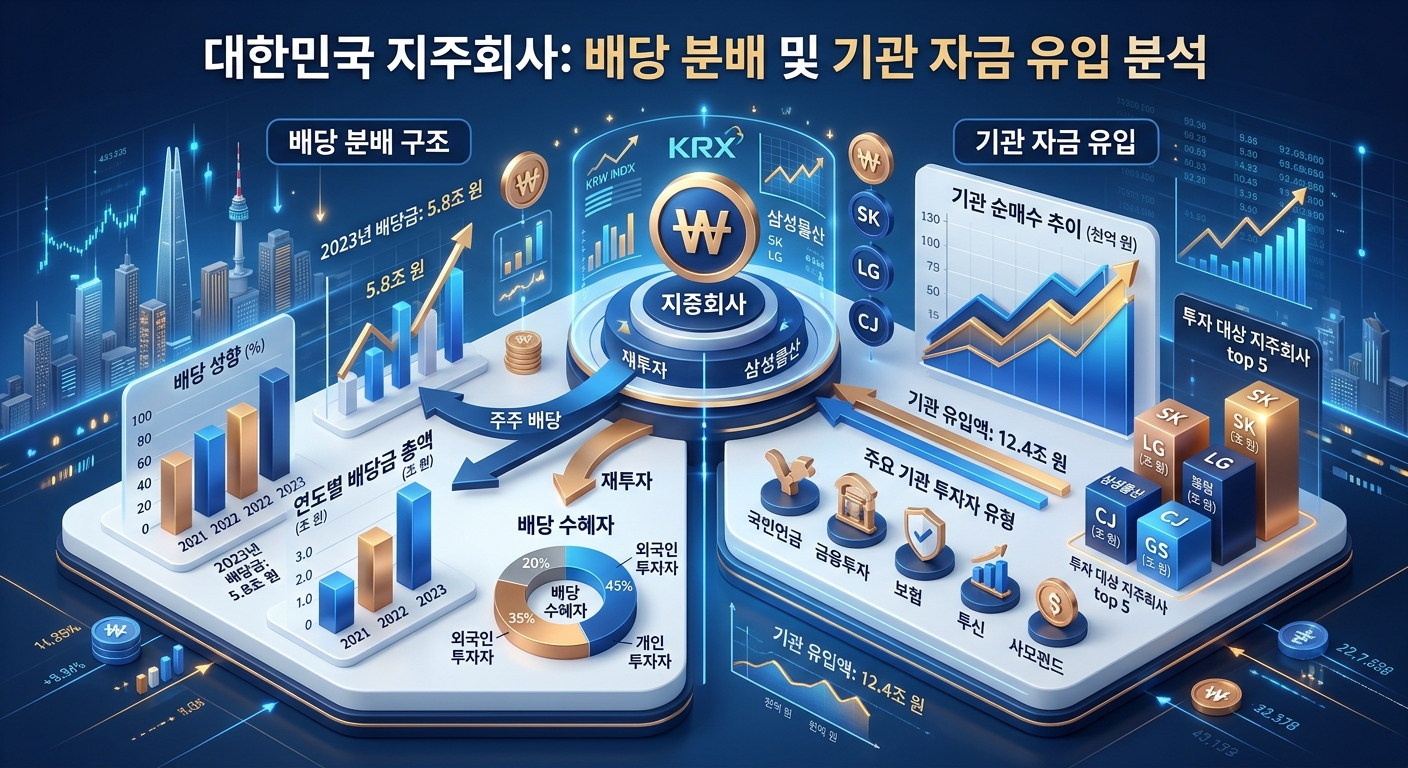
Against this backdrop, passive and active capital flows into large-cap holding companies are being observed as detailed requirements and implementation schedules for separate dividend taxation targeting high-dividend listed firms materialize.
The pathway to special tax treatment is opening up primarily for companies with a dividend payout ratio of 40% or higher, or those with a payout ratio of at least 25% that also expand cash dividends by more than 10% year-over-year.
Financial Analysis
In line with revisions to the Restriction of Special Taxation Act, major holding companies are actively securing shareholder return capital, supported by increased dividend income from subsidiaries and Value-up initiatives.
Backed by abundant free cash flow (FCF) and earnings growth from consolidated subsidiaries, large-cap holding companies are trending toward lifting their dividend payout ratios into the 30% to 40% range.
| Classification | Standard Taxation System (Global Income Tax) | Special Separate Taxation for High-Dividend Firms | Anticipated Policy & Inflow Impact |
|---|---|---|---|
| Taxation Method | 14% up to KRW 20M; progressive rates (up to 45%) combined with other income above KRW 20M | 14% up to KRW 20M; bracket-specific separate taxation (max 30%) | Drives dividend demand among major shareholders and affluent individuals |
| KRW 20M – 300M Tier | Subject to progressive global income tax rates | 20% separate taxation applied | Lock-in effect for upper-middle retail wealth in dividend stocks |
| KRW 300M – 5B Tier | Faces global income tax rate up to 45% | 25% separate taxation applied | Strengthens preference for cash dividends among large retail and key shareholders |
| Over KRW 5B Tier | Effective tax rate approaches 49.5% including local income tax | 30% separate taxation applied | Reduces incentive for major shareholders to retain dividends; boosts shareholder returns |
| Eligibility Criteria | General application to all listed companies | Dividend payout ratio ≥40%, or ≥25% with a ≥10% YoY dividend increase | Drives higher dividend payout ratios across KOSPI-listed holding companies |
As the Bank of Korea's base rate enters a gradual easing cycle, the relative attractiveness of holding companies' dividend yields compared to bond yields is climbing.
However, for holding companies heavily dependent on manufacturing subsidiaries, distributable dividend capital remains vulnerable to fluctuations in Korea's export and import cycles.
Valuation
Large-cap holding companies situated at the top of KOSPI corporate governance structures remain structurally undervalued, trading at a 40% to 60% discount to Net Asset Value (NAV).
Compared to holding groups in the S&P 500 and Japan's TOPIX, KOSPI holding companies trade at an average P/B ratio of 0.5x to 0.7x, maintaining global relative valuation appeal.
When cyclical manufacturing industries such as semiconductors and automobiles face earnings volatility within the KOSPI 200, holding companies provide downside support through steady dividend yields.
Conversely, small- and mid-cap holding companies often face ongoing valuation de-rating due to a lack of absolute cash reserves required to satisfy separate taxation thresholds, deepening market divergence.
If separate taxation on dividend income firmly establishes itself, reduced tax burdens on controlling shareholders could directly translate into higher actual payouts, triggering a re-rating scenario that narrows NAV discounts.
Expert & Institutional Analysis
Securities industry analysts project that separate dividend taxation will drive genuine behavioral shifts, as controlling shareholders perceive a much larger tax reduction compared to past dividend promotion tax regimes.
Financial investment professionals note that with the KRW/USD exchange rate around the 1,330 range, foreign investors are increasingly inclined to hold high-dividend cash-flow stocks long term to buffer against currency loss risks.
While foreign futures trading alternates between net buying and selling depending on macro sensitivity, foreign allocations in the cash market are progressively expanding toward high-dividend financial institutions and holding companies.
Major institutional investors also note that stewardship codes provide added leverage to pressure portfolio companies to meet the 40% dividend payout threshold required for separate taxation.
Conversely, some analysts caution that aggressively raising dividend payout ratios during economic downturns when net income drops sharply could impair corporate financial soundness.
Risk Factors
The primary macro variable to watch is the sluggishness of export and import metrics driven by a global economic slowdown, which could impair subsidiary operating income.
Sustained high volatility in the KRW/USD exchange rate could prompt mechanical outflows of foreign passive capital, causing short-term supply-demand distortions even in high-dividend holding companies.
Delays during the National Assembly's legislative debates over specific enforcement decrees—such as tax criteria for capital-reduction dividends and the treatment of treasury stock cancellations—cannot be ruled out.
There is also a risk of regulatory pushback if expanded dividends are perceived as serving the private interests of controlling shareholders rather than enhancing broader shareholder value.
Investors must also monitor dividend-cut risks if downward revisions to earnings guidance at core operating subsidiaries directly lead to reduced payouts.
Investment Perspective
With the KOSPI Fear & Greed Index lingering in the Fear zone at 21.1, market conditions naturally favor defensive, high-dividend holding companies.
A selective approach is required, simultaneously verifying whether a company can maintain a payout ratio above the 40% separate taxation threshold and tracking its 3-year average dividend growth trajectory.
Investors should holistically monitor foreign spot and futures flows around the 1,335.80 KRW/USD exchange rate, along with the Bank of Korea's interest rate trajectory.
Rather than chasing short-term trading gains, a phased accumulation strategy focused on cash-flow visibility heading into the dividend record date and the potential narrowing of NAV discounts remains prudent.
Portfolio weighting should center on large-cap holding companies characterized by defensive resilience and transparent corporate governance.
Investor Checkpoint Q&A
Q1. What are the mandatory corporate criteria to qualify for separate taxation on dividend income?
A. Companies must meet high-dividend requirements stipulated by law, such as maintaining a dividend payout ratio of 40% or higher for the preceding fiscal year, or a payout ratio of at least 25% combined with a year-over-year cash dividend increase of 10% or more.
Q2. Which tax bracket offers the most significant relief for individual investors?
A. For investors subject to global financial income taxation, dividend income between KRW 20 million and KRW 300 million is taxed separately at 20%, while income between KRW 300 million and KRW 5 billion is taxed at 25%, substantially reducing the tax burden compared to standard progressive rates that reach up to 45%.
Q3. How does the KRW/USD exchange rate affect holding company capital flows?
A. When the exchange rate stabilizes around the 1,335 level, foreign exchange loss risks are contained, reinforcing foreign investors' tendency to buy large-cap holding companies with attractive dividend yields for long-term income strategies.
Q4. Are share buybacks and cancellations included when assessing eligibility for separate dividend taxation?
A. Currently, eligibility criteria under the tax code are calculated based on cash dividends. Ongoing legislative discussions regarding whether to incorporate share cancellations into the qualification formula should be tracked.
Q5. Which metrics should investors examine most carefully when evaluating holding companies?
A. Given that holding companies rely heavily on consolidated net profit, investors must rigorously examine subsidiaries' FCF generation capability, debt-to-equity ratios, and the parent company's standalone capacity to pay dividends.