
This is Daily Stock, delivering in-depth analysis of global financial market trends and structural fundamentals of leading tech companies.
Key Takeaways
Applied Materials (AMAT) continues to build a robust order backlog driven by rising demand for advanced etch and deposition equipment used in Gate-All-Around (GAA) and High Bandwidth Memory (HBM) for expanding AI data centers.
Conversely, due to U.S. Department of Commerce export controls against China, the company's revenue exposure to the Chinese market has narrowed from the mid-to-high 30% range to the high-20% range, remaining a key source of earnings volatility.
On the macroeconomic front, valuation multiples across semiconductor equipment stocks are undergoing a re-rating phase influenced by fluctuations in the 10-year U.S. Treasury yield (US10Y) and movements in the Volatility Index (VIX).
Current Market Overview
In the global wafer fab equipment (WFE) market, Applied Materials supplies integrated materials solutions spanning etch, chemical vapor deposition (CVD), atomic layer deposition (ALD), and chemical mechanical planarization (CMP).
In particular, with the transition to next-generation GAA transistor structures and 3D stacked memory processes, orders for the company's high-selectivity etch and pattern-shaping (Centura Sculpta) tools are accelerating.
However, a clear structural shift is unfolding in regional revenue breakdown.
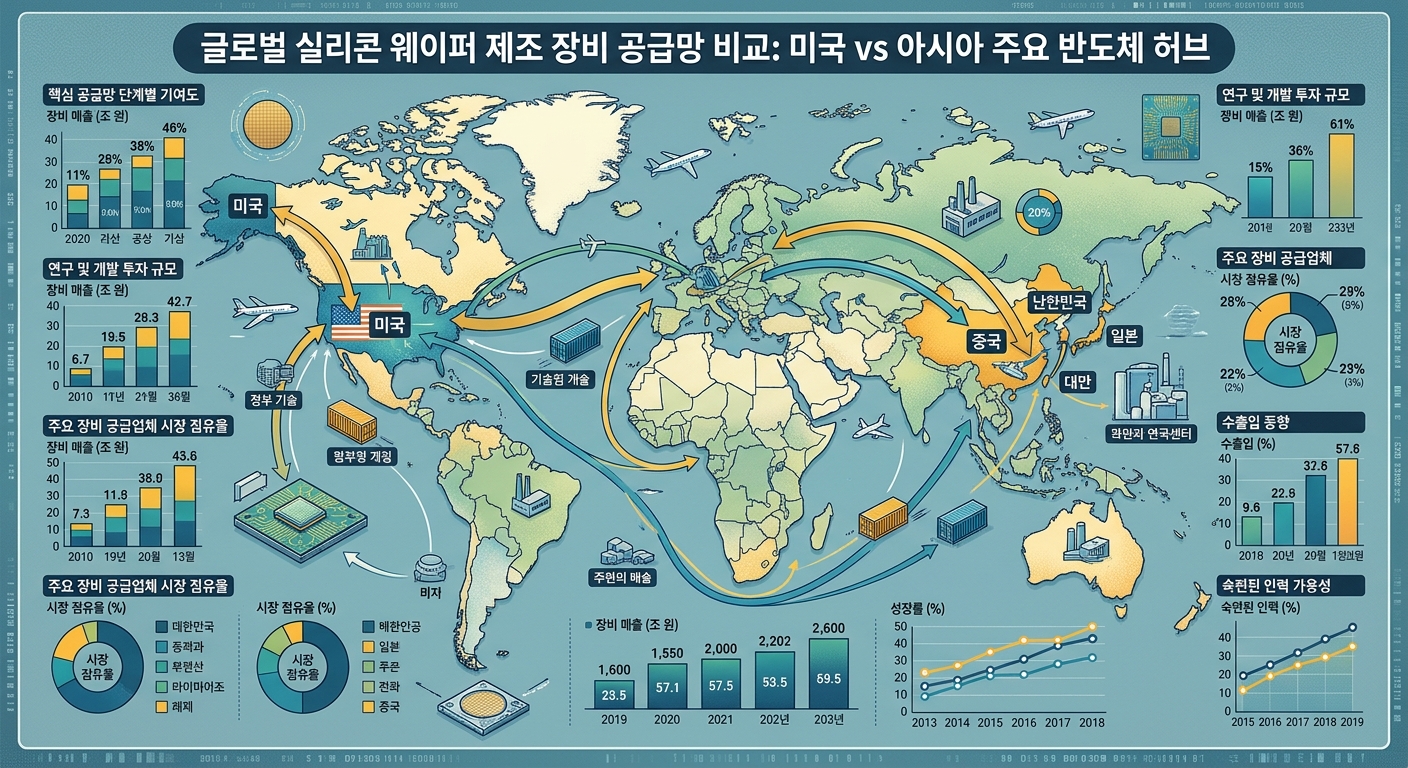
China revenue, which had surged on legacy fab expansion demand by domestic chipmakers, is stabilizing downward due to tightening U.S. regulations and market share gains by local Chinese equipment makers (such as AMEC and NAURA).
Within the Philadelphia Semiconductor Index (SOX) and the Nasdaq 100 Index, equipment stocks are showing divergent performance as markets weigh the sustainability of Big Tech AI infrastructure CAPEX against the scale of revenue lost to China trade restrictions.
As of October 31, 2026, the Nasdaq Index stands at 25,437.00. The proprietary Daily Stock Nasdaq Fear & Greed Index reads 26.2 (Fear), rebounding from 16.7 (Extreme Fear) a week earlier, yet cautious sentiment continues to dominate.
Financial Analysis
Applied Materials' recent quarterly results demonstrate that leading-edge investments driven by AI demand are partially offsetting weakness in legacy and China-related segments.
For the third quarter of fiscal 2026, revenue rose approximately 25% year-over-year to $9.12 billion, with Non-GAAP diluted earnings per share (EPS) reaching $3.50.
China revenue came in at $2.51 billion, accounting for roughly 28% of total net sales—a decline in share from 35% in the same period last year.
The annual revenue impact stemming from additional U.S. export controls is estimated at around $600 million.
| Metric | FY2025 Q3 | FY2026 Q3 | YoY Change |
|---|---|---|---|
| Total Net Sales ($B) | 7.30 | 9.12 | +24.9% |
| Non-GAAP Gross Margin (%) | 47.4% | 50.4% | +3.0%p |
| Non-GAAP Operating Margin (%) | 29.8% | 34.0% | +4.2%p |
| Non-GAAP EPS ($) | 2.12 | 3.50 | +65.1% |
| China Revenue Share (%) | 35.0% | 27.5% | -7.5%p |
| Free Cash Flow (FCF) Capital Returns ($B) | 0.65 | 0.86 | +32.3% |
Across the financial statements, solid margin expansion in Materials Modification and Materials Removal segments stands out.
Furthermore, the company maintains its FCF-backed shareholder return policy, deploying over $800 million per quarter in share repurchases and dividends.
Valuation
As of October 31, 2026, with current-session pricing unverified (based on the latest confirmed levels), AMAT's forward price-to-earnings (Forward P/E) ratio trades in the 19x to 23x range.
This represents a slight discount relative to peers like Lam Research and KLA, positioning near the median of its historical 5-year average multiple.
Semiconductor equipment sector multiples remain tightly linked to the trajectory of the 10-year Treasury yield (US10Y) and the U.S. Dollar Index (DXY).
If Treasury yields stabilize in the low-4% range, the present value of equipment order backlogs can find firm support; conversely, a reacceleration in the VIX could increase discount rate pressures.
Just as conservative sentiment across global risk assets caps multiple expansion—with the domestic market's KOSPI Fear & Greed Index at 21.1 (Fear) and the KOSDAQ Index at 724.38—multiple upside faces resistance. In an exchange-rate environment of 1,335.80 KRW per USD, earnings stability among U.S. equipment makers provides a defense against FX loss risk, but meaningful multiple expansion requires a clear absorption of China-related headwinds.
Wall Street & Institutional Perspectives
Major Wall Street investment banks maintain a positive stance on Applied Materials' competitive edge in leading-edge nodes, while remaining wary of downward revisions to China revenue guidance.
With the transition to advanced 2nm logic and the launch of mass GAA production, the number of etch and deposition steps required per wafer continues to rise, supporting the consensus view that the core order pipeline remains healthy.
On the other hand, several research firms, including Needham, highlight tightening U.S. export controls and the rapid penetration of domestic Chinese equipment vendors (AMEC, NAURA, etc.) in mature nodes of 28nm and above.
As front-loaded pull-in demand from Chinese customers subsides, some analysts warn that legacy WFE investments could slow entering the second half of 2026.
Institutions like JPMorgan view the pace at which global toolmakers such as ASML and AMAT can offset lost China revenue through foundry and memory fab expansions across non-China regions (the U.S., Taiwan, and South Korea) as the decisive variable for medium-term stock performance.
Risk Factors
The most direct risk is a potential expansion of semiconductor equipment export controls by the U.S. administration.
With shipments of high-bandwidth memory and advanced foundry tools already restricted, any expansion of curbs into mature nodes or complementary DUV processes would inevitably inflict additional revenue damage.
A second risk is the potential moderation of fab buildouts if hyperscalers face delayed return on investment (ROI) on AI data center CAPEX.
If Big Tech firms push out chip purchase orders to match monetization rates, foundry and IDM chipmakers could delay delivery schedules for next-generation etch equipment.
A third factor includes supply chain imbalances for critical components alongside monetary policy uncertainties.
Delays in sourcing key materials and components due to geopolitical friction, or setbacks in the path of policy interest rate cuts, could exert downward pressure on equipment delivery cycles and equity valuations.
Investment Perspective
Applied Materials is a primary beneficiary of manufacturing process innovations in AI semiconductors, while simultaneously standing on the frontlines of the U.S.-China tech rivalry.
Its unmatched technological capabilities in advanced WFE segments, such as etch and deposition, represent the core asset anchoring its structural growth.
In the short term, a disciplined, staged approach that monitors quarterly guidance volatility stemming from declining China revenue remains prudent.
Patience is warranted until momentum in next-generation node expansions by non-China foundry and memory clients demonstrably overtakes China-related structural risks.
Investor Checkpoint Q&A
Q1: How do AMAT's etch systems differentiate themselves from Lam Research (LRCX)?
While Lam Research holds traditional dominance in conductor etch, AMAT's strength lies in Integrated Materials Solutions (IMS)—uniting deposition, etch, and metrology on a single platform—and next-generation pattern-shaping technology (Centura Sculpta), which optimizes and reduces lithography and etch step counts.
Q2: What is the estimated financial impact of U.S. export controls on China revenue?
Based on management's latest forecasts, an annual top-line drag of approximately $600 million is expected for fiscal 2026, with China's contribution to total revenue falling from the mid-30% range to the high-20% range.
Q3: Why is the transition to Gate-All-Around (GAA) positive for AMAT?
As transistor architecture shifts from FinFET to GAA nanosheets, the complexity and step count of precision selective etch and thin-film deposition processes increase substantially to carve out silicon nanosheet channels, simultaneously driving up equipment average selling prices (ASPs) and tool unit volumes.
Q4: Do domestic Chinese equipment vendors pose a real threat to AMAT?
While Chinese vendors such as AMEC and NAURA are rapidly raising localization rates in mature nodes of 28nm and above, a pronounced technology gap remains in leading-edge nodes below 7nm and in advanced HBM packaging processes compared to global equipment leaders.
Q5: What is the transmission mechanism between the 10-year Treasury yield and AMAT's stock price?
Because semiconductor equipment entails long lead times from order placement to delivery and revenue recognition, rising interest rates increase the discount rate applied to future equipment order backlogs, typically exerting downward pressure on forward P/E multiples.