
Hello, this is Daily Stock, delivering reliable financial data and sober market analysis.
Key Summary
Shinhan Financial Group reaffirmed the solid earnings power of its core banking and financial franchise by delivering a cumulative Q3 net profit of KRW 5.0274 trillion.
Alongside this, it announced a Q3 cash dividend of KRW 740 per share and resolved to buy back and retire KRW 450 billion worth of treasury shares, making an annual shareholder return total of KRW 3 trillion increasingly visible.
As of October 29, 2026, the KOSPI stands at 5,937.66, the KOSDAQ at 753.23, and the Nasdaq at 26,549.85, with the USD/KRW exchange rate hovering around 1,336.10 won.
According to Daily Stock's proprietary Fear & Greed Index, the KOSPI is currently in Fear (23.8), rebounding slightly from Extreme Fear (8.9) one week ago, but investor sentiment remains conservative compared to Fear (35.5) one month ago.
Although Shinhan Financial Group's daily closing quote could not be confirmed for the session (hovering around KRW 85,500 based on the latest available reference price), market attention is focused on whether its Value-up 2.0 framework—anchored by a robust Common Equity Tier 1 (CET1) ratio of 13.62%—can provide solid downside support.
Current Market Overview
Amid earnings volatility among leading export heavyweights such as semiconductors and automotive stocks, liquidity in the domestic equity market continues to rotate toward large-cap financial names that offer guaranteed execution of Value-up disclosures.
With the USD/KRW exchange rate fluctuating around 1,336.10 won, foreign investors are utilizing the dividend-stable financial sector as a focused defensive portfolio allocation, tied to basis dynamics in the futures market.
On October 27, Shinhan Financial Group's board of directors disclosed a quarterly dividend payment of KRW 740 per share and resolved to execute an on-market buyback and complete cancellation of treasury shares totaling KRW 450 billion.
This buyback program will be carried out in stages over a three-month period from October 28, 2026, to January 26, 2027, while 6,538,515 existing treasury shares previously repurchased will be retired first on November 4.
With external macro uncertainty persisting—as reflected in the Nasdaq Fear & Greed Index hovering in Fear (35.8, compared to Extreme Fear of 20 one week ago, Fear of 31.1 one month ago, and Neutral of 42.1 three months ago)—Shinhan Financial's systematic reduction of circulating shares functions as a structural defense mechanism for earnings per share (EPS).
Financial Analysis
Shinhan Financial Group's cumulative consolidated net profit through Q3 reached KRW 5.0274 trillion, up 12.7% year-on-year from KRW 4.4609 trillion, firmly setting the group on track to record its highest-ever annual net profit.
Single-quarter Q3 net profit reached KRW 1.5846 trillion, down 12.9% quarter-on-quarter; however, this is analyzed as a temporary pause stemming from fee income adjustments due to decreased equity market trading volume and preemptive cost provisioning.
Bank Net Interest Margin (NIM) experienced a 3bp contraction quarter-on-quarter due to low-cost deposit dynamics, but won-denominated loan growth—led by corporate lending—expanded by 1.4%, reliably underpinning the group's net interest income foundation.
Non-bank subsidiaries, including the securities and insurance divisions, also produced portfolio diversification benefits, supporting overall group earnings strength.
| Key Financial Indicator | FY2025 Result | Q3 2026 Cumulative / Current Status | Trend and Target Achievement |
|---|---|---|---|
| **Cumulative Net Profit (Controlling)** | Approx. KRW 4.4609T | KRW 5.0274T | +12.7% YoY growth |
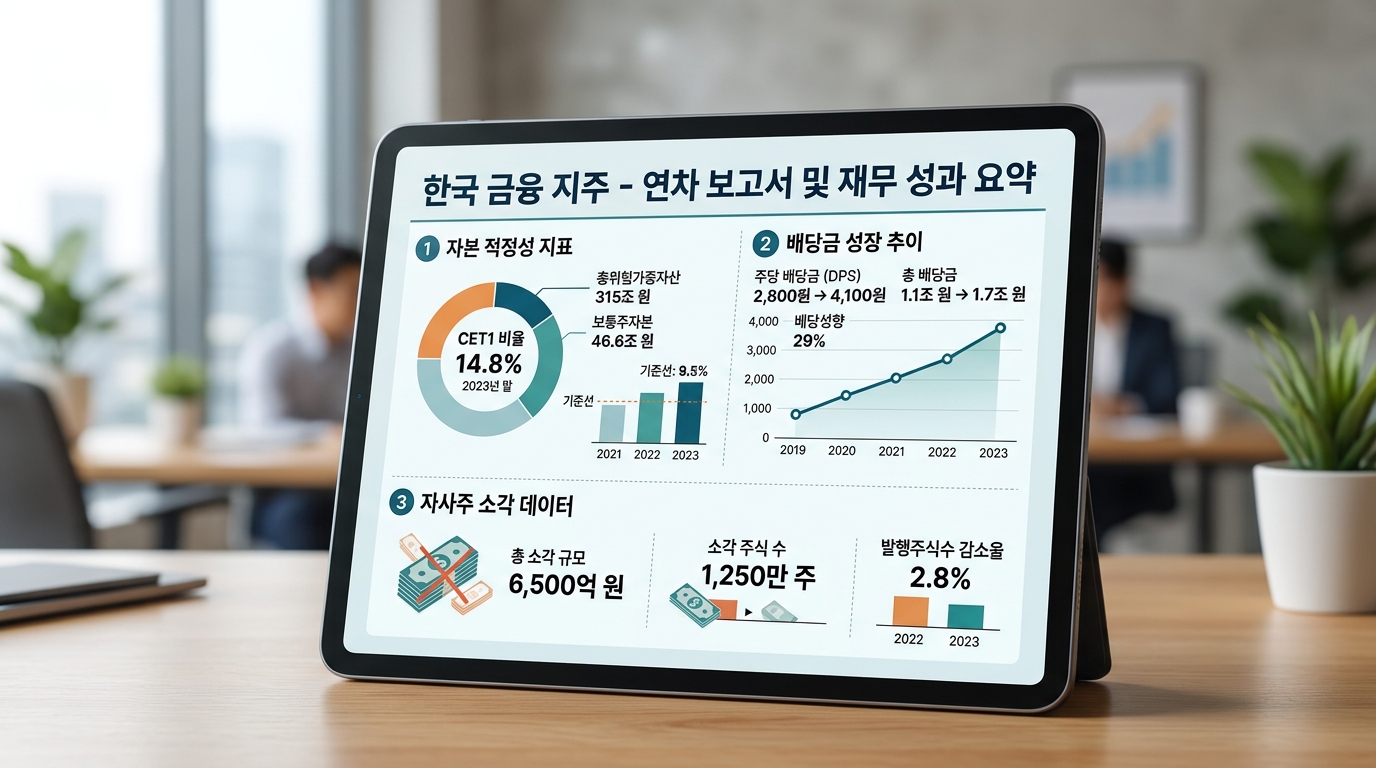
| **Common Equity Tier 1 (CET1) Ratio** | Approx. 13.4% | 13.62% | Exceeded target band (13.0%–13.4%) |
| **Return on Equity (ROE)** | 9.1% | 11.9% (Q3 Cumulative) | Exceeded Value-up 2.0 target (10%+) |
| **Cumulative Annual Shareholder Returns** | Approx. KRW 2.4960T | Approaching approx. KRW 3T (announced basis) | Cash dividend KRW 1.4T + Buyback KRW 1.6T |
| **Total Shareholder Return Ratio** | 50.2% | Expected to maintain above 50% | Expected to settle in 50% range for 2 consecutive years |
Valuation
After achieving its previously announced '10-50-50' targets (10% ROE, 50% shareholder return ratio, and share count reduction) ahead of schedule in 2024, Shinhan Financial Group introduced 'Value-up 2.0,' effectively removing the upper cap on its total shareholder return ratio.
While the KOSPI 200 large-cap financial sector remains within historically undervalued territory at PBR multiples of 0.5x to 0.6x, Shinhan Financial Group's ROE rerating toward 11.9% has expanded its profitability spread relative to its cost of equity.
Global peer financial leaders, such as Wells Fargo in the US and DBS in Singapore, trade at PBR multiples between 1.2x and 1.6x, supported by sustained CET1 ratios near 13% and total shareholder return ratios exceeding 50%.
As Shinhan Financial Group also committed to raising its dividend per share (DPS) by at least 10% annually going forward, the scenario for narrowing its valuation discount relative to global dividend-growth funds becomes increasingly compelling.
Moreover, with total outstanding shares gradually declining from approximately 520 million to the 460 million range, book value per share (BPS) growth is visibly outpacing the overall expansion rate of balance-sheet book value.
Expert and Institutional Analysis
Brokerage analysts conclude that while Shinhan Financial Group experienced some seasonal volatility in non-interest income during Q3, the fundamentals and capital adequacy of its core banking operations met market expectations.
Major research centers providing price targets continue to maintain 'BUY' ratings, establishing fair value estimates in the mid-KRW 130,000 to low-KRW 140,000 range.
SangSangIn Investment & Securities and Daol Investment & Securities evaluated that, even after taking into account capital costs and the regulatory backdrop, the resolution to repurchase an additional KRW 450 billion in treasury shares precisely met market expectations regarding shareholder returns.
Institutional investors are focusing on Shinhan Financial's roadmap toward tax-exempt and separate taxation for dividend income as key differentiators that could enhance after-tax yields for dividend investors.
As reflected in its Grand Prize win (Financial Services Commission Chairman's Award) at the Korea IR Awards, market trust remains strong regarding the capital allocation formula promised by the management and board (returning surplus capital between ROE and asset growth back to shareholders).
Risk Factors
The primary macroeconomic risk to monitor is the direction of the Bank of Korea's benchmark interest rate and the associated asymmetric rise in delinquency rates across household and corporate loans.
If rate cuts materialize in earnest, downward pressure on bank NIM—the core revenue generator—could broaden, potentially slowing total group net interest income growth.
If the USD/KRW exchange rate surges significantly beyond 1,336.10 won, foreign currency-denominated risk-weighted assets (RWA) expand nominally, placing technical downward pressure on the CET1 ratio.
Should the capital ratio fall below the 13.0% threshold, it could impose temporary constraints or delays on the scale and pace of planned share buybacks.
Additionally, the payment of the remaining acquisition balance for Lotte Insurance (approx. KRW 693.3 billion) is estimated to lower the CET1 ratio by roughly 0.19 percentage points, warranting close observation over whether post-M&A capital buffers remain resilient.
Investment Perspective Summary
Shinhan Financial Group has established the clearest and most quantifiable shareholder return framework among domestic banking groups, laying the rails for a virtuous cycle in equity valuation.
With the KOSPI Fear & Greed Index sitting in 'Fear' at 23.8, the portfolio stabilization qualities of large-cap financials—distinguished by superior cash flow and dividend resilience relative to cyclical exporters—are becoming increasingly attractive.
However, macroeconomic growth concerns, additional credit loss provisioning, and FX-induced volatility in capital ratios remain operational variables.
Consequently, rather than chasing short-term price momentum, an incremental accumulation strategy aimed at compounding returns through quarterly dividend reinvestment and the structural reduction of share count via buyback cancellations appears most rational.
Investor Checkpoint Q&A
Q1. What are the specific amounts for Shinhan Financial Group's Q3 dividend and share buyback?
Shinhan Financial Group's board resolved to pay a Q3 cash dividend of KRW 740 per share and separately announced plans to acquire and cancel KRW 450 billion worth of treasury shares.
Q2. When will the newly announced KRW 450 billion share buyback be retired?
The repurchases will be executed on the open market through Shinhan Securities from October 28, 2026, to January 26, 2027, and will be cancelled in full upon completion. Separately, 6,538,515 treasury shares already held will be cancelled first on November 4, 2026.
Q3. What are the key formulas and benchmarks underpinning 'Value-up 2.0'?
Moving beyond static targets, the framework maintains an ROE above 10% while sustaining a CET1 ratio above 13%, returning all surplus capital above growth needs back to shareholders. It also includes a commitment to increase DPS by at least 10% annually.
Q4. Does the ongoing acquisition of Lotte Insurance impact the shareholder return plan?
According to Shinhan Financial's estimates, paying the purchase consideration will reduce the CET1 ratio by approximately 0.19 percentage points. However, because its CET1 ratio stood at a resilient 13.62% at the end of September, management maintains that its planned shareholder return policy will remain unchanged.
Q5. What is the most critical factor to watch in the current macro environment (FX and market sentiment)?
As indicated by the USD/KRW rate of 1,336.10 won and the KOSPI Fear & Greed Index at 23.8 (Fear), broad market volatility is elevated. Investors should closely monitor potential NIM compression from interest rate cuts and RWA expansion caused by FX fluctuations, both of which could pressure capital ratio management.